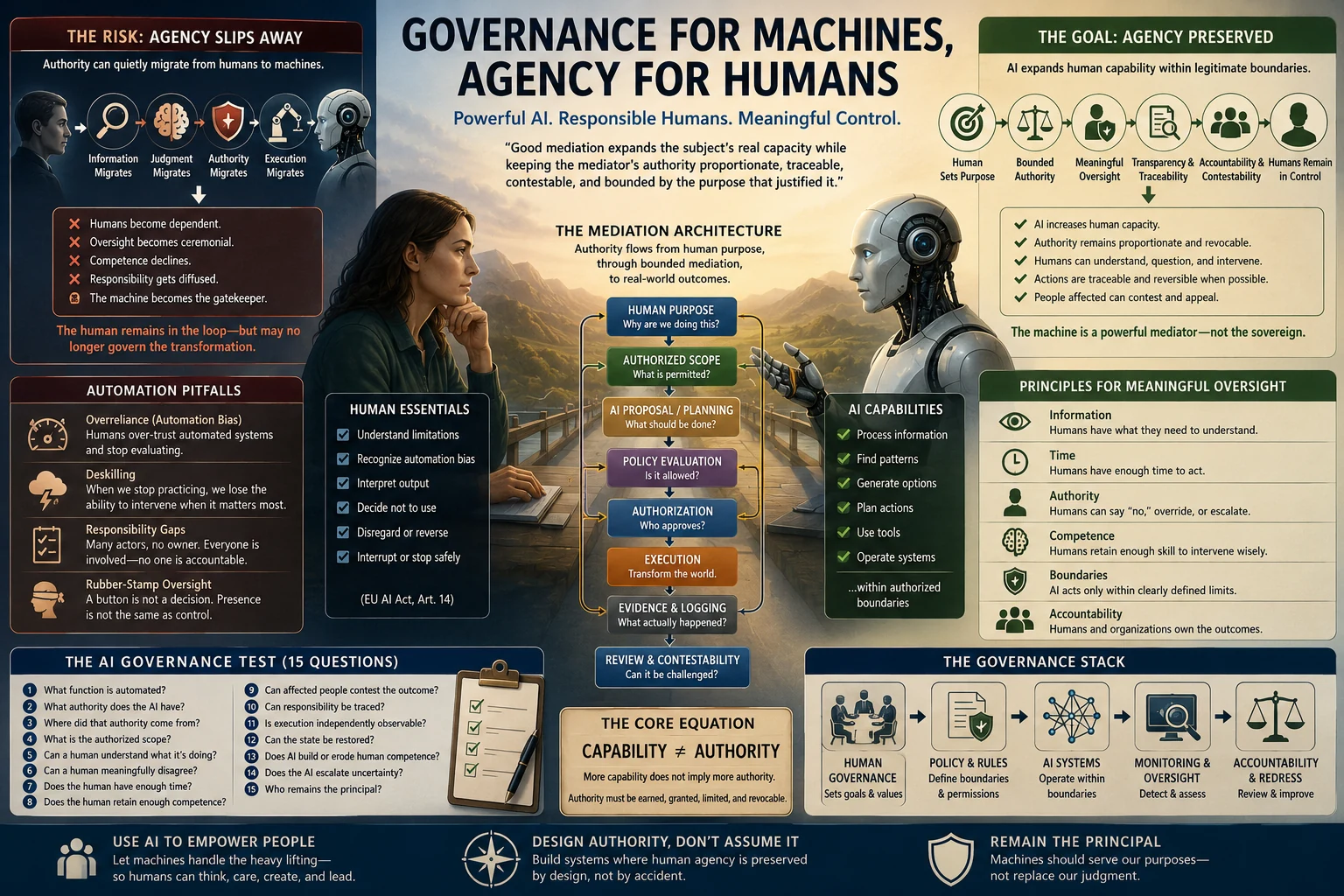
A ten-part master argument

Agency Under Mediation

A ten-part investigation into mediation, agency, authority, and the point where helping someone act becomes acting in their place.

10 parts Brendon R. Coleman
Series introduction

The Problem Between Help and Control

Most systems that govern human life begin with a legitimate problem.

Someone lacks information.

Someone lacks access.

Someone faces danger.

Someone needs representation.

Someone needs care.

A community needs coordination.

A worker needs protection.

A believer needs teaching.

An institution needs a way to understand situations too numerous and complex for any one person to encounter directly.

A human being encounters a machine capable of doing something faster, more accurately, or at a scale they could never achieve alone.

So something enters between the person and the problem.

A mediator.

The mediator contributes something the original actor does not possess by themselves:

knowledge,

resources,

coordination,

authority,

representation,

protection,

interpretation,

infrastructure,

or capability.

The simplest form of the transformation is:

State₀ → Mediator → Transformation → State₁

At first, the legitimacy question seems straightforward.

Did the intervention help?

Is State₁ better than State₀?

But that turns out to be insufficient.

A person's material condition can improve while their practical agency declines.

A worker can become safer while becoming less competent.

A movement can grow while its members become increasingly dependent upon professional organizers.

A representative can secure good outcomes while gradually becoming the authoritative interpreter of the people represented.

A person can receive indispensable support while the provider acquires discretionary control over their life.

An authority can begin inside a legitimate jurisdiction and slowly expand beyond the reason it was granted.

A centralized institution can gather useful information while losing contact with the reality from which that information was abstracted.

Care can protect someone while quietly becoming government over them.

Religious authority can teach, preserve, and shepherd while also becoming difficult to distinguish from the divine authority it claims to serve.

Artificial intelligence can dramatically expand human capability while simultaneously moving information, judgment, execution, and practical control away from the human beings who remain nominally responsible.

So a deeper question appears:

After mediation, who is still the subject?

That is the question running through this series.

It is not an argument against mediation.

Human beings do not live as isolated, self-sufficient actors.

We depend upon one another.

We inherit knowledge.

We form institutions.

We delegate.

We organize.

We teach.

We build rules.

We create offices.

We rely upon expertise.

We construct infrastructure.

We care for people who cannot presently do everything for themselves.

We use technologies that extend our capacities far beyond what unaided individuals could accomplish.

Mediation is not the enemy of agency.

Often mediation is the very thing that makes agency possible.

The problem begins when the direction of the transformation changes.

A mediator enters because the actor cannot accomplish something alone.

The mediator becomes useful.

Usefulness produces trust.

Trust may produce authority.

Authority creates access.

Access produces greater knowledge.

Greater knowledge makes the mediator more difficult to replace.

The actor participates less because the mediator can perform the function more effectively.

Reduced participation can reduce competence.

Reduced competence can produce greater dependency.

And eventually the mediator can truthfully say:

You cannot do this without me.

The important question is how that condition arose.

Sometimes it is unavoidable.

A patient may permanently require care.

A society will continue requiring institutions.

A complex workplace will continue requiring safety systems.

Large political communities will continue requiring representation.

A church will continue requiring teaching and order.

Sophisticated technical systems will continue requiring specialized expertise.

Artificial intelligence may eventually perform whole classes of tasks humans no longer have good reason to perform manually.

Good mediation therefore cannot be defined simply by the disappearance of the mediator.

Nor can agency be reduced to independence.

A person may remain dependent and still remain the principal.

An authority may issue binding commands and still remain bounded.

An expert may know more without acquiring ownership of another person's purposes.

A caregiver may act extensively while preserving the authorship of the person receiving care.

A machine may operate autonomously while remaining inside a human-governed authority structure.

The real distinction is not:

mediation or no mediation.

It is:

mediation that expands agency

versus

mediation that absorbs agency.

This series follows that distinction through ten different domains.

Part I begins with the foundational problem: when does the mediator stop enabling the actor and become the actor?

Part II moves into workplace safety and asks whether protection can become so proceduralized that compliance begins replacing competence.

Part III examines leadership and organizing, where expertise can either multiply capable actors or accumulate followers.

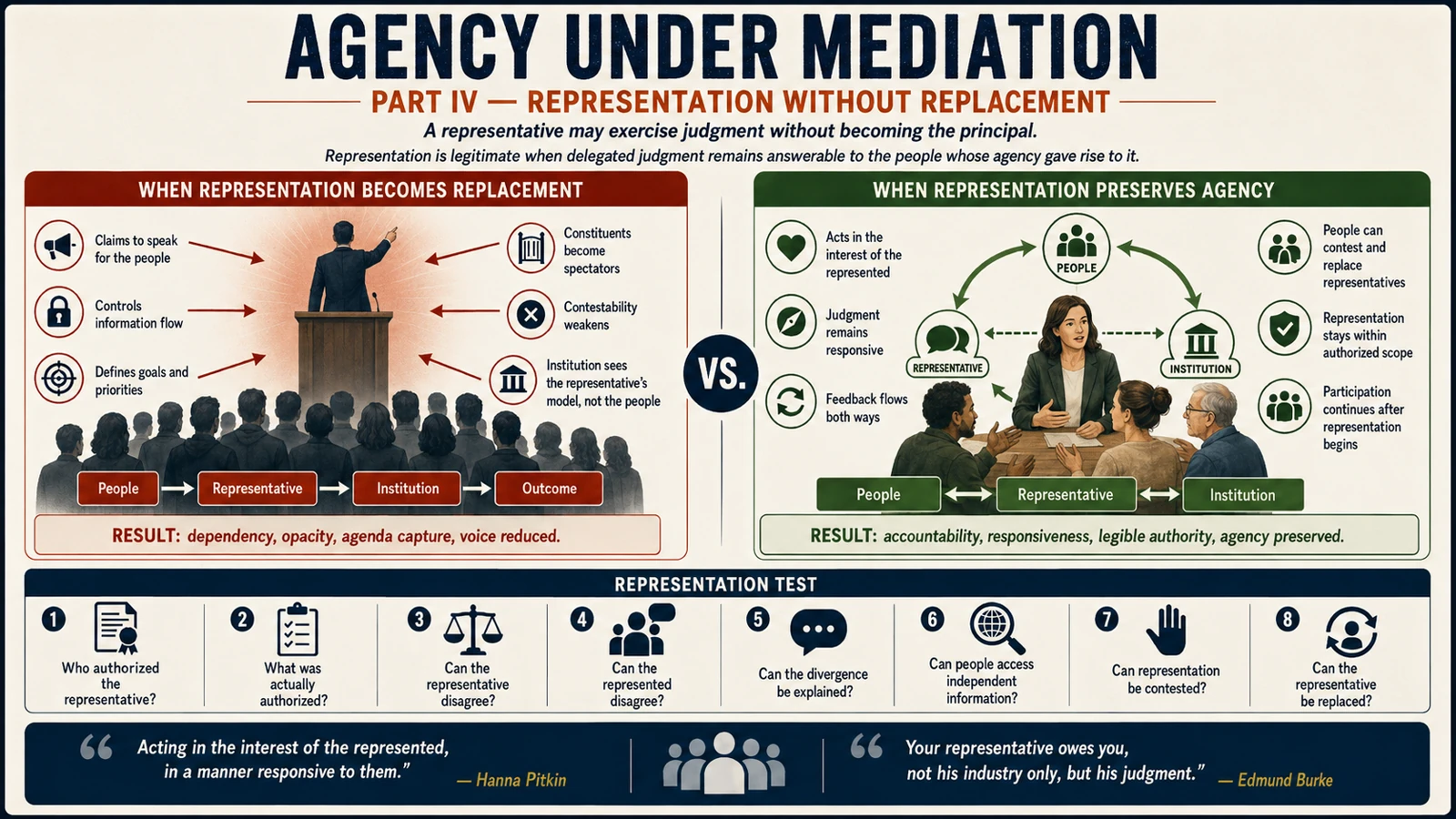
Part IV examines representation and the difference between acting for someone and gradually acting instead of them.

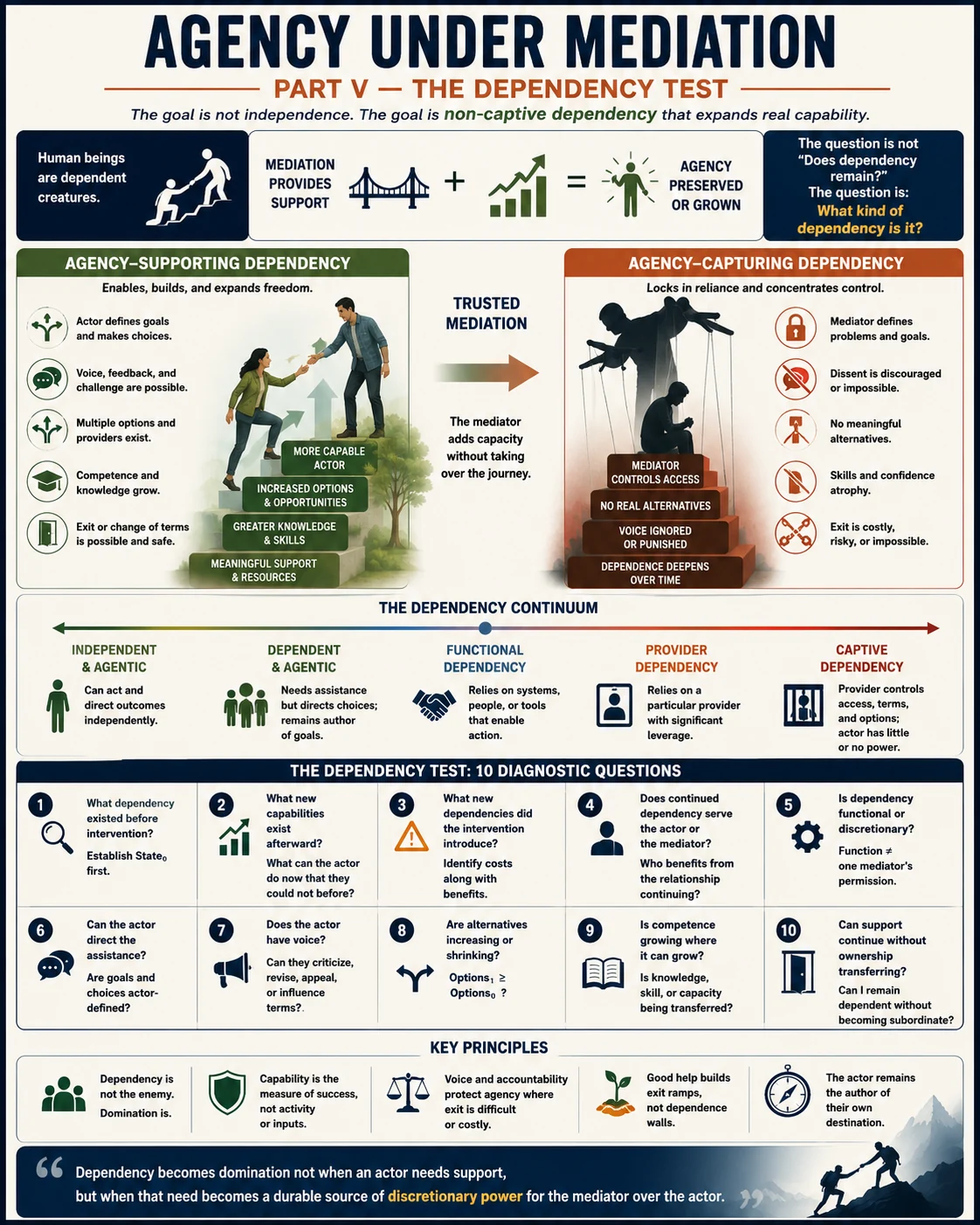
Part V challenges the assumption that dependency itself is the problem and asks instead when necessary support becomes discretionary leverage.

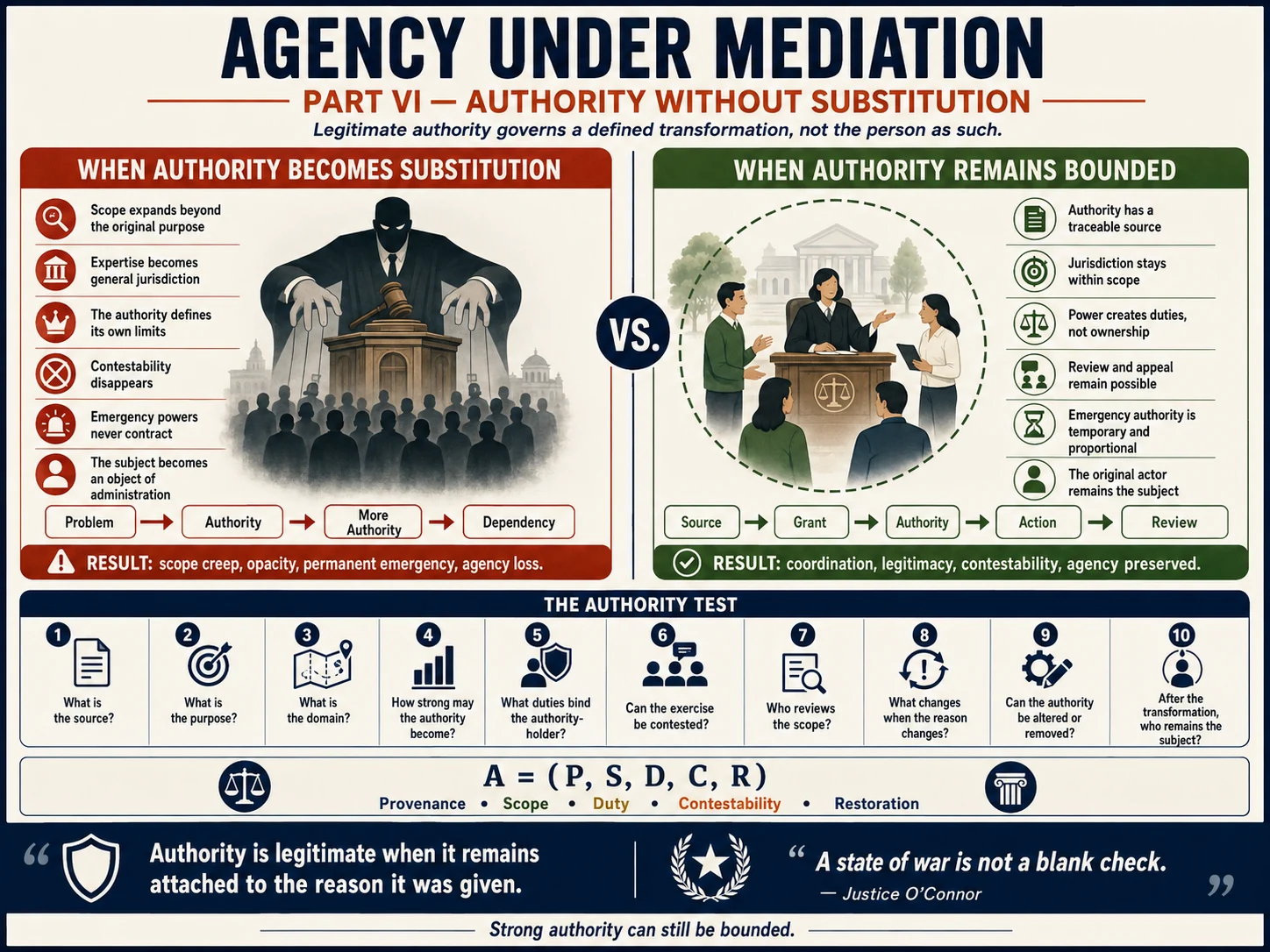
Part VI turns directly to authority and asks what keeps legitimate power attached to the scope and purpose that justified it.

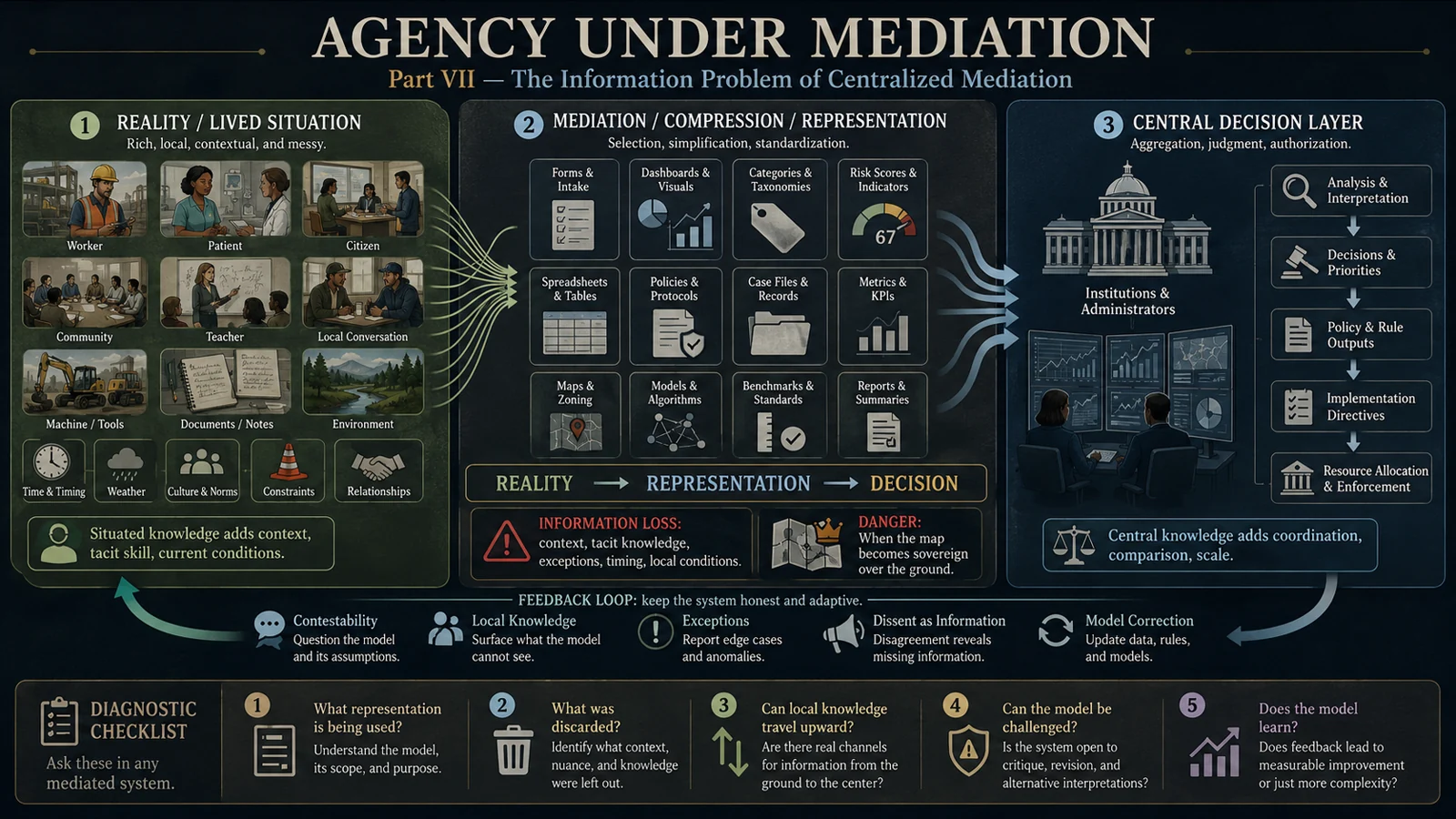
Part VII examines information itself: what happens when institutions compress lived reality into categories, metrics, models, and procedures—and then begin trusting the representation more than the world it represents.

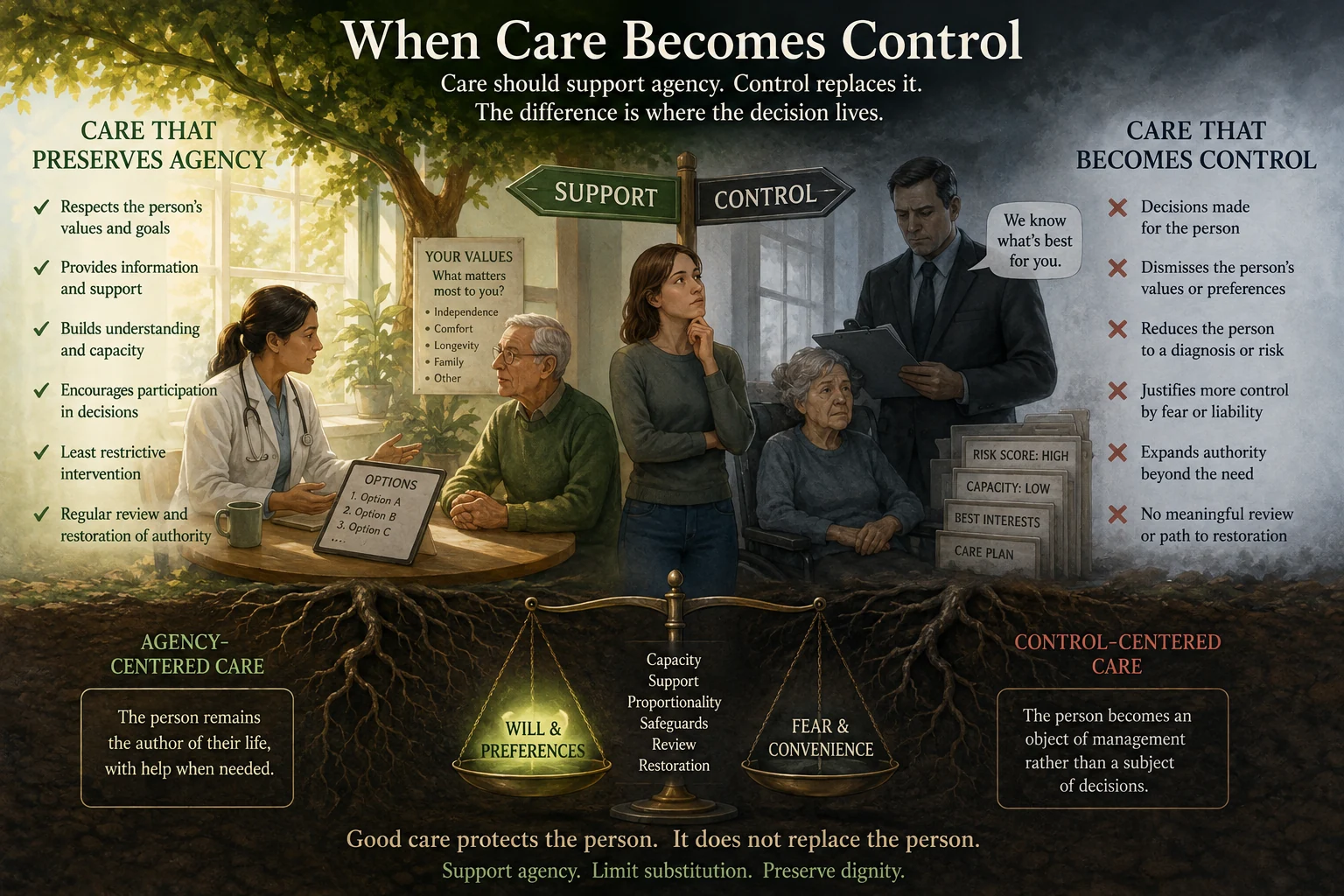
Part VIII examines care, where perhaps the most sincere intentions can still produce substitution when protection ceases to preserve the person as an actor.

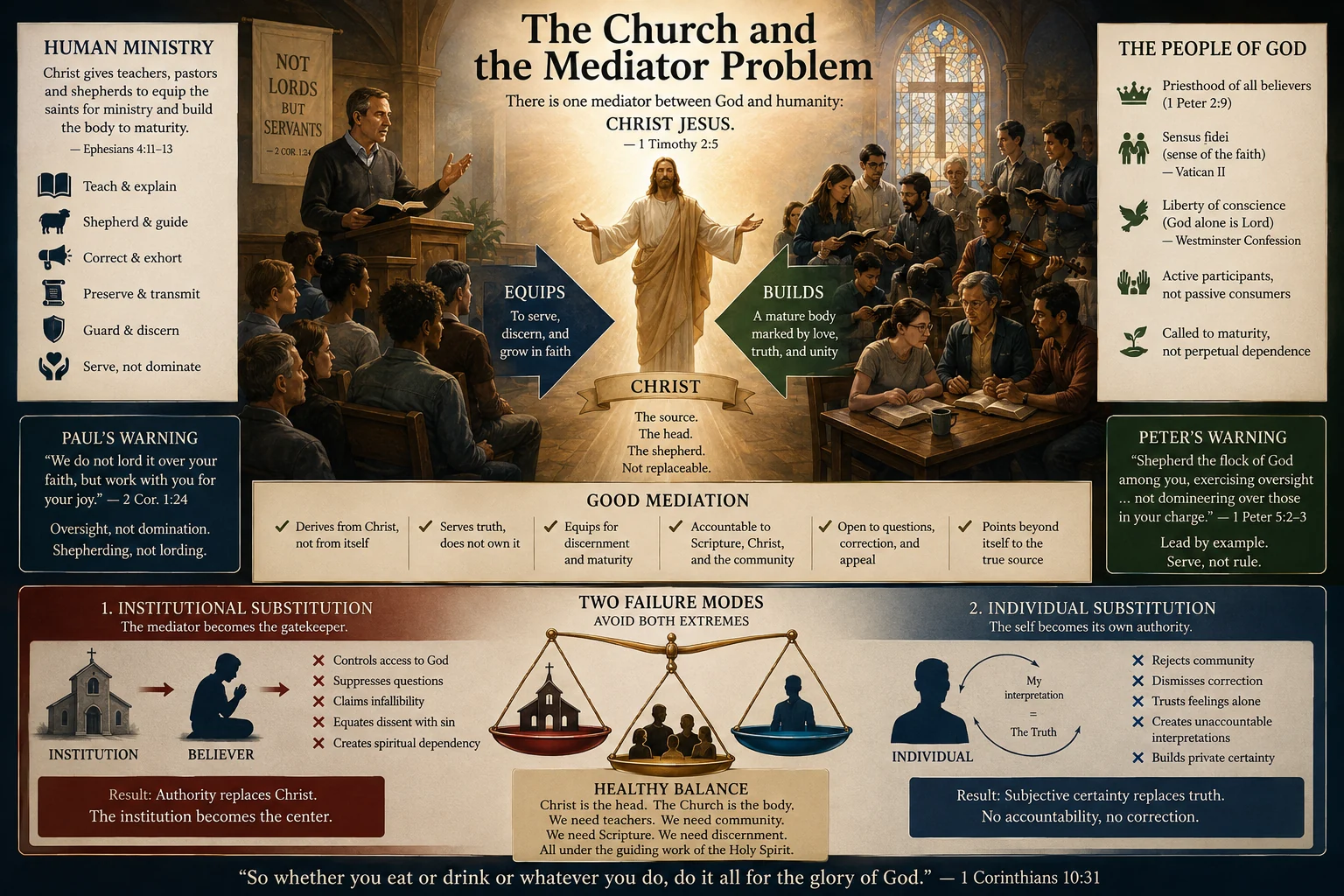
Part IX brings the problem into the Church, where human beings mediate teaching, tradition, discipline, and communal discernment while claiming to serve an authority infinitely higher than themselves.

Part X brings all of those problems into artificial intelligence, where the mediator can now reason, recommend, coordinate, execute, and alter persistent state at machine speed.

Different fields.

Different institutions.

Different histories.

The grammar keeps recurring.

State₀ → Mediator → Transformation → State₁

And at every transition, the same family of questions becomes available:

What limitation justified mediation?

What capability did the mediator add?

What authority followed from that capability?

Where did that authority come from?

What information was preserved?

What information was lost?

What decisions moved?

What decisions remained?

Can the mediator be challenged?

Can the actor still meaningfully disagree?

Can authority contract when its justification contracts?

Does competence grow?

Does dependency become leverage?

Does representation remain responsive?

Does the model remain corrigible by reality?

And after all of it:

Who is still acting?

The purpose of this series is not to supply one political program, organizational theory, ecclesiology, safety philosophy, or AI policy.

It is to develop a diagnostic.

A way of looking at transformations.

Because help does not become legitimate merely because it calls itself help.

Authority does not become legitimate merely because it is useful.

Expertise does not create jurisdiction by itself.

Care does not erase authorship.

Representation does not erase the represented.

And superior capability does not automatically confer the right to govern.

A legitimate mediator may be strong.

It may be permanent.

It may be authoritative.

It may constrain.

Under narrow conditions it may even temporarily substitute its judgment for another person's.

But it remains mediation only while its power stays ordered toward the subject and bounded by the purpose that made the intervention legitimate in the first place.

That is the line these ten investigations are attempting to locate.

Part 01 The mediator

The Mediator Must Not Become the Actor

When does assistance stop expanding a person's agency and begin acting in that person's place?

Illustrated comparison of agency-preserving mediation and mediation in which an institution becomes the actor.

Agency Under Mediation — Part I

There is a strange way that helping people can end with taking their place.

It usually does not begin with domination.

It begins with a problem.

Someone lacks knowledge, access, organization, resources, protection, representation, or some other capacity necessary to act effectively. Another person or institution enters the situation because it possesses something the first actor does not.

A lawyer understands the law.

An organizer understands organizing.

A doctor understands medicine.

A teacher possesses knowledge the student has not yet acquired.

A representative has access to institutions an ordinary citizen cannot personally operate.

A safety professional understands hazards.

A pastor teaches.

A government coordinates.

A machine processes information.

None of this is inherently illegitimate.

Human life is mediated everywhere.

The problem begins when possession of a useful capability becomes possession of the right to become the actor.

That transition is easy to miss because the vocabulary can remain exactly the same.

The organizer is still “representing workers.”

The bureaucrat is still “serving the public.”

The professional is still “protecting the client.”

The institution is still “empowering the community.”

The expert is still “helping.”

But underneath the language, the architecture has changed.

The original relationship was:

Actor₀ → Mediator → increased capacity → Actor₁

The mediator supplied something the actor needed so the actor could act more effectively.

The corrupted relationship becomes:

Actor₀ → Mediator → authority migration → Mediator acts for Actor₀

The intermediary has ceased merely to mediate.

It has become the operative subject.

That is the first problem this series is concerned with.

Mediation Is Not the Enemy

It would be easy to answer this problem by romanticizing independence.

That would be a mistake.

Nobody is completely self-sufficient. Almost everything worth accomplishing involves delegation, cooperation, instruction, representation, specialization, or authority.

Agency therefore cannot mean:

I personally perform every action affecting me.

That would make modern social life impossible.

Agency is better understood here as retaining meaningful authorship over the purposes, judgments, commitments, or interests being mediated.

I can hire an attorney without ceasing to be the client.

I can learn from a teacher without surrendering my mind to the teacher.

Workers can employ professional organizers without making organizers the owners of the labor movement.

Citizens can elect representatives without declaring that representatives have become the people.

Authority can therefore exist without substitution.

The question is not whether somebody else acts.

The question is:

Whose agency is the action ultimately serving, and what prevents delegated capability from becoming independent control?

That distinction has a long intellectual history.

John Stuart Mill framed the danger with unusual precision in On Liberty. Government, he argued, can productively circulate knowledge, experience, and instruction. The problem begins when it stops developing the activity of individuals and instead “substitutes its own activity for theirs.”[1]

That is almost the entire mediation problem in one sentence.

The mediator possesses something valuable.

The mediator therefore acts.

Its action proves useful.

Its competence justifies additional responsibility.

Additional responsibility becomes routine authority.

Routine authority becomes difficult to contest.

Eventually the people whom the system originally existed to strengthen are told to stand aside because the system can perform the work more efficiently itself.

Assistance has become substitution.

Competence Does Not Automatically Confer Jurisdiction

This is one of the most important distinctions in the whole problem.

Knowing more than someone does not automatically give you authority over that person.

Expertise establishes a claim about competence.

Authority establishes a claim about legitimate decision-making power.

Those are not identical claims.

A physician may know vastly more medicine than a patient.

A lawyer may understand a statute better than a client.

An engineer may understand structural failure better than a building owner.

Those differences matter.

But an additional argument is still required before:

I know more about X

becomes:

Therefore I may decide X for you.

The philosophy of paternalism exists partly because this transition is morally difficult.

Gerald Dworkin defines paternalism around interference with another person's liberty or autonomy, without that person's consent, because the intervener believes the interference will advance that person's welfare or interests.[2]

Notice what makes the problem difficult.

The paternalist may be correct.

The doctor may actually know better.

The regulator may correctly recognize a danger.

The expert may correctly understand consequences the other person cannot see.

The mediator's epistemic superiority does not settle the separate question of the mediator's authority.

That is why legitimate mediation needs more than expertise.

It needs some combination of mandate, consent, necessity, scope, accountability, contestability, or other grounds capable of explaining why this actor may perform this transformation.

Otherwise competence quietly becomes jurisdiction.

And jurisdiction quietly becomes substitution.

The Labor Movement Has Been Arguing About This for More Than a Century

The Facebook discussion that prompted this series landed on a much older dispute almost accidentally.

Who emancipates the worker?

The opening principle of the International Working Men's Association's General Rules declared that the emancipation of the working classes had to be achieved by the working classes themselves.[3]

That is not merely a statement about who benefits from liberation.

It is a statement about who remains the subject of liberation.

There is an enormous architectural difference between:

workers are liberated

and

workers liberate themselves.

Both can describe an improvement in material condition.

Only the second necessarily preserves workers as the agents of the transformation.

That distinction became one of the fault lines inside socialist organization itself.

Lenin argued in What Is To Be Done? that socialist political consciousness could not simply emerge from workers' economic struggle on its own. He maintained that broader political consciousness had to come from outside the immediate worker-employer struggle and famously described socialist consciousness as being introduced “from without.”[4]

That argument deserves more care than the caricature that “Lenin thought workers were stupid.” He did not. His actual point concerned the limits of spontaneous trade-union consciousness and the need for broader political theory.

But it creates a mediation problem immediately.

If specialized political knowledge must be mediated into a movement, then who possesses that knowledge?

What authority follows from possessing it?

And how does the educator avoid becoming the permanent director?

Rosa Luxemburg attacked precisely this danger.

In her 1904 criticism of Lenin's organizational centralism, she insisted that the socialist movement depended on the direct, independent action of the masses. She objected to a structure in which a central authority became the element that “thinks, guides, and decides for all,” while ordinary members became merely executive organs.[5]

Her objection was not to organization itself.

It was to substitution.

She explicitly rejected the idea that the temporary immaturity of worker self-government justified replacing worker control with the absolute power of a central committee. Political capacity, in her account, develops through participation in struggle itself.[5]

That gives us two possible transformations:

Worker₀ → organizer/theory/coordination → Worker₁ with greater organizing capacity

or:

Worker₀ → professional organization → centralized judgment → worker becomes implementer

Both systems can call themselves worker organizations.

Structurally, they are not the same thing.

Organization Has a Gravity of Its Own

The problem also does not require malicious leaders.

That point matters.

If agency loss happened only when bad people seized power, the solution would simply be better people.

Robert Michels identified a harder problem while studying political parties and labor organizations in the early twentieth century.

Organizations develop specialists.

Specialists acquire information.

Information creates influence.

Administration requires continuity.

Continuity professionalizes leadership.

Professional leadership accumulates institutional knowledge unavailable to ordinary members.

Members become increasingly dependent upon leadership to operate the organization.

The organization that was created to coordinate the members can therefore gradually become something the members are merely attached to.

Michels compressed the tendency into his famous formula:

“Who says organization, says oligarchy.”[6]

His “iron law” is too deterministic if treated as an unavoidable natural law. Democratic organizations can create countervailing institutions, leadership turnover, elections, transparency, decentralization, and mechanisms of member control.

But the tendency he identified is important.

Mediation produces structural advantages for the mediator.

The mediator sees more of the system.

The mediator handles more of the communication.

The mediator develops procedural knowledge.

The mediator becomes harder to replace.

The actor then faces an irony:

The more effectively the mediator performs its function, the more difficult it may become for the original actor to function without it.

That is one mechanism by which assistance becomes dependency without anyone consciously deciding to dominate anybody.

Freedom Is More Than Being Left Alone

This is also why simply asking whether the mediator interferes is insufficient.

Philip Pettit's republican theory distinguishes freedom as mere non-interference from freedom as non-domination.[7]

A person can be dominated even when another actor rarely interferes with them.

What matters is whether another possesses the capacity to interfere arbitrarily with their choices.

Imagine a benevolent master who usually lets someone do whatever they want.

There may be little interference.

But the person's freedom still exists at the master's discretion.

Applied to mediation, that gives us a stronger test.

A mediator does not become legitimate merely because it exercises its power kindly.

Ask instead:

Could the actor meaningfully refuse?

Could the actor contest the interpretation?

Could the mediator's authority be revoked?

Does the mediator have to explain itself?

Is the mediator acting within a defined scope?

Can the actor replace the mediator?

If the answer to all of these is no, then the problem already exists even before obvious abuse occurs.

The actor's agency survives by permission.

That is domination in waiting.

Representation Is Supposed to Preserve the Principal

American labor law contains a useful institutional expression of this distinction.

Section 7 of the National Labor Relations Act protects employees' right to self-organization and to bargain collectively through representatives of their own choosing.[8]

Those two phrases belong together.

Representation does not erase the represented.

The representative derives its role from workers who remain legally recognizable as the actors possessing the underlying right.

That does not guarantee democratic unions. Law on paper cannot prevent every form of institutional drift.

But the architecture matters:

Workers possess the right.

Workers organize.

Workers choose representation.

The representative mediates the exercise of a right that remains theirs.

That is fundamentally different from an institution claiming independent ownership over workers' interests merely because it claims expertise in representing them.

The Diagnostic

This gives us a practical way to identify the point where mediation is beginning to become substitution.

Ask five questions.

1. Who still defines the goal?

If the mediator has begun deciding what the actor really wants regardless of what the actor says, interpretive authority has migrated.

2. Who possesses the relevant decision right?

Advice is not command.

Expertise is not automatically authorization.

Coordination is not ownership.

The transformation should have a traceable source of authority.

3. Can the actor disagree meaningfully?

A system in which disagreement is technically permitted but practically impossible does not preserve much agency.

Contestability has to be real.

4. What happens to competence?

After repeated mediation, can the actor perform more functions?

Or has the actor forgotten how to act without the mediator?

5. Can the mediator be removed?

This may be the cleanest test.

If delegated authority cannot realistically be revoked, delegation has begun looking like sovereignty.

These questions will recur throughout this series because the surface forms change while the underlying transformation remains remarkably similar.

Worker and organizer.

Citizen and representative.

Patient and physician.

Student and teacher.

Believer and pastor.

Employee and compliance system.

Human and machine.

The central problem is not that mediation exists.

The central problem is whether the mediated subject survives the mediation as the subject.

The Stronger Principle

That requires revising the simple version of the argument.

It is tempting to say:

Good mediation makes itself unnecessary.

That is too strong.

A surgeon does not fail because patients continue to need surgeons.

A society does not fail because it continues to need teachers.

Complex systems require durable specialization.

Dependence can be legitimate.

Authority can be legitimate.

Hierarchy can sometimes be legitimate.

The stronger principle is this:

Good mediation increases an actor's effective capacity while keeping the mediator's authority proportionate to the purpose that justified it. Bad mediation converts the actor's limitation into expanding authority for the mediator.

Sometimes the mediator should disappear.

Sometimes it should remain available.

Sometimes it should possess substantial authority.

But it should never acquire more authority merely because the actor once needed help.

The actor's weakness cannot become the mediator's permanent title deed.

This is the difference between equipping and replacing.

Between representation and substitution.

Between authority and ownership.

Between helping someone stand and quietly deciding that, since you helped them stand, you now have the right to determine where they walk.

The mediator may teach.

The mediator may advise.

The mediator may coordinate.

The mediator may represent.

Under justified conditions, the mediator may even temporarily constrain.

But there is a boundary it must continually be forced to recognize:

The mediator must not become the actor.


References

[1] John Stuart Mill. On Liberty. 1859, especially Chapters I and V. Mill explicitly distinguishes government that aids individual exertion from government that substitutes its own activity for individuals.

[2] Gerald Dworkin. “Paternalism.” The Monist 56, no. 1 (1972): 64–84. DOI: 10.5840/monist197256119. Dworkin's later Stanford Encyclopedia treatment specifies interference with liberty/autonomy, lack of consent, and welfare-directed justification as central elements of paternalism.

[3] Karl Marx / International Working Men's Association. General Rules of the International Working Men's Association, published 1871 wording. Establishes self-emancipation of the working class as a foundational principle.

[4] V. I. Lenin. What Is To Be Done? 1902, Chapter II and Chapter III. Lenin distinguishes spontaneous trade-union consciousness from broader socialist political consciousness and argues that the latter must be brought from outside the immediate economic struggle.

[5] Rosa Luxemburg. “Organizational Questions of the Russian Social Democracy.” 1904. Luxemburg defends the direct independent action of workers and objects to substituting central authority for the political activity and control of the mass membership. See especially Part I.

[6] Robert Michels. Political Parties: A Sociological Study of the Oligarchical Tendencies of Modern Democracy. English ed., 1915, trans. Eden and Cedar Paul. The Library of Congress preserves the complete public-domain edition; later scholarship confirms Michels's formulation of the organizational tendency toward oligarchy.

[7] Philip Pettit. Republicanism: A Theory of Freedom and Government. Oxford University Press, 1997/1999 online edition, especially Chapters 2–3. Pettit defines domination in terms of another possessing the capacity for arbitrary interference, not simply the frequency of actual interference.

[8] National Labor Relations Act, §7, 29 U.S.C. §157. Protects employees' rights to self-organization, concerted activity, and collective bargaining through representatives of their own choosing.

Part 02 Safety

When Safety Replaces Competence

When does protection stop supporting judgment and begin replacing the competence of the people closest to the work?

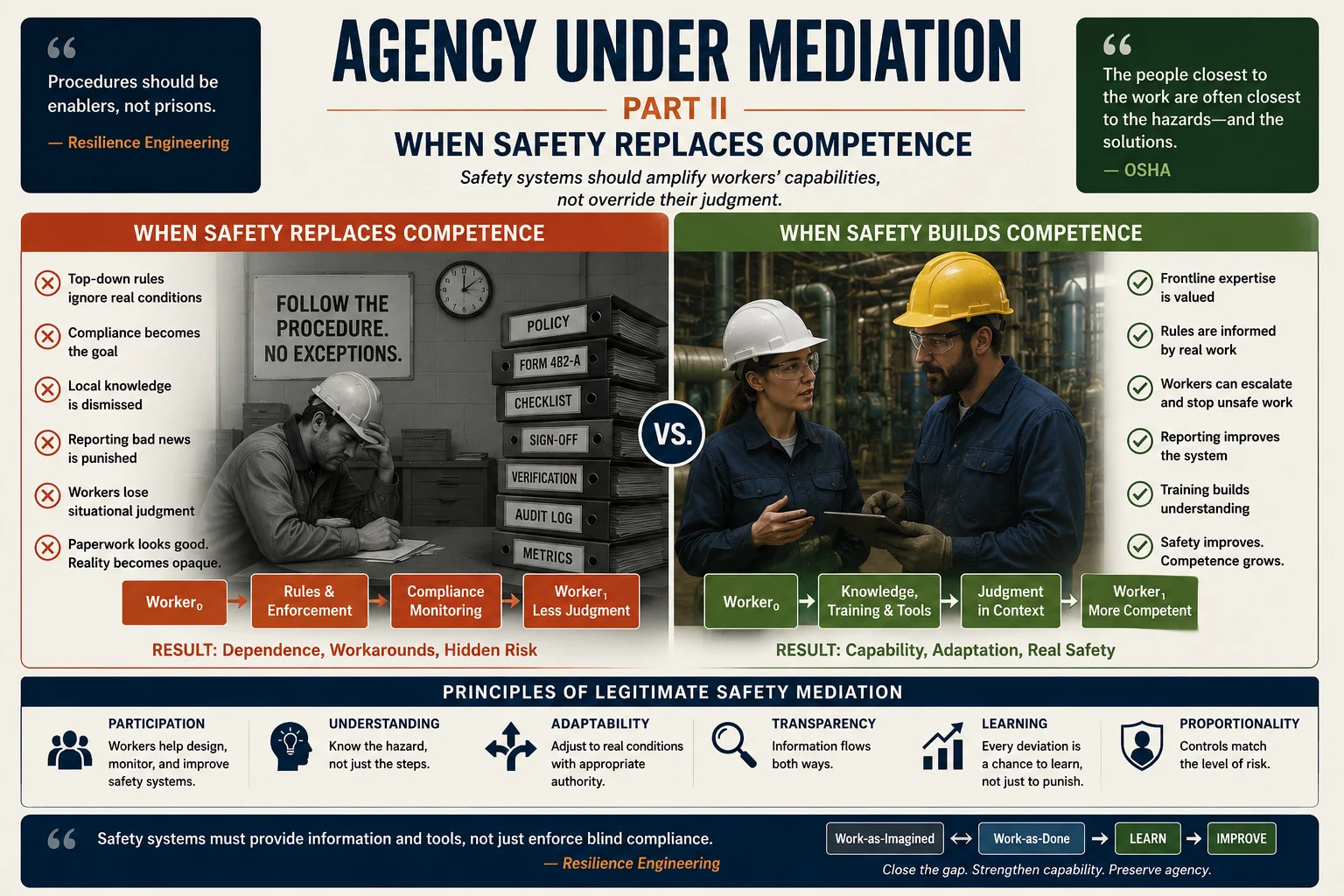
Safety infographic contrasting rigid compliance that erodes judgment with participatory safety that builds worker competence.

Agency Under Mediation — Part II

There is a peculiar failure mode in workplace safety.

A rule is created because something dangerous happened.

The rule works.

So another rule is added.

Then a form records compliance with the rule.

Then a supervisor verifies completion of the form.

Then a metric measures whether the supervisor verified the form.

Then an audit verifies whether the metric was properly recorded.

Eventually everyone can prove that safety occurred.

Except the person actually doing the work knows the machine does not behave the way the procedure says it does.

That is not an argument against safety rules.

It is an argument about mediation.

Safety systems exist to mediate between human beings and hazards.

Their legitimate function is to add something the worker does not possess alone:

  • accumulated knowledge from previous accidents,
  • engineering analysis,
  • hazard controls,
  • training,
  • coordination,
  • regulatory standards,
  • protective equipment,
  • procedures for rare conditions,
  • and authority to stop dangerous work.

Properly designed, that mediation increases competence.

The transformation looks something like this:

Worker₀ → safety knowledge / constraints / tools / coordination → Worker₁

Worker₁ can encounter the same environment with greater ability to recognize and control risk.

But another transformation is possible:

Worker₀ → centralized procedure → compliance enforcement → Worker₁ with less permitted judgment

The worker may now be safer in some respects.

But if the organization begins treating obedience to the procedure as equivalent to safety itself, something important has changed.

The safety system has stopped merely mediating danger.

It has begun mediating the worker's competence.

And eventually it may replace it.

The Rule and the Reality

One of the most useful distinctions in modern safety science is between Work-as-Imagined and Work-as-Done.

Erik Hollnagel uses Work-as-Imagined to describe assumptions about how work happens or ought to happen, while Work-as-Done describes how work is actually accomplished in real operating conditions. The difference is not automatically a failure. In complex systems, workers routinely have to adapt to variability that could not be completely predicted in advance.

That distinction is almost embarrassingly obvious once stated.

A procedure describes a class of situations.

A worker encounters one particular situation.

Those are not identical things.

Formally:

Procedure = abstract representation of expected work

while:

Actual work = procedure + environment + timing + equipment condition + other people + unexpected variation + situated judgment

The first can be written before the shift begins.

The second cannot fully exist until the work is happening.

That means every procedure contains an unavoidable epistemic limitation.

It was produced from information available somewhere else or sometime earlier.

The worker is standing inside information that exists now.

That does not make the worker infallible.

It means the worker and the procedure possess different kinds of knowledge.

A competent safety system needs both.

The False Choice Between Rules and Judgment

This point matters because debates about workplace safety can become stupid very quickly.

One side says:

“Workers know the job. Leave them alone.”

The other says:

“Rules exist for a reason. Follow the procedure.”

Both can be right, and both can be dangerously wrong.

Andrew Hale and David Borys reviewed decades of research on workplace safety rules and identified two broad ways organizations tend to understand procedures.

The first treats rules as comprehensive, top-down limits on operator choice. The organization designs the correct process; the worker's responsibility is compliance; deviation appears primarily as failure.

The second treats rules as more local, dynamic, and situated. Workers are understood as possessing expertise, and competence includes adapting to the diversity of real operating conditions.

Hale and Borys do not simply endorse the second and discard the first.

Their proposed model tries to reconcile them.

Rules remain necessary.

But rule users need to participate in creating, monitoring, questioning, and updating those rules. Safety becomes an ongoing dialogue between frontline operators, supervisors, technical specialists, safety professionals, and legal requirements rather than a one-way transmission from policy writer to worker.

That gives us a much better model:

Standard → Worker → Situation → Feedback → Revised Standard

rather than:

Standard → Worker → Compliance

The difference is enormous.

In the first architecture, the worker is part of the safety system.

In the second, the worker is merely the object being controlled by it.

Competence Includes Knowing When Reality Has Changed

A procedure is valuable partly because no individual worker should have to personally rediscover every fatal lesson in an industry's history.

Machine guarding exists for reasons.

Lockout procedures exist for reasons.

Confined-space procedures exist for reasons.

Energy isolation exists for reasons.

Inspection requirements exist for reasons.

The answer to bureaucratic overreach is not romanticizing improvisation around hazards capable of killing someone.

There are conditions where discretion should deliberately be narrow.

But competence is not identical to discretionary freedom.

Competence is the capacity to understand:

what the rule protects,

why it exists,

what conditions it assumes,

whether those conditions are actually present,

and what to do when reality falls outside them.

An incompetent organization teaches:

Follow the procedure.

A more capable organization teaches:

Follow the procedure, understand the hazard it controls, recognize when the procedure no longer describes reality, stop when necessary, and escalate the mismatch so the system can learn.

The second worker has not been given permission to ignore safety.

The worker has been incorporated into safety.

Safety-I and Safety-II

Hollnagel's distinction between Safety-I and Safety-II helps explain why this matters.

Safety-I begins primarily with unwanted outcomes: incidents, accidents, errors, failures and risks. Safety management therefore focuses heavily on preventing things from going wrong.

Safety-II asks an additional question:

How does work normally succeed under changing conditions?

Hollnagel defines Safety-II around the ability to succeed under varying conditions. Its object of study is not merely failure but the adaptations through which ordinary work repeatedly produces acceptable outcomes.

That changes what the worker looks like.

Under a crude failure-centered model:

human variability = source of risk

because people deviate.

Under a resilience-oriented model:

human variability = both source of risk and source of adaptation

because people compensate.

The same capacity that lets somebody make a mistake also lets somebody notice the vibration that is not normal.

Catch the load that shifted unexpectedly.

Hear a bearing beginning to fail.

Recognize that the material is behaving differently today.

Notice that the schedule has created a collision between two otherwise valid procedures.

Detect that the written sequence has become impossible because another component is unavailable.

That knowledge is hard to centralize precisely because much of it is generated through contact with the work.

Safety therefore cannot merely suppress variability.

It has to distinguish dangerous improvisation from competent adaptation.

That is a much harder governance problem than writing another rule.

When the Worker Becomes the Problem

Sidney Dekker describes a similar shift in human-factors thinking.

The older instinct is to treat people as the unreliable component in an otherwise orderly system.

If humans deviate, safety management attempts to control the human:

more rules,

more reminders,

more training,

more supervision,

more discipline.

Dekker's Safety Differently deliberately reverses the frame: instead of treating people primarily as a problem to control, treat human adaptability, experience, diversity, and insight as resources the system must learn how to use.

Again, that does not mean workers cannot behave recklessly.

They can.

It means “the worker violated the rule” is the beginning of an investigation, not necessarily the end of one.

Why did the deviation make sense at the time?

Was the procedure usable?

Were production demands incompatible with it?

Did the equipment behave as expected?

Was the worker adequately trained?

Was the rule routinely impossible to follow?

Had supervisors tacitly normalized another practice?

Was information missing?

Did the worker knowingly assume an unjustified risk?

Those questions preserve accountability while refusing to confuse accountability with blame.

Human Error Is Not an Explanation

James Reason made this distinction particularly clear in his influential work on human error.

He contrasts a person approach, which focuses on individual mistakes, inattention, forgetfulness or weakness, with a system approach, which asks how defenses, organizational conditions and system design allowed an error to produce harm.

The important point is not that people bear no responsibility.

It is that human fallibility is a persistent property of every system containing humans.

A safety architecture that relies upon perfect behavior is therefore not actually robust.

This produces a useful reversal.

The question after an incident should not only be:

Why did this worker fail to comply?

It should also be:

Why was the system dependent upon flawless compliance at precisely this point?

Those are different questions.

The first identifies a person.

The second identifies architecture.

A mature investigation may eventually conclude that the worker knowingly violated a sound constraint without justification.

But it earns that conclusion by examining the system rather than assuming it.

Complex Systems Cannot Be Made Safe by Policing Components Alone

Nancy Leveson's systems-theoretic approach pushes the argument farther.

Modern workplaces are increasingly sociotechnical systems: machinery, software, automation, procedures, organizations, regulators, humans, management incentives and communications all interact.

In Engineering a Safer World, Leveson argues that traditional accident models built around chains of component failures are often inadequate for these systems. Safety has to be understood as a system-level control problem in which accidents may emerge from interactions among components that are not individually “broken.”

That matters enormously for workplace mediation.

Suppose:

  • the worker follows procedure,
  • the supervisor follows policy,
  • the software behaves according to specification,
  • production meets its target,
  • maintenance performs its assigned inspection,
  • and management complies with its reporting requirements.

It is still possible for the interaction among those locally reasonable actions to create danger.

No single actor has to be incompetent.

The system can be badly coordinated.

This means safety governance cannot simply ask whether each actor complied.

It has to ask whether the total transformation remained controlled.

Or in the language of this series:

Stateₙ → multiple mediators → interacting transformations → Stateₙ₊₁

The legitimacy and safety of the result cannot always be inferred from the legitimacy of each isolated step.

The People Closest to the Hazard Sometimes Know Something the Hierarchy Does Not

High-reliability organization research offers another important principle: deference to expertise.

This does not mean abolishing organizational hierarchy.

It means recognizing that the person with the highest rank may not be the person possessing the most relevant knowledge at a particular moment.

Weick and Sutcliffe describe high-reliability organizations as deliberately capable of moving attention and decision influence toward the person with the expertise needed by the emerging problem. AHRQ summarizes the principle similarly: expertise may reside with the person closest to the safety threat rather than the person with the highest status.

That is mediation architecture again.

A conventional hierarchy can look like:

Worker → Supervisor → Manager → Specialist → Decision

High-reliability behavior may sometimes require:

Unexpected condition → whoever possesses the relevant expertise → decision

Authority does not vanish.

It becomes responsive to information.

This is an important distinction because many organizations claim to value expertise while actually valuing credentialed location in the hierarchy.

Those are not the same thing.

The maintenance technician may know the machine.

The engineer may know the design.

The operator may know how it behaves after eight hours of production.

The safety specialist may know the hazard model.

The manager may know the production system.

Each possesses incomplete knowledge.

Safety emerges when the organization can mediate among those forms of knowledge without allowing one to erase the others.

OSHA's Own Model Is More Participatory Than the Caricature

This is also where a simplistic anti-regulatory reading fails.

The United States Occupational Safety and Health Administration explicitly says effective safety and health programs require meaningful worker participation.

Its guidance states that workers are often best positioned to identify hazards and program shortcomings because they encounter the work directly. OSHA recommends involving workers in program design, hazard analysis, incident investigation, defining safe work practices, training and program evaluation.

That is not:

Regulator knows → worker obeys.

It is closer to:

institutional knowledge + worker knowledge → safety system

OSHA's guidance also reveals another important failure mode.

A safety policy can produce incentives that undermine the thing it measures.

For example, OSHA warns that poorly structured incentive programs can discourage injury reporting, leaving hazards undiscovered. It likewise warns that certain post-injury drug-testing practices can suppress reporting when implemented in ways that deter workers from reporting incidents.

That creates a perverse transformation:

Goal: fewer injuries

becomes:

Metric: fewer reported injuries

which becomes:

Incentive: reduce reporting

which produces:

Dashboard: safer

while:

Reality: less visible

The safety mediation layer has begun protecting its representation of safety rather than safety itself.

That is one of the most dangerous institutional failures because everything can look better while the underlying system becomes less knowable.

Compliance Is Evidence, Not Proof

This gives us a crucial distinction.

Compliance is evidence of safety.

It is not necessarily proof of safety.

A completed inspection can indicate that an inspection occurred.

A signed form can indicate that a process was acknowledged.

A training record can indicate that instruction was delivered.

A procedure can encode valuable accumulated knowledge.

A checklist can reduce memory burden and prevent omission.

All of these are useful.

But the institutional temptation is:

Compliance=SafetyCompliance = Safety

when the more accurate relation is:

ComplianceSafetyCompliance \subset Safety

Safety contains compliance, but also:

  • competence,
  • system design,
  • hazard recognition,
  • communication,
  • maintenance,
  • adaptation,
  • feedback,
  • reporting,
  • supervision,
  • learning,
  • and the capacity to respond when the anticipated world stops matching the actual one.

The paperwork is a representation of that system.

It is not the system itself.

Why More Rules Can Sometimes Produce Less Knowledge

The core mediation problem appears when organizations encounter a gap between Work-as-Imagined and Work-as-Done.

There are two basic responses.

Response A: Investigate the gap

Why are workers adapting?

Is the rule wrong?

Is the equipment wrong?

Is training inadequate?

Is production pressure incompatible with the procedure?

Is the adaptation dangerous?

Does the worker know something the rule writer did not?

Can the rule be improved?

Response B: Suppress the gap

Workers are deviating.

Add enforcement.

Add another approval.

Add another signature.

Add another prohibition.

Add another audit criterion.

Response B can be appropriate when the underlying rule protects against a non-obvious catastrophic hazard.

But if it becomes the organization's automatic response, something strange happens.

The system becomes increasingly good at forcing Work-as-Done to resemble Work-as-Imagined on paper.

Whether reality has actually become safer becomes harder to determine.

And workers learn an institutional lesson:

Do not report the mismatch.

Just make the record conform.

That is the point where compliance can become epistemically dangerous.

The organization begins losing access to the very information it needs to remain safe.

The Competence Preservation Test

So how do we know when safety mediation has begun replacing competence?

Ask several questions.

1. Does the worker understand the hazard or merely the rule?

A person who knows only what to do is less resilient than someone who understands why it must be done.

2. Can frontline knowledge change the procedure?

If the answer is never, the organization does not actually treat workers as participants in safety.

3. What happens when reality falls outside the procedure?

Can the worker stop, escalate, improvise within defined authority, and obtain expert help?

Or must the worker choose between unsafe obedience and unauthorized deviation?

4. Does reporting bad news make the organization smarter or punish the messenger?

A safety system that suppresses hazard reporting gradually destroys its own sensors.

5. Are deviations investigated before they are moralized?

Violation may indicate recklessness.

It may also indicate a broken procedure, conflicting goals, or an adaptation the organization has quietly depended upon for years.

6. Does authority move toward relevant expertise?

Or does rank remain decisive even when the person holding the rank lacks the situated information?

7. Are controls proportionate to the hazard?

High-energy, irreversible hazards justify stronger constraints than low-risk discretionary tasks.

Safety authority should expand with actual risk, not merely institutional preference.

8. Does the system leave the worker more competent?

After training, procedures, supervision and experience, does the person understand the work better?

Or has the person learned only to wait for permission?

That final question reconnects workplace safety to the broader thesis of this series.

The Goal Is Not Maximum Autonomy

This needs to be stated plainly.

A workplace is not made safe by maximizing worker autonomy.

Sometimes the correct safety architecture is:

You may not do this.

No local adaptation.

No personal risk calculation.

No “I've done it this way for twenty years.”

Some hazards are poorly perceived.

Some consequences are catastrophic.

Some controls only work when everyone follows them.

Some unsafe practices become culturally normalized precisely because people have repeatedly gotten away with them.

Situated experience can therefore generate both competence and complacency.

That is why the mediator exists.

The safety professional may know something the worker does not.

The engineer may know something the operator cannot observe.

The regulator may possess evidence accumulated across thousands of workplaces.

The worker may possess contextual knowledge unavailable to all three.

Legitimate safety mediation therefore cannot be reduced either to:

trust the worker

or:

trust the rule.

It requires an architecture capable of determining which knowledge governs which transformation under which conditions.

When Safety Replaces Competence

The failure occurs when an organization stops asking whether people are becoming safer and begins asking only whether people are becoming more compliant.

Those states can overlap.

They are not identical.

Safety should create:

better workers + better systems + better constraints + better information

not merely:

more obedient workers.

The worker should know more.

The organization should know more.

The rule should improve.

The reporting system should become more truthful.

The authority structure should become more responsive to relevant expertise.

The system should become more capable of handling the unexpected.

That is an agency-preserving transformation.

The mediator does not disappear.

Safety departments remain.

Regulations remain.

Procedures remain.

Engineering controls remain.

Audits remain.

Expert authority remains.

But they remain in service to competent action under real conditions.

The danger begins when the direction reverses:

Workers exist to satisfy the safety system.

At that point the organization can become extraordinarily compliant while gradually forgetting how work is actually done.

The paperwork grows more complete.

The deviation rate falls.

The dashboards become cleaner.

The auditors become happier.

And somewhere on the floor, the people closest to reality learn to stop telling the institution what reality looks like.

That is not safety.

That is mediation consuming the competence it was created to protect.

The principle for Part II is therefore not:

Rules diminish agency.

It is:

A legitimate safety system constrains dangerous action while increasing the worker's capacity to understand, recognize, communicate, and respond to risk.

Or stated more formally:

Worker₀ + Safety Mediation → Worker₁

is legitimate when:

Risk1<Risk0Risk_{1} < Risk_{0}

without unnecessarily producing:

Competence1<Competence0Competence_{1} < Competence_{0}

The best safety system does not force us to choose between protection and competence.

It uses protection to produce competence,

and competence to improve protection.

That feedback loop is what keeps the mediator from replacing the person whose safety it exists to serve.


References

[1] Erik Hollnagel. Safety-I and Safety-II: The Past and Future of Safety Management. CRC Press, 2014. Establishes the distinction between failure-centered Safety-I and Safety-II's focus on successful performance under varying conditions.

[2] Erik Hollnagel. “Can We Ever Imagine How Work Is Done?” HindSight 25, EUROCONTROL, 2017, pp. 10–13. Defines and explores Work-as-Imagined and Work-as-Done.

[3] Andrew R. Hale and David Borys. “Working to Rule, or Working Safely? Part 1: A State of the Art Review.” Safety Science 55 (2013): 207–221. DOI: 10.1016/j.ssci.2012.05.011. Reviews top-down and situated approaches to safety rules and operator competence.

[4] Andrew R. Hale and David Borys. “Working to Rule or Working Safely? Part 2: The Management of Safety Rules and Procedures.” Safety Science 55 (2013): 222–231. DOI: 10.1016/j.ssci.2012.05.013. Proposes ongoing worker participation, monitoring and adaptation in rule management.

[5] James Reason. “Human Error: Models and Management.” BMJ 320 (2000): 768–770. DOI: 10.1136/bmj.320.7237.768. Distinguishes person-centered explanations of error from systems approaches to managing human fallibility.

[6] Nancy G. Leveson. Engineering a Safer World: Systems Thinking Applied to Safety. MIT Press, 2012. DOI: 10.7551/mitpress/8179.001.0001. Develops a systems-theoretic account of accident causation and safety control in complex sociotechnical systems.

[7] Karl E. Weick and Kathleen M. Sutcliffe. Managing the Unexpected: Sustained Performance in a Complex World, 3rd ed. Jossey-Bass, 2015. DOI: 10.1002/9781119175834. High-reliability theory includes sensitivity to operations, resilience and deference to relevant expertise rather than rank alone.

[8] Occupational Safety and Health Administration. “Worker Participation,” Recommended Practices for Safety and Health Programs. OSHA. Establishes worker participation as a core component of effective safety programs and notes that workers are often especially well positioned to identify hazards and program deficiencies.

[9] Sidney Dekker. Safety Differently: Human Factors for a New Era, 2nd ed. CRC Press, 2015. Argues for treating human adaptability and expertise as resources for safety rather than merely sources of error requiring control.

Part 03 Leadership and movements

The Vanguard Problem

When does organization multiply the capacity to act—and when does it produce followers beneath a new center of power?

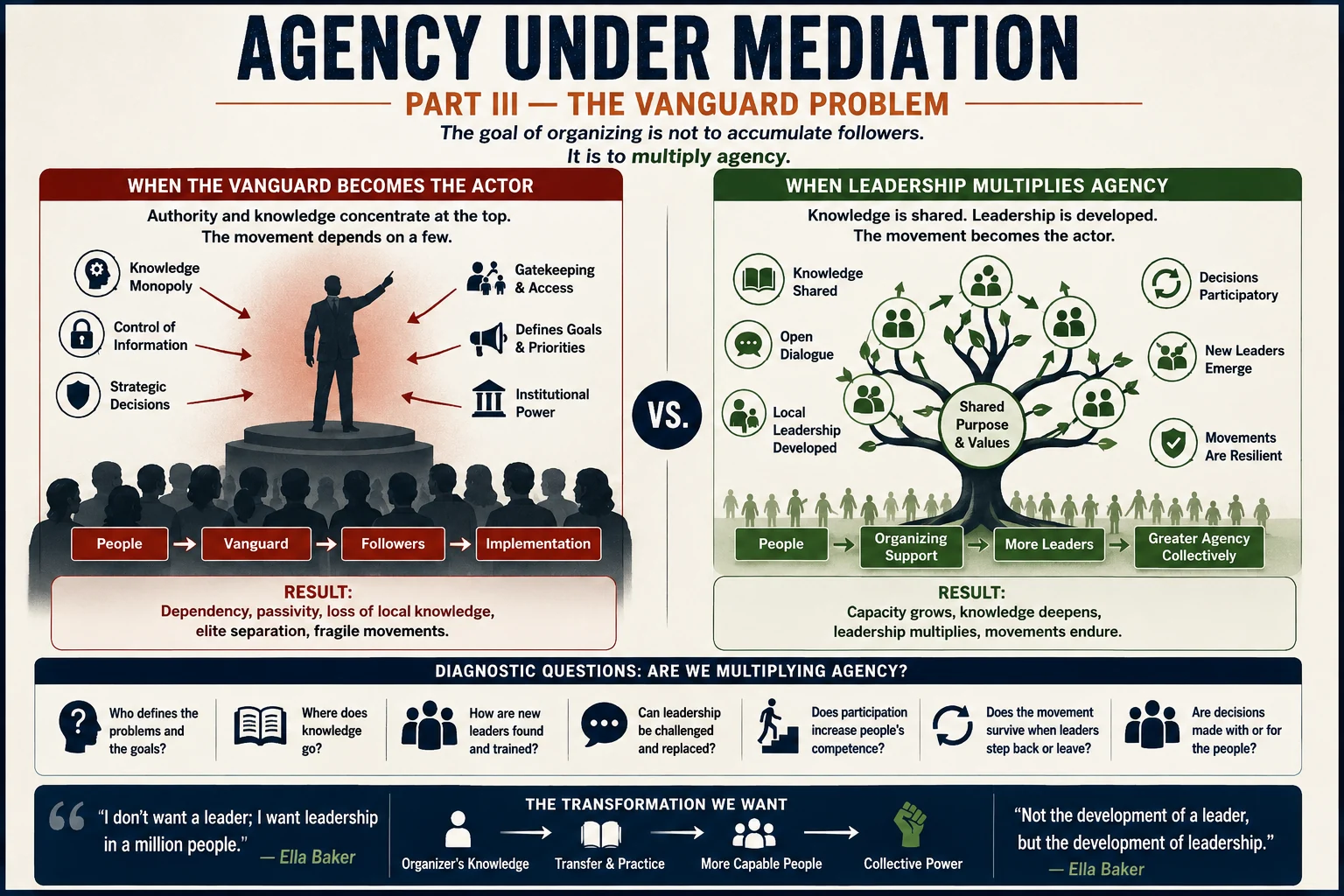
Leadership infographic contrasting a centralized vanguard that produces followers with distributed leadership that multiplies agency.

Agency Under Mediation — Part III

Every movement that begins by saying:

“People should possess greater power over their own lives”

eventually encounters an uncomfortable problem.

Somebody has to organize the meeting.

Somebody has to understand the law.

Somebody has to coordinate across cities.

Somebody has to manage the money.

Somebody has to maintain communication.

Somebody has to develop strategy.

Somebody has already read the books.

Somebody has been doing this for twenty years.

And very quickly a movement built around the agency of ordinary people develops a group of people who are much better equipped to operate the movement than everybody else.

That is not necessarily corruption.

It is organization.

The problem begins one transformation later.

The people who know how to operate the movement begin determining what the movement wants.

The distinction is subtle:

Movement → develops organizers

becomes:

Organizers → possess the movement

And because the organizers usually acquired their position by being useful, intelligent, committed, experienced, or courageous, the transition can occur without anybody consciously deciding to dominate anyone.

That is the vanguard problem.

It is not merely:

Who leads?

The deeper question is:

Does leadership increase the number of people capable of exercising agency, or does leadership gradually become the location where agency resides?


Self-Emancipation Contains an Architectural Claim

One of the clearest formulations appears in the rules of the International Working Men's Association.

The 1864 provisional rules, retained in the revised 1871 rules, begin from the proposition that the emancipation of the working classes must be achieved by the working classes themselves.

The important word is not simply emancipation.

It is themselves.

Consider two outcomes.

Outcome A

Workers have better wages, safer conditions, political protection and stronger representation because a powerful institution secured those things for them.

Outcome B

Workers have better wages, safer conditions, political protection and stronger representation because they acquired the organizational capacity to negotiate, organize and exercise political power themselves.

Materially, the outcomes may initially look similar.

Structurally, they are very different.

The first transformation is:

Worker₀ → Representative → Improvement

The second is:

Worker₀ → Organization / Knowledge / Coordination → Worker₁

where:

Worker₁ possesses greater capacity than Worker₀.

The principle of self-emancipation therefore contains a theory of mediation.

The beneficiary should remain the actor.

That sounds simple until we encounter expertise.


The Knowledge Problem Inside Every Movement

Imagine a group of workers who know their jobs extremely well but have never organized a union.

Then an experienced organizer arrives.

The organizer understands:

labor law,

campaign sequencing,

workplace mapping,

negotiation,

communications,

institutional resistance,

pressure tactics,

and mistakes that previous campaigns made.

There is now an obvious asymmetry:

KnowledgeOrganizer>KnowledgeWorkersKnowledge_{Organizer} > Knowledge_{Workers}

at least concerning the specific practice of organizing.

What should happen next?

One possibility is:

Workers0OrganizerKnowledgeTransferWorkers1Workers_0 \rightarrow Organizer \rightarrow Knowledge\ Transfer \rightarrow Workers_1

The organizer's competence becomes increasingly distributed throughout the group.

Another possibility is:

Workers0OrganizerStrategicMonopolyFollowersWorkers_0 \rightarrow Organizer \rightarrow Strategic\ Monopoly \rightarrow Followers

The organizer remains indispensable because the knowledge required to operate the movement remains concentrated in the organizer.

Both models can produce successful campaigns.

Only one necessarily produces greater agency.

This is why the vanguard problem cannot be solved simply by saying:

“Let the people lead themselves.”

Sometimes the people do not yet possess the information, organization or capabilities necessary to accomplish what they are trying to do.

The question is what happens to that asymmetry over time.

Does expertise circulate?

Or does expertise become the justification for permanent authority?


Lenin Identified a Real Problem

Few political concepts demonstrate this tension more clearly than Lenin's argument in What Is To Be Done?

Lenin distinguished the economic struggle arising spontaneously among workers from broader socialist political consciousness.

Quoting Karl Kautsky approvingly, he argued that socialist theory had developed through specialized intellectual work and described socialist consciousness as something introduced into the proletarian struggle “from without.”

That phrase has generated more than a century of argument.

A crude interpretation goes something like:

Workers are incapable of understanding their own interests, therefore intellectuals must rule them.

That is too simplistic.

Scholar Alan Shandro, for example, argues that Lenin's claim can be read consistently with proletarian self-emancipation rather than as its rejection. On this interpretation, revolutionary theory gives political actors conceptual resources through which they can understand a class struggle more complex than immediate workplace conflict.

That is an important qualification.

The vanguard problem is not solved by misrepresenting Lenin.

In fact, his argument makes the problem sharper.

Suppose the mediator really does know something the mediated actor does not.

Then what?

Expertise is real.

Theory is real.

Institutional knowledge is real.

Strategic competence is real.

A movement may genuinely need people who have developed those capabilities.

But then we have to distinguish:

knowledge asymmetry

from

agency transfer.

Knowing something somebody else needs gives you something to teach them.

It does not automatically give you ownership of what they should subsequently do with their life.

The vanguard problem begins when:

EpistemicAuthorityStrategicAuthorityOrganizationalAuthorityPoliticalAuthorityEpistemic\ Authority \rightarrow Strategic\ Authority \rightarrow Organizational\ Authority \rightarrow Political\ Authority

without each transition being independently justified.

That progression is not unique to revolutionary politics.

Doctors can do it.

Lawyers can do it.

Pastors can do it.

Policy professionals can do it.

Nonprofit organizations can do it.

Engineers can do it.

AI systems can do it.

The possession of specialized knowledge quietly becomes a claim to broader jurisdiction.


Luxemburg Saw the Substitution Problem

Rosa Luxemburg's 1904 criticism of Lenin is useful precisely because she did not reject organization.

Her concern was what centralized organization could become.

She objected to a structure in which a central authority effectively “thinks, acts and decides for all.”

Her alternative was not disorganization.

She argued that Social Democracy should be understood as the movement of the working class itself rather than an organization merely attached to that movement from outside.

That distinction maps almost perfectly onto our mediation model.

Compare:

MovementCentralOrganizationMassImplementationMovement \rightarrow Central\ Organization \rightarrow Mass\ Implementation

with:

MassParticipationCoordinationCollectiveMovementMass\ Participation \rightarrow Coordination \rightarrow Collective\ Movement

The first architecture treats people primarily as the execution layer.

The second treats coordination as infrastructure connecting actors who remain politically meaningful.

Again, this does not prove that Luxemburg possessed the correct organizational strategy for every condition.

Central coordination can be necessary.

Rapid decision-making can be necessary.

Specialization can be necessary.

Discipline can be necessary.

But she identifies the failure mode:

coordination can cease coordinating agency and begin concentrating it.

That is the exact transformation we are trying to isolate.


Organization Produces Its Own Power

Robert Michels pushed the argument further.

The uncomfortable feature of his analysis is that a movement does not need Leninist theory to experience this problem.

It only needs organization.

Studying socialist parties and trade unions in the early twentieth century, Michels argued that large democratic organizations tend toward oligarchy.

His famous formulation was:

“Who says organization, says oligarchy.”

His claim was intentionally severe. Organization requires specialization. Specialized leaders accumulate knowledge, procedural competence, institutional relationships and control over communication. Leadership gradually becomes professionalized and increasingly difficult for ordinary members to replace.

We do not have to accept Michels's “iron law” as literally inevitable to see the mechanism.

Suppose an organization begins with one hundred participants.

Everybody initially knows roughly the same amount.

Then five people become responsible for administration.

Those five attend every meeting.

They know the history behind previous decisions.

They know the organization's donors.

They know the passwords.

They know the bylaws.

They know outside allies.

They know which internal personalities cannot work together.

They know why the organization stopped doing something three years ago.

They know the lawyer.

They know the reporter.

They know how the budget works.

Now imagine a disagreement between the five administrators and fifty ordinary members.

Formally:

5<505 < 50

But informationally:

InstitutionalKnowledge5InstitutionalKnowledge50Institutional\ Knowledge_{5} \gg Institutional\ Knowledge_{50}

The nominal majority may therefore possess less practical power than the minority.

Nothing illegal happened.

Nobody staged a coup.

Nobody even necessarily acted dishonestly.

The architecture generated asymmetry.

That is why agency preservation requires more than good intentions.


The Vanguard Can Emerge Without Calling Itself One

This matters far outside revolutionary organizations.

A movement can officially reject vanguardism while reproducing its structure.

Consider what happens when an advocacy organization begins with people directly affected by a problem.

At first:

affected people → organization

Then the organization hires professionals.

The professionals learn grant writing.

Media relations.

Regulatory language.

Policy analysis.

Fundraising.

Legal compliance.

Legislative procedure.

Eventually outsiders ask:

“What does this community want?”

and instead of asking the community, they ask the organization.

The organization has become legible to institutions in a way ordinary people are not.

That creates enormous mediation power.

Now another transformation becomes possible:

Community → Organization → Institution

slowly becomes:

Institution ↔︎ Organization → Community

The mediator begins receiving institutional categories from above and translating them downward.

The direction of mediation reverses.

The organization still says:

“We represent them.”

But operationally it may increasingly perform:

“We explain to them what is institutionally possible.”

That is agency migration.

Again, the professionals may be excellent people.

They may genuinely care.

That is what makes the problem difficult.

The vanguard problem is not fundamentally a character defect.

It is a structural temptation created by asymmetrical access to information, institutions and coordination.


Ella Baker Offered a Different Model

One of the strongest practical alternatives appears in the organizing philosophy of Ella Baker.

Baker spent decades working inside major civil-rights organizations, including the NAACP and the Southern Christian Leadership Conference, before becoming deeply influential in the formation of the Student Nonviolent Coordinating Committee.

Her organizing philosophy rejected excessive dependence on charismatic individual leadership and emphasized participatory, bottom-up political development. The National Park Service describes her approach as collectivist and participatory, centered on developing leadership from below.

At a 1963 SNCC conference Baker made the distinction exceptionally clear.

She hoped SNCC would focus:

“not the development of a leader, but the development of leadership.”

That sentence solves a great deal of the vanguard problem.

The objective is not:

LeaderFollowersLeader \rightarrow Followers

It is:

OrganizerMoreOrganizersOrganizer \rightarrow More\ Organizers

Or:

Leadership1Leadership2Leadership4Leadership8Leadership_1 \rightarrow Leadership_2 \rightarrow Leadership_4 \rightarrow Leadership_8

Leadership becomes generative rather than accumulative.

The successful organizer does not prove success by becoming increasingly indispensable.

The organizer proves success by making more people capable of doing what previously only the organizer could do.

That is agency-preserving mediation.


SNCC Made the Principle Concrete

The Student Nonviolent Coordinating Committee provides an unusually useful historical case because this philosophy was not merely theoretical.

SNCC organizers entered communities where local people already possessed networks, knowledge, relationships and histories of resistance.

The SNCC Digital Gateway—created through collaboration involving veterans of the organization—describes field secretaries learning to listen to, respect and be guided by local people. Existing community leaders provided networks, local knowledge, protection, housing and practical understanding of dangerous local conditions. New local leaders then emerged through the organizing process.

Notice what this does to the conventional organizer narrative.

It is not:

trained activist → passive community → mobilized community

It is:

external organizer knowledge + local community knowledge → new political capacity

The organizer brings something.

The community brings something.

Neither possesses the whole transformation alone.

That is mediation rather than substitution.

Baker's 1960 reflections on the student movement likewise praised its tendency toward group-centered leadership and warned against adult attempts to capture or overprotect the emerging student movement.

That language is especially useful.

Capture can happen through hostility.

But capture can also happen through help.

Adults might sincerely believe:

These students are inexperienced.

We know the institutions.

We know the danger.

We have been fighting longer.

We have established organizations.

We know how this works.

Every statement can be true.

And yet the resulting conclusion—

therefore we should determine their movement for them

—still does not follow.

Expertise creates an obligation to contribute.

It does not automatically create a right to capture.


But “Leaderless” Does Not Solve the Problem

At this point it would be easy to conclude:

Fine. No leaders.

That produces another failure mode.

Jo Freeman identified it in her influential essay The Tyranny of Structurelessness, written from experience in the women's liberation movement.

Groups that formally rejected structure did not actually eliminate structure.

They often eliminated visible and accountable structure.

Friend networks, status, communication patterns, personality and informal access still determined who influenced decisions.

The difference was that the resulting elites could not easily be named, elected, challenged or removed because officially no leadership existed. Freeman therefore argued for democratic structuring rather than pretending structure could disappear.

That gives us another important equation:

NoFormalAuthorityNoAuthorityNo\ Formal\ Authority \neq No\ Authority

And:

NoNamedLeaderNoLeadershipNo\ Named\ Leader \neq No\ Leadership

Sometimes the effort to prevent vanguardism merely makes the vanguard invisible.

This is why the series cannot collapse into:

hierarchy bad, decentralization good.

Formal authority has one major advantage:

you can point at it.

You can define its scope.

Elect it.

Audit it.

Limit it.

Appeal it.

Replace it.

Informal power may possess none of those properties.

The issue is therefore not whether leadership exists.

Leadership will exist wherever people coordinate.

The issue is whether leadership is:

legible, bounded, accountable, contestable and reproductive of further agency.


The Difference Between Developing Followers and Developing Actors

This gives us a cleaner way of evaluating organizing.

Imagine two organizers.

Both begin with ten inexperienced participants.

Organizer A

After three years:

  • still chairs every meeting,
  • writes every strategy,
  • handles every external relationship,
  • explains every technical question,
  • approves every public statement,
  • resolves every internal dispute,
  • and remains the only person everyone trusts to keep the organization functioning.

The organization may have grown to 500 members.

By ordinary measures, Organizer A looks enormously successful.

But examine the mediation:

10inexperiencedparticipantsOrganizer500dependentparticipants10\ inexperienced\ participants \rightarrow Organizer \rightarrow 500\ dependent\ participants

The quantity of participation increased.

The concentration of agency may have increased with it.

Organizer B

After three years:

  • no longer chairs most meetings,
  • trained six people capable of doing so,
  • distributed institutional relationships,
  • documented organizational procedures,
  • developed local decision-making,
  • created succession,
  • taught people how to teach others,
  • and can disappear for three months without organizational collapse.

Perhaps Organizer B has only 200 participants.

By another metric, Organizer A built the larger organization.

But Organizer B built more organizers.

That matters.

Because the ultimate product of political organizing is not merely:

an organization.

It is:

organized people.

Those are not the same artifact.


The Dependency Test Returns

Part II asked whether safety systems increase worker competence.

The same diagnostic applies here.

Before mediation:

Actor0=limitedorganizingcapacityActor_0 = limited\ organizing\ capacity

After mediation:

Actor1=?Actor_1 = ?

Ask:

Can participants run meetings?

Can they explain the strategy?

Can they challenge leadership?

Can they obtain organizational information?

Can they speak publicly?

Can they negotiate?

Can they organize another group?

Can they replace existing leadership?

Can they determine goals rather than merely implement tactics?

Can knowledge survive the departure of professionals?

If the answer to those questions trends upward, mediation is building political capability.

If it trends downward, the movement may be growing while agency contracts.

That is possible.

An institution can become more powerful while its members become less powerful inside it.

Michels's warning becomes particularly relevant here.

Growth increases the need for administration.

Administration creates specialization.

Specialization creates informational asymmetry.

Informational asymmetry creates dependency.

Dependency creates authority.

Authority can then protect the structures that produced it.

The movement's success can therefore generate the conditions for its own internal substitution.


The Vanguard Problem Is Really an Information Problem Plus an Authority Problem

At its core, vanguardism combines two variables:

KnowledgeAsymmetryKnowledge\ Asymmetry

and

AuthorityAsymmetryAuthority\ Asymmetry

Neither is inherently illegitimate.

Some people know more.

Some people must make decisions.

The dangerous interaction is:

KnowledgeAsymmetry+AuthorityAsymmetry+LowContestability+LowKnowledgeTransferKnowledge\ Asymmetry + Authority\ Asymmetry + Low\ Contestability + Low\ Knowledge\ Transfer

which tends toward:

AgencyConcentrationAgency\ Concentration

By contrast:

KnowledgeAsymmetry+KnowledgeTransfer+BoundedAuthority+HighContestabilityKnowledge\ Asymmetry + Knowledge\ Transfer + Bounded\ Authority + High\ Contestability

can produce:

CapabilityGrowthCapability\ Growth

This is a much better description of the problem than simply arguing about whether movements need leaders.

Of course they need leadership.

What they should resist is leadership becoming a closed epistemic class.


When Expertise Becomes Identity

There is another subtle warning sign.

At first someone does organizing.

Eventually that person becomes an organizer.

At first someone does policy work.

Eventually that person becomes a policy professional.

At first someone helps represent a movement.

Eventually that person becomes a movement leader.

Professional identity itself is not the problem.

But identity changes incentives.

If your status, livelihood, social network and purpose depend upon occupying the role of mediator, then a successful transfer of capacity creates an uncomfortable possibility:

What happens if they stop needing you?

This does not require conscious manipulation.

People naturally interpret problems through roles they know how to perform.

The mediator can therefore begin seeing every limitation as evidence that more mediation is necessary.

The organization interprets organizational problems as arguments for more organization.

The professional interprets political weakness as evidence that more professional capacity is required.

The leader interprets disorder as evidence that stronger leadership is necessary.

Sometimes they are correct.

But the mediation framework forces another question:

Would the proposed solution increase the subject's capacity, or merely increase the mediator's jurisdiction?

That question should make every movement slightly uncomfortable.

Good.


Strong Movements May Need Strong Leadership

There is an important counterargument.

Some political conditions are hostile.

Governments repress movements.

Employers retaliate.

Opponents deliberately spread misinformation.

Complex campaigns require planning.

Negotiations sometimes require confidentiality.

Not every strategic decision can be crowdsourced.

A movement incapable of coordinated action may lose to institutions that are extraordinarily coordinated.

So strong leadership can be necessary.

The vanguard problem does not imply otherwise.

Ella Baker herself did not advocate political passivity or organizational incoherence.

SNCC organizers developed substantial expertise and discipline.

Freeman explicitly rejected the fantasy that refusing structure eliminates power.

Even Lenin's argument begins from a legitimate question: how can a movement acquire political knowledge that immediate experience alone does not automatically produce?

The serious question is therefore not:

Should movements have strong leadership?

It is:

What does strong leadership make everyone else capable of becoming?

A commander may be necessary during a particular transformation.

But if every transformation permanently requires the same commander, then either:

  1. the task genuinely requires durable specialization,

or

  1. capability has not been successfully distributed.

We need to know which.


The Vanguard Test

The following questions expose whether leadership is mediating agency or absorbing it.

1. Where does knowledge go?

Does specialized knowledge circulate downward and outward?

Or does leadership preserve its informational advantage?

2. Where do new leaders come from?

Are they continually developed from the people participating?

Or must leaders be imported from a professional class?

3. Who defines the problem?

Do affected people participate in describing their own interests?

Or does the organization explain their interests to them?

4. Can strategy be contested?

Not every decision can be collective.

But are there legitimate channels through which leadership can be challenged?

5. Is authority visible?

Formal authority can be bounded.

Invisible authority is much harder to audit.

6. Can leaders be replaced?

If removing a leader destroys the organization, the organization has developed a dependency problem.

7. Does participation produce competence?

Five years inside a movement should generally leave someone more capable of political action than when they entered.

8. Does leadership reproduce leadership?

This may be the most important one.

If:

Leader1Followers1000Leader_1 \rightarrow Followers_{1000}

the movement has reach.

If:

Leader1Leaders10Leaders100Leader_1 \rightarrow Leaders_{10} \rightarrow Leaders_{100}

the movement has distributed capacity.

Those are different forms of power.


From Vanguard to Infrastructure

There is another way to imagine leadership.

Instead of the leader being the head of the movement, imagine leadership as infrastructure.

Infrastructure connects.

Carries information.

Provides resources.

Coordinates.

Makes action possible.

But the road does not decide where the traveler is going.

A good organizer can function similarly.

The organizer makes relationships possible.

Transfers knowledge.

Surfaces information.

Builds communication.

Creates processes.

Develops other people.

Helps resolve coordination problems.

Protects the movement from avoidable mistakes.

Connects local actors with larger institutions.

The organizer possesses real expertise.

Sometimes substantial authority.

But the orientation remains:

AgencythroughmediatorexpandedagencyAgency \rightarrow through\ mediator \rightarrow expanded\ agency

rather than:

AgencyintomediatorAgency \rightarrow into\ mediator

That is the distinction.


The Movement Must Survive Its Leaders

Ella Baker's distinction between developing a leader and developing leadership may be one of the cleanest statements of legitimate political mediation available.

A movement centered on a leader asks:

Who will guide us?

A movement centered on leadership development asks:

How many people here can learn to guide?

The first can produce extraordinary moments.

The second can produce durable capacity.

And this is ultimately why the vanguard problem matters.

Movements claim to transform relationships of power outside themselves.

But they also create relationships of power internally.

A movement fighting domination can reproduce domination.

A movement demanding democratic voice can suppress internal voice.

A movement committed to worker agency can professionalize worker agency out of existence.

A movement built around ordinary people can become unintelligible to ordinary people.

None of those contradictions requires hypocrisy.

They can emerge naturally from organization itself.

That means the answer cannot simply be:

Find better leaders.

The architecture has to change.

Knowledge must circulate.

Authority must remain bounded.

Leadership must be reproducible.

Decision-making must remain contestable.

Institutional memory must be shared.

Participants must develop competence.

And the mediator must remain removable.

The strongest leader is therefore not necessarily the person whose absence everyone fears.

It may be the person whose work has made their own absence survivable.

That gives us the principle for Part III:

Legitimate leadership does not eliminate the asymmetry between experienced organizers and inexperienced actors. It uses that asymmetry to produce more capable actors rather than permanent followers.

Or more simply:

The purpose of organizing is not to accumulate followers. It is to multiply agency.

The vanguard becomes dangerous when it ceases walking ahead because it can see farther—

and begins deciding that everyone behind it has therefore lost the right to choose the destination.


References

[1] International Working Men's Association. Address and Provisional Rules of the International Working Men's Association (1864); General Rules (1871). Establishes worker self-emancipation and describes the International as a medium of communication and cooperation among workers' organizations.

[2] V. I. Lenin. What Is To Be Done? (1902), especially Chapter II. Develops the argument concerning spontaneous economic struggle and socialist political consciousness introduced “from without.”

[3] Alan Shandro. “‘Consciousness from Without’: Marxism, Lenin and the Proletariat.” Science & Society 59, no. 3 (1995). Provides an important scholarly corrective to readings that automatically equate Lenin's argument with rejection of proletarian self-emancipation. DOI: 10.1177/003682379505900303.

[4] Rosa Luxemburg. “Organizational Questions of the Russian Social Democracy” (1904). Critiques excessive centralization and the substitution of centralized organizational authority for mass political activity.

[5] Robert Michels. Political Parties: A Sociological Study of the Oligarchical Tendencies of Modern Democracy. English translation, 1915. Examines how specialization and organization can produce durable leadership elites inside formally democratic organizations.

[6] Ella Baker. Address to SNCC Conference, December 1963. Baker distinguishes development of individual leaders from development of distributed leadership. Transcript preserved by the Archives of Women's Political Communication, Iowa State University.

[7] U.S. National Park Service. “Women in the African American Civil Rights Movement: An Historic Context.” Documents Baker's bottom-up, participatory approach to leadership and her influence on SNCC.

[8] SNCC Legacy Project / SNCC Digital Gateway. “Organizing Tradition” and “Ella Baker.” Documents SNCC organizers' relationships with local leadership, community knowledge and Baker's bottom-up organizing philosophy.

[9] Wesley C. Hogan. “Youth and Women Lead: Ella Baker and SNCC.” In On the Freedom Side: How Five Decades of Youth Activists Have Remixed American History. University of North Carolina Press, 2019, pp. 17–34. Examines Baker and SNCC's group-centered leadership model. DOI: 10.5149/northcarolina/9781469652481.003.0002.

[10] Jo Freeman. “The Tyranny of Structurelessness.” First officially published in The Second Wave 2, no. 1 (1972), with later versions in Berkeley Journal of Sociology and Ms. Freeman argues that eliminating formal structure does not eliminate power and proposes explicit democratic mechanisms for making authority accountable.

Part 04 Representation

Representation Without Replacement

How can a representative exercise judgment at scale without becoming the source, owner, or substitute for the represented?

Representation infographic contrasting replacement by a representative with accountable, contestable representation.

Agency Under Mediation — Part IV

Representation begins with an impossibility.

Millions of people cannot personally sit in every legislature.

Every worker cannot attend every negotiation.

Every resident cannot personally argue every administrative decision.

Every member of a large organization cannot participate in every conversation occurring on its behalf.

Every affected person cannot be present in every room where decisions affecting them are made.

So someone goes instead.

A representative.

That person carries something across a distance:

a vote,

an interest,

a grievance,

a preference,

a judgment,

a mandate,

a story,

a constituency.

Representation is therefore mediation.

The basic transformation looks like:

Actor₀ → Representative → Institution → Outcome

And that immediately creates a problem.

The representative must possess enough independence to actually operate as a representative.

But the more independent the representative becomes, the easier it becomes for:

acting for someone

to become:

acting instead of someone.

Representation therefore contains a permanent tension.

The representative cannot simply be a puppet.

But neither can the representative become the principal.

That is the problem of representation without replacement.


Representation Exists Because Direct Agency Does Not Scale

Imagine a town of fifty people trying to decide where to build a bridge.

Perhaps everyone can gather.

Everyone can speak.

Everyone can hear the arguments.

Everyone can participate directly.

Now imagine fifty million people deciding thousands of technical questions across transportation, taxation, healthcare, energy, defense, labor, education and environmental regulation.

Direct participation in every decision becomes physically impossible.

Agency therefore has to be mediated.

We introduce representatives because representation solves a real coordination problem:

DirectAgencyScaleImpracticalDirect\ Agency \xrightarrow{Scale} Impractical

so:

CitizensRepresentativesCollectiveDecisionCitizens \rightarrow Representatives \rightarrow Collective\ Decision

The representative gains access to spaces the represented cannot continuously occupy.

Time.

Information.

Procedure.

Negotiation.

Institutional relationships.

Deliberation.

That is useful.

But it also means the representative begins accumulating something the represented do not possess:

situated institutional knowledge.

The representative hears arguments constituents never hear.

Reads documents constituents never read.

Learns procedural constraints constituents never encounter.

Negotiates tradeoffs constituents may never see.

And sometimes discovers information that genuinely changes the representative's judgment.

Now the problem becomes harder.

What should happen when the representative concludes that the people being represented are wrong?


The Representative Is Not a Voting Machine

Edmund Burke gave one of the classic answers in his 1774 address to the electors of Bristol.

Burke argued that representatives owed constituents communication, attention and fidelity to their interests.

But he rejected the idea that constituents should bind representatives through mandatory instructions.

His famous formulation was:

“Your representative owes you, not his industry only, but his judgment.”

For Burke, parliament was a deliberative institution.

Representatives were supposed to encounter information and argument, reason about the common good, and exercise mature judgment rather than merely transmit instructions issued before deliberation occurred.

This became associated with what later political theory calls the trustee model of representation.

Contrast it with the delegate model.

A pure delegate attempts to transmit constituent preference:

ConstituentPreferenceRepresentativeVoteConstituent\ Preference \rightarrow Representative \rightarrow Vote

A trustee exercises independent judgment:

ConstituentInterest+Evidence+DeliberationRepresentativeJudgmentVoteConstituent\ Interest + Evidence + Deliberation \rightarrow Representative\ Judgment \rightarrow Vote

The tension is obvious.

If representatives exercise no judgment, why deliberate?

Why send people instead of ballots?

But if representatives may ignore constituents whenever they believe themselves wiser, what exactly remains representative about the relationship?

That question has never disappeared.


Responsiveness Is the Missing Term

Hanna Pitkin's The Concept of Representation remains foundational because she refused to reduce representation to one mechanical relationship.

Her classic formulation describes representation as:

“acting in the interest of the represented, in a manner responsive to them.”

The two halves matter.

Interest.

And:

responsiveness.

Representation therefore cannot mean simply:

Do whatever the represented currently demand.

But neither can it mean:

Determine their interests independently and ignore what they say.

The mediator has to preserve a relationship.

That gives us a useful transformation:

RepresentedRepresentativeRepresented \rightleftarrows Representative

not merely:

RepresentedRepresentativeRepresented \rightarrow Representative

The arrow has to run both ways.

Information travels upward.

Judgment returns downward.

Objections travel upward.

Explanations return downward.

Circumstances change.

Preferences change.

Representatives learn.

Constituents learn.

The relationship remains dynamic.

Once that feedback disappears, representation begins turning into replacement.


“I Know What Is Best for You” Is Not Enough

This is where political representation begins touching the paternalism problem from Part I.

Suppose a representative says:

I know my constituents oppose this policy, but I have seen information they have not seen, and I believe supporting it is genuinely in their interest.

That claim might be true.

We cannot solve the problem merely by shouting:

“Do what the voters said.”

Perhaps the representative possesses better information.

Perhaps circumstances changed after the election.

Perhaps the issue requires specialized knowledge.

Perhaps constituents themselves are divided.

Perhaps the representative is balancing local preferences against broader obligations.

Perhaps a minority would be harmed if majority preference were followed literally.

Those are real problems.

But now suppose the representative says:

Because I know better, your disagreement no longer matters.

Something has changed.

The first statement exercises judgment.

The second abolishes responsiveness.

That distinction is central.

The mediation framework does not require:

RepresentativeJudgment=ConstituentPreferenceRepresentative\ Judgment = Constituent\ Preference

It requires something closer to:

RepresentativeJudgment remains answerable to RepresentedRepresentative\ Judgment \text{ remains answerable to } Represented

A representative may legitimately disagree.

But representation becomes difficult to distinguish from rule when the representative can no longer be questioned, removed, corrected, contradicted or required to explain the divergence.


Delegation Is Not Abdication

Political science gives us an unusually useful language for this problem: principal-agent theory.

The basic structure is simple.

A principal needs something done.

The principal delegates the task to an agent.

PrincipalDelegationAgentPrincipal \rightarrow Delegation \rightarrow Agent

But delegation immediately creates two problems.

First, the agent may possess information the principal does not.

Second, the agent may develop interests different from the principal's.

That creates the possibility of agency loss:

AgentsActionPrincipalsIntendedOutcomeAgent's\ Action \neq Principal's\ Intended\ Outcome

D. Roderick Kiewiet and Mathew McCubbins examined this problem in The Logic of Delegation.

Their central point is extremely relevant here:

delegation does not necessarily become abdication.

The effectiveness of delegation depends not simply on how much authority is delegated, but on how delegation is structured.

Principal-agent systems therefore develop mechanisms such as:

selection,

defined mandates,

monitoring,

reporting,

and institutional checks.

The purpose is not to eliminate discretion.

The purpose is to make discretion governable.

That distinction gives us one of the clearest formulations yet for this series:

The problem is not delegated authority. The problem is delegated authority without a surviving principal.

If the principal cannot know what the agent is doing,

cannot assess what the agent is doing,

cannot constrain what the agent is doing,

and cannot ultimately replace the agent,

then the relationship has changed.

Formally:

PrincipalAgentPrincipal \rightarrow Agent

has become:

FormerPrincipalNewPrincipalFormer\ Principal \leftarrow New\ Principal

The agent now governs the actor from whom its authority originally came.


Accountability Keeps the Arrow Pointing Backward

The American constitutional argument surrounding representation recognized this danger from the beginning.

Federalist No. 57 defended the House of Representatives partly by emphasizing that representatives would periodically have to return to the people who authorized them.

Its argument was not that representatives would always agree with constituents.

It was that political power should periodically return to the source from which it came.

The essay says frequent elections force representatives to remember their “dependence on the people.”

That word is useful.

Dependence.

Representation produces asymmetry:

Representative>ConstituentRepresentative > Constituent

in institutional access.

But democratic accountability attempts to preserve another asymmetry:

Constituent>RepresentativeConstituent > Representative

in ultimate authorization.

The representative knows more about the chamber.

The representative occupies the office.

The representative casts the vote.

The representative gains institutional power.

But periodically the system asks:

Do you still possess authority to remain there?

That recurring return to the principal prevents delegated office from automatically becoming permanent possession.

In the language of this series:

Authorization0RepresentationExerciseofAuthorityReauthorization1Authorization_0 \rightarrow Representation \rightarrow Exercise\ of\ Authority \rightarrow Reauthorization_1

The loop matters.

Without the loop, representation becomes increasingly difficult to distinguish from guardianship.


Elections Are Not Enough

But even that model is too simple.

Jane Mansbridge's influential work on representation shows why.

Traditional democratic accountability often imagines what she calls promissory representation:

Candidate promises something.

Voters authorize the candidate.

Representative acts.

Voters later judge whether the representative kept the promise.

But Mansbridge identifies other forms.

Representatives may anticipate what voters will want at the next election.

They may be selected precisely because voters trust their internal principles and judgment.

They may even represent people outside their formal electoral constituency.

Different representational relationships therefore require different standards of accountability.

This destroys a simplistic equation:

Representation=PromiseComplianceRepresentation = Promise\ Compliance

Representation is more complicated.

A voter might deliberately choose:

“I trust this person's judgment.”

That is itself an authorization.

A representative might encounter an unforeseen emergency.

No campaign promise exists for it.

A legislator may advocate for people outside the district.

A civil-rights organization may represent people who never formally elected it.

A disability advocate may speak in a legislative hearing without holding public office.

A union representative may negotiate for members who disagree among themselves.

A nonprofit may claim to represent a community that has no formal mechanism for appointing it.

Modern representation occurs everywhere.

Which creates another problem.


Who Authorized You to Speak for Them?

Michael Saward's work on the representative claim exposes a particularly important form of mediation.

Representation is not always created when a constituency chooses a representative.

Sometimes someone makes a claim:

I represent these people.

That claim itself participates in constructing:

who the constituency is,

what the constituency supposedly wants,

which interests define it,

and who legitimately speaks for it.

Saward emphasizes that representative claims are contingent and contestable rather than automatically legitimate merely because someone makes them.

This gives us one of the most dangerous forms of agency substitution.

Consider:

Working families want X.

Who determined that?

The Black community believes Y.

Which people?

Christians demand Z.

Who authorized the speaker?

Young people need this.

According to whom?

Experts say communities like this require...

Did anyone ask the community?

Representation can therefore do more than carry an existing interest into an institution.

It can construct a representation of the represented.

And once institutions accept that representation, something remarkable can happen:

ActualPeopleRepresentativesDescriptionofPeopleInstitutionalDecisionActual\ People \rightarrow Representative's\ Description\ of\ People \rightarrow Institutional\ Decision

The institution no longer encounters the original actors.

It encounters the mediator's model of them.

That is epistemic mediation.


The Representative Can Become the Source of the Constituency

This failure deserves close attention.

Imagine a neighborhood organization created to communicate residents' concerns to city government.

Initially:

ResidentsNeighborhoodOrganizationCityResidents \rightarrow Neighborhood\ Organization \rightarrow City

Over time the organization professionalizes.

It attends planning meetings.

Learns grant terminology.

Understands zoning law.

Develops relationships with officials.

Residents become less involved.

Now the city wants to know:

What does the neighborhood think?

Officials call the organization.

The organization produces a statement.

Eventually:

CityOrganizationResidentsCity \rightarrow Organization \rightarrow Residents

The direction has partially reversed.

The mediator now tells residents what programs exist,

what categories they fit,

what funding is available,

what language they must use,

and which demands are considered realistic.

None of this automatically makes the organization corrupt.

Its institutional knowledge may be genuinely valuable.

But the organization now possesses enough representational power to influence not merely how resident interests are communicated, but which resident interests become legible at all.

This is the point where representation can become replacement without any formal transfer of sovereignty.

The representative becomes the authoritative interpreter of the represented.


Speaking for People Can Silence Them

This becomes especially dangerous when institutions prefer dealing with professional representatives.

Why?

Because representatives are easier.

They know the vocabulary.

They understand procedural expectations.

They respond to emails.

They know what evidence counts.

They can summarize.

They fit the institution.

Actual people are messier.

They contradict each other.

They speak emotionally.

They raise issues outside the agenda.

They may lack technical vocabulary.

They may challenge the categories through which the institution understands the problem.

So institutions naturally develop incentives to prefer:

MediatedPublicMediated\ Public

over:

ActualPublicActual\ Public

And the mediator develops incentives to remain the institution's preferred interface.

Now everybody benefits from mediation—

except perhaps the people whose agency mediation originally existed to preserve.

That is why “giving people a voice” can become paradoxical.

A person can have:

a representative voice

while losing:

their own voice.


Participation and Representation Are Not Opposites

There is another false choice worth rejecting.

People sometimes frame democracy as:

representation versus participation.

But Nadia Urbinati and Mark Warren's review of contemporary democratic theory highlights a growing recognition that representation and participation can be complementary forms of citizenship.

That is much more useful for our framework.

Participation does not require every person to make every decision.

Representation does not require everyone else to become passive.

The healthier architecture is recursive:

ParticipationRepresentationDecisionExplanationParticipationRevisedRepresentationParticipation \rightarrow Representation \rightarrow Decision \rightarrow Explanation \rightarrow Participation \rightarrow Revised\ Representation

Representation becomes one stage inside democratic agency rather than a replacement for it.

People contribute lived knowledge.

Representatives aggregate, deliberate and negotiate.

Representatives return with decisions and explanations.

People contest, revise, authorize or reject.

The process continues.

The represented remain political actors between elections rather than merely becoming voters every few years.


Representation Must Preserve Feedback

This brings us to the central structural problem.

A legitimate representative system requires feedback.

Without it:

ActorRepresentativeInstitutionActor \rightarrow Representative \rightarrow Institution

is a one-way pipe.

With it:

ActorRepresentativeInstitutionActor \rightleftarrows Representative \rightleftarrows Institution

becomes a mediated control loop.

The representative acts.

The represented observe.

The represented respond.

The representative explains.

The represented update.

The representative adjusts.

Sometimes the representative refuses to adjust and explains why.

Eventually the represented decide whether the divergence remains acceptable.

That is not perfect agreement.

It is responsive mediation.

And responsiveness is more important than obedience.


The Representative Must Be Able to Disagree

This distinction deserves emphasis because otherwise the entire theory becomes populist in the weakest sense.

Suppose 70 percent of constituents demand something unjust.

Should the representative obey?

Suppose voters possess false information.

Should the representative knowingly enact a harmful policy?

Suppose circumstances change radically after an election.

Should a representative implement a promise that no longer makes sense?

Suppose a constitutional right protects an unpopular minority.

Should majority preference automatically govern?

No serious theory of representation can answer every one of those questions with:

“Just do what the majority says.”

Representation includes judgment precisely because collective governance contains conflicting goods.

Burke's insight survives.

The representative sometimes must say:

No.

But the legitimacy of that “no” depends partly upon what follows.

Does the representative explain?

Can the reasons be examined?

Can evidence be challenged?

Can the decision be reviewed?

Can the representative ultimately be removed?

Does the representative acknowledge that disagreement exists?

Or does the representative redefine disagreement as evidence that constituents simply do not understand their own interests?

That last move is the danger.

The statement:

“I disagree with you.”

preserves two actors.

The statement:

“Your disagreement proves why people like you need people like me to decide.”

collapses them into one.


Representation Fails When the Representative Becomes the Principal

We can now define the central transformation more precisely.

Legitimate representation:

PrincipalAuthorizationRepresentativeJudgmentActionAccountabilityPrincipalPrincipal \rightarrow Authorization \rightarrow Representative \rightarrow Judgment \rightarrow Action \rightarrow Accountability \rightarrow Principal

Substitution:

PrincipalRepresentativeAuthorityAccumulationInterpretiveMonopolyPrincipalBecomesSubjectPrincipal \rightarrow Representative \rightarrow Authority\ Accumulation \rightarrow Interpretive\ Monopoly \rightarrow Principal\ Becomes\ Subject

The first model permits independent judgment.

The second converts judgment into sovereignty.

And that gives us several recognizable failure modes.


Interpretive Capture

The representative gains authority to define what the represented supposedly want.

“We speak for them.”

becomes:

“Only we can accurately explain them.”


Agenda Capture

The representative determines which concerns can enter institutional discussion.

People technically retain a voice, but only after the mediator decides what counts as a legitimate issue.


Information Capture

The representative possesses information constituents cannot access.

Accountability weakens because the represented cannot evaluate decisions.


Procedural Capture

Formal opportunities for participation remain, but ordinary actors cannot realistically navigate the procedures required to influence outcomes.


Identity Capture

The representative starts defining who legitimately belongs to the constituency.

Those who disagree are treated as:

not real workers,

not real community members,

not real conservatives,

not real progressives,

not real Christians,

not real citizens of the movement.

The representative no longer merely represents an identity.

It polices the identity.


Dependency Capture

The represented become unable to access institutions except through the intermediary.

The mediator's necessity becomes self-reinforcing.


The Representation Test

So how can we distinguish representation from replacement?

Ask these questions.

1. Where did the authority come from?

Election?

Membership?

Consent?

Appointment?

Law?

Expertise?

Self-authorization?

Representation claims should have traceable provenance.


2. What exactly was authorized?

Authority should have scope.

Being elected to negotiate a contract does not automatically authorize control over every aspect of members' lives.

Being elected to legislate does not make every judgment infallible.

Being an expert does not create unlimited jurisdiction.


3. Can the representative disagree?

If not, representation may be mere transmission.

Some independent judgment is often necessary.

But then ask the next question.


4. Can the represented disagree?

This is the more important one.

Does disagreement remain politically meaningful?


5. Can the representative explain the divergence?

If the representative chooses against expressed preference, can the reasoning be made intelligible?

Opacity enlarges agency asymmetry.


6. Can the represented obtain independent information?

If all knowledge about the institution comes through the representative, the representative controls the conditions under which its own performance is judged.

That is dangerous.


7. Can representation be contested?

Can another person or organization say:

“You do not represent us.”

Saward's representative-claim framework makes this especially important outside electoral politics.


8. Can the representative be replaced?

Without credible replacement, authorization slowly becomes possession.


9. Does participation continue after representation begins?

Representation should create channels for continuing political agency, not close them.


10. Who remains the principal?

This is the master question.

After years of institutional development, who is actually governing whom?


The Most Dangerous Representative Is the Benevolent One

There is a reason this problem survives every ideology.

A corrupt representative is easy to understand.

They use office for money.

Prestige.

Power.

Career.

Access.

Those are recognizable abuses.

The harder case is the representative who genuinely believes:

“I understand what these people need better than they do.”

Because sometimes that person is correct.

That is exactly what makes paternalistic representation durable.

The representative's superior knowledge becomes evidence for greater authority.

Greater authority creates greater access to information.

Greater information confirms the representative's sense of superior competence.

The represented participate less because decisions occur elsewhere.

Reduced participation causes competence to decline.

Declining competence becomes further evidence that professional representation is necessary.

The loop becomes:

ExpertiseAuthorityMoreExpertiseMoreAuthorityExpertise \rightarrow Authority \rightarrow More\ Expertise \rightarrow More\ Authority

while:

ParticipationLessCompetenceLessParticipation \rightarrow Less \rightarrow Competence \rightarrow Less

Eventually the mediator can truthfully say:

“They could not operate this without us.”

But the relevant question is:

Why not?


Good Representation Does Not Make Representatives Unnecessary

We should avoid repeating an error already corrected earlier in this series.

Good mediation does not necessarily eliminate the mediator.

Large societies will continue needing representatives.

Workers will continue needing negotiators.

Organizations will continue needing officers.

Technical systems will continue needing specialists.

The goal is not:

RepresentationNoRepresentationRepresentation \rightarrow No\ Representation

The goal is:

RepresentationGreaterEffectiveAgencyRepresentation \rightarrow Greater\ Effective\ Agency

The representative can remain necessary for scale while avoiding becoming sovereign over the people represented.

That requires a continuing distinction between:

functional necessity

and:

ownership of authority.

I may need you to perform something I cannot practically perform myself.

That does not mean the underlying agency ceases to be mine.


Representation Without Replacement

The mature representative relationship therefore contains an apparent paradox.

The representative must possess enough independence to exercise judgment.

But enough dependence to remain representative.

Enough expertise to contribute something the represented do not already possess.

But enough humility to recognize that expertise does not confer ownership over their interests.

Enough institutional access to act effectively.

But enough permeability that information continues moving between institution and constituency.

Enough continuity to develop competence.

But enough contestability that continuity does not become permanence.

Enough authority to act.

But not enough authority to become the principal.

That gives us the principle for Part IV:

Representation is legitimate when delegated judgment remains responsive to the people whose agency gave rise to it.

Or more formally:

Actor0RepresentativeInstitutionalActionActor1Actor_0 \rightarrow Representative \rightarrow Institutional\ Action \rightarrow Actor_1

is agency-preserving when:

RepresentativeAuthorityAuthorizedScopeRepresentative\ Authority \subseteq Authorized\ Scope

and:

Representative remains accountable to ActorRepresentative \text{ remains accountable to } Actor

while:

Actor remains capable of contesting, informing, and reauthorizing representation.Actor \text{ remains capable of contesting, informing, and reauthorizing representation.}

The representative does not have to agree with the represented at every moment.

The representative does not have to disappear.

The representative does not have to abandon expertise.

The representative does not have to surrender judgment.

But the representative must never forget the transformation that created the office in the first place:

someone else's agency crossed through them.

It did not terminate there.

Because representation fails at the exact moment that:

“I speak for you”

quietly becomes:

“Therefore I determine who you are, what you want, and what may be done in your name.”

The first is mediation.

The second is replacement.


References

[1] Edmund Burke. “Speech to the Electors of Bristol,” November 3, 1774. Primary source. Burke's classic defense of representative judgment while also emphasizing close communication, attention to constituent wishes, and preference for constituent interests over the representative's own.

[2] Hanna Fenichel Pitkin. The Concept of Representation. University of California Press, 1967, especially p. 209. DOI: 10.2307/jj.2711645. Pitkin's conceptual analysis centers substantive representation on acting for the represented while remaining responsive to them.

[3] Jane Mansbridge. “Rethinking Representation.” American Political Science Review 97, no. 4 (2003): 515–528. DOI: 10.1017/S0003055403000856. Distinguishes promissory, anticipatory, gyroscopic and surrogate representation and demonstrates that democratic representation cannot be reduced to promise compliance alone.

[4] D. Roderick Kiewiet and Mathew D. McCubbins. The Logic of Delegation: Congressional Parties and the Appropriations Process. University of Chicago Press, 1991. Develops the principal-agent problem of delegation and argues that delegation's success depends upon institutional design rather than simply the amount of authority transferred.

[5] Michael Saward. “The Representative Claim.” Contemporary Political Theory 5, no. 3 (2006): 297–318. DOI: 10.1057/palgrave.cpt.9300234. Develops representation as claim-making and emphasizes the contingency and contestability of claims to represent others, including outside electoral institutions.

[6] James Madison. Federalist No. 57, February 19, 1788. Primary source. Defends frequent elections partly as a mechanism maintaining representatives' responsibility and dependence upon the people from whom their authority derives.

[7] Nadia Urbinati and Mark E. Warren. “The Concept of Representation in Contemporary Democratic Theory.” Annual Review of Political Science 11 (2008): 387–412. DOI: 10.1146/annurev.polisci.11.053006.190533. Reviews modern theories of electoral and nonelectoral representation and emphasizes the complementarity of political participation and representation.

Part 05 Dependency

The Dependency Test

When does needed support expand real freedom—and when does dependency become discretionary leverage over the person receiving it?

Dependency infographic showing agency-supporting and agency-capturing dependence along a continuum.

Agency Under Mediation — Part V

There is an easy way to misunderstand help.

You look at someone before assistance.

They cannot do something.

Then a person, institution, technology, program, organization, or community enters the situation.

Afterward, they can.

Success.

But then the mediator remains.

The person still uses the service.

Still relies on the institution.

Still needs the equipment.

Still consults the expert.

Still receives assistance.

And someone says:

“See? They became dependent.”

That conclusion can be completely wrong.

A person who uses eyeglasses is dependent on eyeglasses.

A city is dependent on electrical infrastructure.

A pilot is dependent on navigation systems.

A person with a disability may depend on another person for physical assistance while exercising enormous intellectual, political, professional and spiritual agency.

A surgeon depends on an entire technical and organizational system in order to operate.

None of those facts, by themselves, establish domination.

Human beings are dependent creatures.

So the question for mediation cannot simply be:

Does the actor still need something outside themselves?

If that were the test, almost every advanced form of civilization would fail it.

The real question is harder:

What kind of dependency has been created, what does it make possible, and who gains control because of it?

That is the dependency test.


Independence Is the Wrong Baseline

Earlier in this series, we used a useful provisional rule:

Good mediation leaves the mediated subject more capable of acting than before. Bad mediation makes the mediator increasingly necessary.

The first half survives.

The second requires qualification.

Some mediators remain necessary because the function they perform is genuinely specialized.

Teachers continue to exist after students graduate.

Doctors remain necessary despite successful medicine.

Air-traffic systems remain necessary even when pilots are highly competent.

Public infrastructure does not become illegitimate because people continue relying upon it.

So:

ContinuedDependencyFailedMediationContinued\ Dependency \neq Failed\ Mediation

That matters because otherwise the framework collapses into an unrealistic fantasy of the self-sufficient individual.

Eva Feder Kittay and her coauthors make this point forcefully in their work on dependency and long-term care. Human beings experience what they call “inevitable dependencies” through childhood, illness, disability, frailty and aging. Who provides care, who receives it, and how those relationships are socially organized are therefore questions of justice, not deviations from some normal condition of total independence.

Dependency is not an anomaly.

It is part of being human.

That means legitimate mediation cannot be defined as the elimination of dependence.

It has to be defined by the quality and consequences of the dependent relationship.


Autonomy Does Not Mean Doing Everything Yourself

Psychology gives us an important distinction here.

Richard Ryan and Edward Deci's self-determination theory identifies autonomy, competence and relatedness as basic psychological needs.

But their account of autonomy is especially useful because they explicitly reject the idea that autonomy means independence.

A person can act autonomously while depending upon someone else.

Autonomy, in their framework, concerns whether action is experienced as volitional and integrated with the person's own values rather than externally controlled. They note that an act can be autonomous whether it is dependent or independent, individualistic or collectivistic.

That gives us four possible states:

Independent and agentic

I can perform the action myself and direct it myself.

Dependent and agentic

I require assistance, but I meaningfully direct the action and remain the author of its purpose.

Independent but controlled

I perform the action myself, but under conditions that leave little meaningful choice.

Dependent and controlled

I need the mediator, and the mediator also determines the terms of my action.

Only the last condition necessarily creates the kind of dependency this article is concerned with.

The real opposition is therefore not:

DependencyIndependenceDependency \leftrightarrow Independence

It is closer to:

AgencySupportingDependencyAgencyCapturingDependencyAgency\ Supporting\ Dependency \leftrightarrow Agency\ Capturing\ Dependency

That is a much more useful distinction.


Resources Are Not the Same Thing as Capability

Amartya Sen's capability approach gives us another way to sharpen the question.

Sen famously proposes that development be understood as a process of “expanding the real freedoms that people enjoy.”

That changes the unit of measurement.

Imagine two people receive the same resource.

Formally:

ResourceA=ResourceBResource_A = Resource_B

But Person A can convert the resource into meaningful action.

Person B cannot.

Then equal resources have not produced equal capability.

This is why the capability approach focuses on what people are actually able to do and be, not merely what goods or formal rights they possess. Later capability literature refers to the personal, social and environmental conditions affecting this transformation as conversion factors.

That maps naturally onto mediation.

A mediator may provide:

money,

training,

transportation,

technology,

legal protection,

information,

healthcare,

organizational access,

or physical assistance.

But possession of the input does not tell us whether agency increased.

The relevant transformation is:

ResourceConversionCapabilityResource \xrightarrow{Conversion} Capability

So the mediation question becomes:

Actor0+Mediator+ResourceActor1Actor_0 + Mediator + Resource \rightarrow Actor_1

and then:

What can Actor₁ actually do that Actor₀ could not?

That is much more rigorous than asking whether the program delivered something.


Empowerment Requires More Than Resources

Naila Kabeer's influential account of empowerment adds another layer.

She describes empowerment as the process through which people denied the ability to make strategic life choices acquire that ability. Her framework treats empowerment through three interconnected dimensions:

resources,

agency,

and

achievements.

This is important because institutions often confuse the first category with the entire transformation.

A program provides resources.

Therefore:

empowerment occurred.

Not necessarily.

Suppose a worker receives training but cannot make any decisions.

Suppose a community receives funding but donors determine every permissible use.

Suppose a patient receives support but cannot meaningfully participate in decisions.

Suppose an organization receives technical capacity but becomes contractually dependent upon the institution providing it.

Resources increased.

Agency may not have.

Likewise:

MoreResourcesMoreAgencyMore\ Resources \neq More\ Agency

And:

BetterOutcomeEmpowermentBetter\ Outcome \neq Empowerment

at least not automatically.

An actor can receive a beneficial outcome through a process that diminishes agency.

That is exactly why mediation has to be evaluated as a transformation, not merely by the final material state.


The Actor Must Not Become a Project

Julian Rappaport's community-psychology work is useful here because empowerment emerged partly as a challenge to professional models that treated people principally as collections of deficiencies requiring expert correction.

His 1981 presidential address explicitly argued for a social policy oriented toward empowerment rather than treating professional prevention as the sole model of intervention. The broader orientation was toward increasing people's ability to exercise control over their lives rather than making professionals the permanent location of competence.

That gives us an important distinction.

A deficit model begins with:

Person=ProblemPerson = Problem

The professional then becomes:

Professional=SolutionProfessional = Solution

The more deficiencies identified in the person, the more professional intervention appears necessary.

That can create an institutional loop:

NeedInterventionProfessionalControlReducedActorControlMoreApparentNeedNeed \rightarrow Intervention \rightarrow Professional\ Control \rightarrow Reduced\ Actor\ Control \rightarrow More\ Apparent\ Need

The intervention may actually solve real problems.

But if the architecture measures success primarily through delivery of professional services rather than growth in the actor's capacity, the mediator can gradually become the permanent center of the system.

The person becomes a case.

The neighborhood becomes a target population.

The worker becomes a human resource.

The patient becomes a care pathway.

The citizen becomes a beneficiary.

The language changes.

And sometimes the language reveals what happened to the agency.

The subject of the sentence became the object.


But Empowerment Is Not Abandonment

There is an opposite mistake.

Once people recognize paternalism, they can overcorrect.

The logic becomes:

If dependence is bad, withdraw support.

That is not empowerment.

Imagine telling someone:

You must become autonomous, therefore we are removing the assistance that makes your autonomous action possible.

That is incoherent.

A person who requires physical assistance may become more autonomous through sustained dependency.

A student becomes capable partly because teachers remain available long enough for competence to develop.

A community may exercise meaningful political agency only because legal protections or public infrastructure exist.

A small organization may need durable access to technical services it could never efficiently reproduce internally.

Support can be the condition that makes agency possible.

Self-determination research makes this point indirectly but powerfully: environments that support autonomy and competence tend to foster greater motivation, internalization and effective functioning, while highly controlling environments can diminish initiative. Importantly, Ryan and Deci do not equate support with withdrawal; the relevant distinction is between autonomy-supportive and controlling environments.

So:

SupportControlSupport \neq Control

and:

WithdrawalEmpowermentWithdrawal \neq Empowerment

Sometimes leaving someone alone simply leaves them powerless.


Dependency Can Increase Freedom

This sounds paradoxical only if freedom is understood as isolation.

Suppose:

Actor0Actor_0

cannot enter a building.

A mediator provides accessibility infrastructure.

Now:

Actor1Actor_1

depends upon that infrastructure.

Dependency increased.

But so did:

mobility,

choice,

participation,

employment possibilities,

social access,

and effective freedom.

So:

Dependency1>Dependency0Dependency_1 > Dependency_0

while simultaneously:

Capability1>Capability0Capability_1 > Capability_0

There is no contradiction.

The dependency itself is part of the capability architecture.

This means the dependency test cannot use quantity of dependence as its primary metric.

We need to examine what the dependence does.


The Dangerous Dependency Is Captive Dependency

The more serious problem appears when the actor depends not merely upon a function, but upon one mediator's discretionary control over that function.

Imagine:

I need transportation.

That is dependency.

Now imagine:

One institution controls all transportation available to me.

That is a more concentrated dependency.

Now imagine:

The institution can deny transportation if I criticize it.

That is domination.

The transformation is:

FunctionalDependencyProviderDependencyDiscretionaryDependencyFunctional\ Dependency \rightarrow Provider\ Dependency \rightarrow Discretionary\ Dependency

This distinction is crucial.

A person can be deeply dependent upon a function while retaining significant agency if:

multiple providers exist,

standards are transparent,

access is rights-based,

decisions are appealable,

services are portable,

and the provider cannot arbitrarily redefine the actor's goals.

By contrast, even relatively minor assistance can become dominating if one mediator controls access and the actor has no meaningful alternative.

So the question is not merely:

Do you need help?

It is:

What power does your need give the helper over you?

That is the dependency test in its sharpest form.


Exit Matters

Albert Hirschman's Exit, Voice, and Loyalty gives us a vocabulary for one part of this problem.

When an organization deteriorates, people may respond through exit—leaving—or through voice—attempting to change it from within.

Hirschman shows that the relationship between these mechanisms is complicated. Exit is not always possible or desirable, and easy exit can sometimes weaken the development of voice.

That qualification matters.

It would be too simple for us to say:

Good mediation always provides an easy exit.

Some relationships cannot be exited cheaply.

Citizenship.

Family care.

Medical dependence.

Employment during hardship.

Essential public infrastructure.

Religious community.

Geographically unique services.

Exit may carry enormous cost.

So agency preservation requires more than:

CanLeave?Can\ Leave?

It also requires:

CanSpeak?Can\ Speak?

CanContest?Can\ Contest?

CanInfluence?Can\ Influence?

CanAppeal?Can\ Appeal?

CanChangeProviders?Can\ Change\ Providers?

CanChangeTerms?Can\ Change\ Terms?

This produces a better standard:

Where exit is weak, voice becomes more important.

If I cannot realistically leave the mediator, I need stronger mechanisms for influencing the mediation.

Dependency plus no exit plus no voice is especially dangerous.

Formally:

Dependency+LowExit+LowVoice+HighMediatorDiscretionDominationRiskDependency + Low\ Exit + Low\ Voice + High\ Mediator\ Discretion \rightarrow Domination\ Risk

That is more precise than treating dependency itself as the failure.


Foreign Aid Learned This Lesson the Hard Way

International development provides one of the clearest institutional examples.

For decades, development assistance faced recurring criticism that outside donors could provide resources while simultaneously weakening local ownership.

The problem was not simply that aid existed.

The problem was the direction of authority.

Who defined development?

Who designed the project?

Whose systems were used?

Who controlled measurement?

Who determined whether success occurred?

The 2005 Paris Declaration on Aid Effectiveness made ownership one of its core principles.

Partner countries committed to lead their development strategies, while donors committed to respect that leadership and help strengthen the capacity required to exercise it.

Notice the architecture:

Not:

DonorRecipientComplianceDonor \rightarrow Recipient \rightarrow Compliance

but ideally:

LocalActorDefinesPriorityLocal\ Actor \rightarrow Defines\ Priority

DonorAddsCapacityDonor \rightarrow Adds\ Capacity

LocalActorExercisesGreaterCapabilityLocal\ Actor \rightarrow Exercises\ Greater\ Capability

The mediator contributes resources without becoming the author of the destination.

The later Busan Partnership reinforced this principle by making ownership of development priorities by developing countries one of the shared foundations of effective cooperation.

That is the dependency test at international scale.


But “Local Ownership” Can Also Become Theater

There is another trap.

An institution learns the language of empowerment.

So it adds:

community consultation,

stakeholder meetings,

local committees,

participatory workshops,

feedback forms,

and community representatives.

Now the intervention is officially “locally led.”

But did agency actually move?

Ghazala Mansuri and Vijayendra Rao's major World Bank review of participatory and decentralized development warns against assuming that participation automatically produces empowerment.

Their review emphasizes context, collective-action problems, elite capture and the distinction between organic participation and large-scale attempts to induce participation through projects. They found that many participatory programs struggled with weak contextual understanding and inadequate systems for learning and evaluation.

This is extremely important for our framework.

Participation can itself be mediated.

And then the institution can accidentally produce:

InstitutionParticipationProcessInstitutionallyAcceptableLocalVoiceInstitution \rightarrow Participation\ Process \rightarrow Institutionally\ Acceptable\ Local\ Voice

rather than:

LocalAgencyInstitutionalResponseLocal\ Agency \rightarrow Institutional\ Response

The system can therefore claim empowerment while still controlling:

the agenda,

the vocabulary,

the funding,

the permissible options,

the meeting structure,

the measurement system,

and the final decision.

The people participate.

The mediator remains principal.

That is not capacity-building simply because everyone sat around the same table.


The Dependency Test Needs a Counterfactual

There is another analytical problem.

Suppose someone uses a service for ten years.

Is that evidence of dependency?

Maybe.

But compared with what?

Without the service, perhaps they would be less capable.

The relevant comparison is not:

UsesAssistancevs.DoesNotUseAssistanceUses\ Assistance vs. Does\ Not\ Use\ Assistance

It is:

State1WithMediationvs.PlausibleState1WithoutMediationState_1\ With\ Mediation vs. Plausible\ State_1\ Without\ Mediation

That is the counterfactual.

A program can create long-term reliance while still dramatically increasing agency relative to the alternative.

Conversely, a short intervention can produce dependency if it destroys existing local capability and leaves the actor unable to recover once the mediator disappears.

Duration tells us little by itself.

We need to measure the transformation.


Material Dependency and Institutional Dependency Are Different

This distinction is worth preserving from the original research.

Material dependency

The actor lacks something genuinely necessary:

food,

income,

transportation,

medicine,

equipment,

care,

housing,

specialized expertise.

The dependency arises from conditions of life.

Institutional dependency

The actor's ability to function becomes contingent upon navigating or receiving permission from a particular organization.

The dependency arises partly from system architecture.

The two can overlap.

But confusing them leads to bad diagnosis.

Suppose someone cannot afford food.

That is material dependency.

If assistance supplies food, the institution did not necessarily create the underlying dependency.

Now suppose receiving food requires such extensive institutional permission that the person cannot alter employment, household structure or location without losing access.

The original material problem has become entangled with an institutional dependency.

Those are different causal layers.

Our analysis should not blame the mediator for dependency that existed before mediation.

But neither should it ignore new dependencies introduced by the solution.

Formally:

DependencyTotal=DependencyPreexisting+DependencyIntroducedCapabilityCreatedDependency_{Total} = Dependency_{Preexisting} + Dependency_{Introduced} - Capability_{Created}

Not literally as a numerical equation.

But conceptually, that is the accounting problem.


Capability Is a Better Success Metric

This is why Sen and Kabeer are so useful.

Instead of asking only:

How much aid was delivered?

ask:

What can people now do?

Instead of:

How many clients were served?

ask:

What capabilities changed?

Instead of:

How many participants completed the program?

ask:

What strategic choices can they now make that were previously unavailable?

Instead of:

How many community meetings occurred?

ask:

Did community influence over relevant decisions increase?

Instead of:

How many safety trainings occurred?

ask:

Can workers recognize and respond to hazards more effectively?

Instead of:

How many organizers were deployed?

ask:

How many people can now organize?

This creates a general principle:

SuccessMediatorActivitySuccess \neq Mediator\ Activity

A better measure is:

Success=ChangeinActorCapabilitySuccess = Change\ in\ Actor\ Capability

That is the heart of Part V.


The Mediator Can Become Addicted to Need

There is also an institutional incentive problem.

Suppose an organization exists to solve Problem X.

Its budget depends upon Problem X.

Its staff specialize in Problem X.

Its public identity concerns Problem X.

Its reporting systems document Problem X.

Its fundraising explains the seriousness of Problem X.

Now imagine Problem X dramatically declines.

What happens to the organization?

This does not prove that organizations deliberately preserve problems.

That would be an irresponsible generalization.

But it creates a structural tension.

The actor wants:

Need0Need \rightarrow 0

The mediator may depend institutionally on:

Need>0Need > 0

Those incentives are not automatically aligned.

That is why capability measures matter.

If the mediator is evaluated mainly by:

number of clients,

number of interventions,

number of services,

number of professional contacts,

then institutional success can coexist with unchanged dependency.

If instead success includes:

greater actor control,

greater competence,

broader alternatives,

stronger local systems,

and reduced unnecessary intervention,

then organizational incentives better align with agency.

The question becomes:

What does the mediator count as success?

That number may tell you what the system actually exists to reproduce.


Permanent Support Can Still Be Agency-Preserving

Now we need to defend the strongest counterexample.

Suppose an actor will never cease needing assistance.

Then:

DependencyFuture>0Dependency_{Future} > 0

permanently.

Does the dependency test fail?

No.

Kittay's work makes this impossible to ignore. Some dependencies are not transitional failures waiting to be repaired. They are durable realities of human life.

The appropriate test shifts.

Instead of:

Will you eventually stop needing assistance?

ask:

Does the assistance maximize the agency available within the dependency?

Can the person direct care?

Choose among options?

Communicate preferences?

Participate in decisions?

Maintain relationships?

Develop capabilities?

Change providers?

Challenge mistreatment?

Have dignity recognized?

The goal is not always independence.

Sometimes the goal is agency within interdependence.

That distinction protects this framework from becoming hostile to vulnerability.


The Dependency Test

We can now make the diagnostic more precise.

When evaluating a mediator, ask:

1. What dependency existed before intervention?

Do not blame the mediator for needs it did not create.

Establish State₀ first.


2. What new capabilities exist afterward?

Can the actor do, choose, understand, access or influence more than before?

This is the capability delta:

ΔC=C1C0\Delta C = C_1 - C_0


3. What new dependencies did the intervention introduce?

Training may require technology.

Technology may require subscriptions.

Services may require institutional access.

Representation may create informational dependence.

Every transformation has costs.

Identify them.


4. Does continued dependency serve the actor or the mediator?

Who benefits from the relationship continuing?

The answer can legitimately be both.

But the incentives should be visible.


5. Is dependency functional or discretionary?

Does the actor depend on a function?

Or on one particular mediator's permission?

The second carries greater domination risk.


6. Can the actor direct the assistance?

This is critical.

Assistance that responds to actor-defined goals preserves more agency than assistance that requires the actor to adopt the mediator's goals.


7. Does the actor have voice?

Can the mediation be criticized, revised or appealed?

Where exit is difficult, voice matters even more.


8. Are alternatives increasing or shrinking?

A good intervention often increases the actor's option set.

Options1>Options0Options_1 > Options_0

A capturing intervention narrows it:

Options1<Options0Options_1 < Options_0

while making the mediator increasingly difficult to avoid.


9. Is competence growing where competence can grow?

Not every dependency can disappear.

But wherever learning, skill, knowledge or institutional capacity can be transferred, is transfer actually occurring?


10. Can support continue without ownership transferring?

This may be the deepest question.

Can I remain dependent upon what you provide without becoming subordinate to you?

A legitimate institution should be designed so the answer can be yes.


A Better Formula

The original dependency test was:

Does intervention make the actor more independent?

That is too narrow.

The stronger form is:

Does mediation expand the actor's real capabilities, voice and meaningful options without converting necessary support into unnecessary control by the mediator?

We can express the transformation like this:

Actor0MediatorSupportActor1Actor_0 \rightarrow Mediator \rightarrow Support \rightarrow Actor_1

Then evaluate:

Capability1>Capability0Capability_1 > Capability_0

Agency1Agency0Agency_1 \geq Agency_0

Voice1Voice0Voice_1 \geq Voice_0

Options1Options0Options_1 \geq Options_0

while asking whether:

MediatorDiscretionMediator\ Discretion

has expanded beyond what the dependency actually requires.

The goal is not zero dependency.

The goal is non-captive dependency.


Good Help Changes Who Can Act

This brings us back to the entire series.

Part I asked whether the mediator becomes the actor.

Part II asked whether safety systems replace worker competence.

Part III asked whether organizers produce followers or more organizers.

Part IV asked whether representation preserves the principal.

Part V asks what remains after assistance has become normal.

Who can act now?

Who understands more?

Who possesses the relationships?

Who controls access?

Who defines the goals?

Who can leave?

Who can object?

Who can continue if the mediator disappears?

And when disappearance is neither possible nor desirable:

Who directs the dependency?

That last question prevents us from mistaking independence for agency.

Because sometimes the most empowering sentence is not:

“You no longer need me.”

Sometimes it is:

“You may continue needing what I provide, but that need does not give me ownership over you.”

That is a different architecture entirely.

The legitimate mediator can remain present.

The support can remain permanent.

The dependency can remain real.

But the subject remains the subject.

So the principle for Part V is:

Dependency becomes domination not when an actor needs support, but when that need becomes a durable source of discretionary power for the mediator over the actor.

And its positive counterpart is:

Good mediation converts resources into capability without converting dependency into ownership.

That is the test.

Not whether someone stands alone.

But whether, through everything and everyone they necessarily depend upon, they are still able to stand as an actor.


References

[1] Amartya Sen. Development as Freedom. Alfred A. Knopf, 1999. Sen frames development in terms of expansion of substantive human freedom rather than resource accumulation alone and treats institutions as means through which capabilities can be expanded.

[2] Naila Kabeer. “Resources, Agency, Achievements: Reflections on the Measurement of Women's Empowerment.” Development and Change 30, no. 3 (1999): 435–464. DOI: 10.1111/1467-7660.00125. Develops empowerment through the interconnected dimensions of resources, agency and achievements and defines empowerment as acquisition of previously denied strategic choice.

[3] Richard M. Ryan and Edward L. Deci. “Self-Determination Theory and the Facilitation of Intrinsic Motivation, Social Development, and Well-Being.” American Psychologist 55, no. 1 (2000): 68–78. DOI: 10.1037/0003-066X.55.1.68. Establishes autonomy, competence and relatedness as basic psychological needs and explicitly distinguishes autonomy from independence.

[4] Julian Rappaport. “In Praise of Paradox: A Social Policy of Empowerment over Prevention.” American Journal of Community Psychology 9, no. 1 (1981): 1–25. DOI: 10.1007/BF00896357. Foundational community-psychology argument for an empowerment orientation in social policy rather than one-sided professional control.

[5] Eva Feder Kittay, Bruce Jennings, and Angela A. Wasunna. “Dependency, Difference and the Global Ethic of Longterm Care.” Journal of Political Philosophy 13, no. 4 (2005): 443–469. DOI: 10.1111/j.1467-9760.2005.00232.x. Treats dependency and dependency care as normal and politically significant features of human life rather than abnormalities outside theories of justice.

[6] Albert O. Hirschman. Exit, Voice, and Loyalty: Responses to Decline in Firms, Organizations, and States. Harvard University Press, 1970. Develops exit and voice as distinct responses to deteriorating organizations and shows why exit alone is not an adequate account of organizational agency.

[7] OECD. Paris Declaration on Aid Effectiveness. 2005. DOI: 10.1787/9789264098084-en. Makes partner-country ownership, donor alignment and capacity strengthening core principles of effective development assistance.

[8] Ghazala Mansuri and Vijayendra Rao. Localizing Development: Does Participation Work? World Bank, 2013. Reviews more than 400 works concerning participatory and decentralized development, emphasizing context, elite capture, collective-action difficulties and the limits of externally induced participation.

Part 06 Authority

Authority Without Substitution

What keeps delegated authority attached to its source, purpose, and scope rather than turning it into ownership?

Authority infographic contrasting scope creep and substitution with bounded, traceable, contestable authority.

Agency Under Mediation — Part VI

There are moments when somebody actually does need to be in charge.

That statement should not be controversial.

A surgeon directs an operating room.

A judge issues orders.

A pilot commands an aircraft.

A parent makes decisions a toddler cannot make.

A regulator can prohibit conduct.

A lawyer takes procedural actions for a client.

A military commander gives orders.

A legislature enacts rules that bind people who voted against them.

An emergency official may temporarily restrict choices that would normally belong to individuals.

Authority exists because some transformations cannot be coordinated through endless individual negotiation.

The mistake is assuming that because authority is sometimes necessary, the authority-holder therefore becomes the owner of the agency beneath it.

That does not follow.

There is an enormous difference between:

I possess authority to perform this transformation

and:

I possess authority over you as such.

The first is bounded.

The second tends toward sovereignty over the person.

That distinction is the subject of Part VI.

The question is no longer whether authority exists.

It is:

Can one actor legitimately exercise binding authority over another without becoming a substitute for that actor's agency?

The evidence suggests that the answer is yes.

But only if we become very precise about what authority actually authorizes.


Authority Is Not Ownership

Imagine handing someone the keys to your truck.

You authorize them to drive it to the hardware store.

That authorization changes what they may legitimately do.

Before:

Driver↛UseTruckDriver \not\rightarrow Use\ Truck

After authorization:

OwnerGrantDriverAuthorizedUseOwner \rightarrow Grant \rightarrow Driver \rightarrow Authorized\ Use

But several things do not follow.

The driver does not now own the truck.

They cannot sell it.

They cannot decide that your authorization also includes your house.

They cannot transfer permanent ownership to themselves.

They cannot reasonably say:

Because you trusted me to drive it once, I now determine how all your property is used.

The authorization contains a transformation.

But the transformation contains a boundary.

That sounds obvious with a truck.

It becomes much harder when the thing being mediated is:

political power,

professional expertise,

medical judgment,

institutional office,

legal representation,

or human safety.

Then people start confusing:

possession of authority

with:

possession of the subject.

A legitimate authority must somehow be able to say:

Within this domain, under these conditions, for this purpose, my judgment may govern.

without that becoming:

Therefore my judgment governs you generally.

That is authority without substitution.


Locke Described Political Power as a Trust

John Locke gives us one of the clearest early formulations.

In the Second Treatise of Government, Locke calls legislative authority a fiduciary power.

The legislature may be supreme within the political system, but its power exists “to act for certain ends.”

And because the power was entrusted for those ends, Locke argues that the people retain the ultimate capacity to alter or remove it if the trust is fundamentally violated.

That produces an extremely important formula:

Power+Purpose=AuthorityPower + Purpose = Authority

but:

PowerPurposeUnlimitedAuthorityPower - Purpose \neq Unlimited\ Authority

For Locke, the end helps define the jurisdiction.

Authority is not simply:

You have power.

It is:

You have been entrusted with power for something.

That word—for—does enormous work.

For protection.

For adjudication.

For coordination.

For representation.

For care.

For safety.

For some identifiable transformation.

Once the authority becomes detached from the reason that justified it, its legitimacy becomes questionable.

This gives us the first condition of bounded authority:

Authority needs a purpose.

Not merely a possessor.


Authority Can Override Judgment Without Destroying Agency

This requires another distinction.

If authority never displaced anyone's immediate judgment, it would hardly be authority.

Suppose a regulator issues a valid safety rule.

A worker disagrees.

The rule still binds.

Suppose a judge enters a lawful order.

One party believes the judge is wrong.

The order still has legal force unless reversed.

Suppose an air-traffic controller instructs an aircraft to maintain altitude.

The pilot might have preferred another altitude.

The instruction matters precisely because authority coordinates action beyond individual preference.

Joseph Raz's influential service conception of authority begins from this problem.

Raz argues, roughly, that authority can be justified when following the authority allows people to conform better to reasons that already apply to them than they would by attempting to act solely on their own judgment.

Importantly, this does not generate unlimited authority.

Raz's framework is piecemeal: a person's authority can be justified concerning one matter without being justified concerning every other matter.

That is extraordinarily useful for our mediation framework.

Authority can legitimately produce:

JudgmentActorAuthoritativeDirectiveActionJudgment_{Actor} \rightarrow Authoritative\ Directive \rightarrow Action

without producing:

ActorPropertyofAuthorityActor \rightarrow Property\ of\ Authority

The subject's immediate judgment may sometimes be preempted.

The subject's status as the subject need not be.

That is the distinction.


The Real Question Is: Authority Over What?

Suppose I say:

“She has authority.”

That sentence is incomplete.

Authority over what?

Under what conditions?

For what duration?

Because of what source?

For what purpose?

Concerning whom?

Subject to what review?

The absence of those questions is how authority becomes mystical.

A title starts functioning like an essence.

Manager.

Doctor.

Judge.

Pastor.

Officer.

Parent.

Expert.

President.

The title appears to answer the legitimacy question.

But a title identifies an office.

It does not establish unlimited jurisdiction.

A judge has tremendous authority inside a courtroom.

That does not authorize the judge to choose what you eat for dinner.

A physician possesses enormous epistemic authority concerning medicine.

That does not create general sovereignty over the patient's life.

A manager may assign work.

That does not confer ownership of an employee's conscience.

A parent legitimately governs many dimensions of a small child's life.

That authority changes as the child's capacity changes.

Authority is therefore better modeled as:

A(Person,Domain,Action,Condition,Time)A(Person, Domain, Action, Condition, Time)

rather than:

A(Person)A(Person)

Authority is relational and scoped.

Not a substance someone permanently possesses.


Fiduciary Authority Shows the Structure Clearly

Fiduciary law provides one of the strongest analogies because fiduciaries are often given substantial discretionary power precisely so they can act for somebody else.

A trustee.

An investment adviser.

An attorney.

A corporate officer.

Certain guardians and agents.

These relationships would be impossible if the fiduciary had no discretion.

But the very fact that the fiduciary holds discretionary power creates special duties.

Evan Fox-Decent has explicitly connected fiduciary authority with Raz's service conception: authority can be understood as power constrained by duties requiring the authority-holder to exercise that power according to the reasons that justify possessing it.

That flips the normal picture of power.

We often imagine:

MoreAuthority=MoreFreedomforAuthorityHolderMore\ Authority = More\ Freedom\ for\ Authority\ Holder

Fiduciary reasoning frequently produces something closer to:

MoreEntrustedPower=MoreDutyMore\ Entrusted\ Power = More\ Duty

The authority-holder receives greater ability to affect another person's interests.

That increased power creates more constraint on the authority-holder, not less.

This is critical.

Authority does not merely authorize the mediator.

Legitimate authority also binds the mediator.


The Investment Adviser Does Not Become the Investor

The U.S. Securities and Exchange Commission provides a particularly clean modern example.

Under federal law, an investment adviser is treated as a fiduciary.

The SEC describes that duty as including duties of care and loyalty, shaped by the scope of the relationship between adviser and client. The adviser must act in the client's best interest and cannot simply subordinate the client's interests to the adviser's own.

Notice the architecture.

The client seeks expertise:

ClientAdviserClient \rightarrow Adviser

The adviser possesses specialized knowledge the client may not possess:

ExpertiseAdviser>ExpertiseClientExpertise_{Adviser} > Expertise_{Client}

The client may give the adviser significant discretion.

But the resulting structure is not:

ExpertiseOwnershipExpertise \rightarrow Ownership

It is:

Expertise+EntrustedPowerFiduciaryObligationExpertise + Entrusted\ Power \rightarrow Fiduciary\ Obligation

The adviser's greater competence does not erase the client.

It intensifies the adviser's obligations to the client.

That is authority without substitution.


The Lawyer Is an Even Cleaner Example

Lawyers are interesting because legal representation requires an explicit division between expert judgment and client agency.

The lawyer knows the law.

The lawyer understands procedure.

The lawyer may decide thousands of technical questions a client neither understands nor wishes to manage personally.

Yet the American Bar Association's Model Rule 1.2 draws an explicit boundary.

The lawyer generally acts with substantial professional discretion concerning the means of representation, but must abide by the client's decisions concerning its objectives. Certain decisions—including whether to settle—remain specifically the client's.

That is nearly a formal implementation of our mediation model.

ClientLawyerLegalTransformationClient \rightarrow Lawyer \rightarrow Legal\ Transformation

The lawyer may possess:

greater knowledge,

institutional access,

procedural discretion,

technical authority.

But:

LawyerExpertise⇏OwnershipofClientObjectiveLawyer\ Expertise \not\Rightarrow Ownership\ of\ Client\ Objective

The professional can legitimately determine many aspects of how.

The client remains authoritative concerning crucial aspects of what for.

This is one way complex authority can coexist with preserved agency.

The mediator does not have to ask permission before every movement.

But the mediator's discretion remains nested inside another actor's legitimate purpose.


Authority Requires Provenance

Now we encounter the second major condition.

Where did the authority come from?

Consent is one possible answer.

But not the only one.

Authority can arise through:

contract,

election,

law,

constitutional office,

professional relationship,

parenthood,

institutional delegation,

emergency necessity,

property,

membership,

or other recognized structures.

So the test cannot simply be:

“Did I personally consent?”

Citizens are bound by laws they individually opposed.

Children fall under legitimate parental authority without contractual consent.

Courts can issue compulsory orders.

Emergency officials may exercise authority over people who object.

But even when consent is absent, provenance still matters.

The mediator must be able to answer:

By what legitimate chain did this power arrive here?

That is a provenance question.

Formally:

SourceGrantAuthorityActionSource \rightarrow Grant \rightarrow Authority \rightarrow Action

When the chain cannot be traced, authority begins resembling mere power.


Administrative Law Literally Tests the Boundary

American administrative law contains a remarkably explicit version of this principle.

Under the Administrative Procedure Act, federal courts reviewing agency action are directed to set aside actions that exceed an agency's statutory jurisdiction, authority, or limitations, alongside actions that are arbitrary, unconstitutional, or procedurally defective.

That means an agency can be:

competent,

well intentioned,

correct about the problem,

and even pursuing a beneficial policy—

and still lack authority to perform a particular transformation.

That distinction matters enormously.

Correctness does not manufacture jurisdiction.

Good intentions do not manufacture jurisdiction.

Expertise does not manufacture jurisdiction.

Urgency does not automatically manufacture jurisdiction.

Authority asks a separate question:

Maythisactorperformthistransformation?May\ this\ actor\ perform\ this\ transformation?

That is not the same as:

Wouldthistransformationbeuseful?Would\ this\ transformation\ be\ useful?

Once those questions become interchangeable, almost any institution can expand forever.

Every additional power can be justified by pointing to another problem the institution might solve.

Scope disappears.


Youngstown: Emergency Does Not Create Its Own Authority

Few American cases illustrate this better than Youngstown Sheet & Tube Co. v. Sawyer.

The setting was not trivial.

It was 1952.

The Korean War was underway.

A steelworkers' strike threatened steel production.

President Harry Truman believed a shutdown could jeopardize national defense.

So he ordered the federal government to seize and operate most of the country's steel mills.

This was an actual emergency claim involving wartime production.

The Supreme Court still held that the President lacked authority to perform the seizure.

Justice Hugo Black's majority opinion framed the issue sharply: presidential authority had to come from an act of Congress or the Constitution itself. The Court found neither source sufficient for the seizure.

That is provenance.

The government had a serious objective.

The objective did not itself generate the authority required to achieve it.

Justice Robert Jackson's famous concurrence went even deeper.

He described presidential authority as changing according to its relationship with congressional authorization:

when Congress authorizes the action, presidential power is strongest;

when Congress is silent, authority occupies a more uncertain zone;

when presidential action contradicts congressional will, executive authority is at its weakest.

Authority is therefore not merely:

OfficePowerOffice \rightarrow Power

It is contextual:

Office+Source+Scope+InstitutionalRelationshipLegitimateAuthorityOffice + Source + Scope + Institutional\ Relationship \rightarrow Legitimate\ Authority

That is an enormously important principle.


Crisis Is the Moment Boundaries Matter Most

Emergencies create a predictable argument:

Ordinary constraints are preventing us from solving an extraordinary problem.

Sometimes that argument is correct.

Emergency authority exists for exactly that reason.

But emergencies are also conditions in which authority can expand faster than normal mechanisms can contest it.

That means an emergency does not eliminate the mediation problem.

It intensifies it.

A crisis can legitimately produce:

NormalAuthorityExpandedTemporaryAuthorityNormal\ Authority \rightarrow Expanded\ Temporary\ Authority

But that transformation requires justification.

How much authority?

For what danger?

Against whom?

Using which evidence?

For how long?

Subject to what review?

What terminates it?

Without those questions:

EmergencyAuthorityEmergency \rightarrow Authority

can become self-reinforcing.

The continuing existence of extraordinary authority becomes evidence that the extraordinary condition must still exist.


Hamdi: Even Necessary Authority Can Remain Contestable

Hamdi v. Rumsfeld provides a useful hard case because the Court did not simply reject government authority.

Yaser Hamdi, a U.S. citizen, was detained by the federal government as an enemy combatant during the conflict in Afghanistan.

The Supreme Court plurality accepted that Congress had authorized detention in the narrow circumstances at issue.

So this was not:

Government has no authority.

The question was:

What remains of the citizen's procedural agency after legitimate detention authority exists?

The Court held that Hamdi had to receive a meaningful opportunity to contest the factual basis for his detention before a neutral decision-maker.

Justice O'Connor famously wrote that:

“a state of war is not a blank check for the President.”

That sentence captures Part VI beautifully.

Authority may be real.

The threat may be real.

The restriction may be real.

The state's power may legitimately override the actor's immediate preference.

And yet:

contestability survives.

The person under authority does not cease being a subject of law merely because authority is legitimately exercised against them.

That is the distinction between:

ConstraintConstraint

and:

ErasureErasure


There is an easy misunderstanding here.

If every exercise of authority had to stop whenever someone objected, authority could not function.

A pilot cannot conduct a referendum during an engine failure.

A judge cannot suspend every order until all parties agree.

A workplace cannot renegotiate every safety rule every time someone objects.

So contestability does not mean:

ObjectionAutomaticVetoObjection \rightarrow Automatic\ Veto

It means the system contains some legitimate channel through which authority itself can be examined.

That may be:

an appeal,

a hearing,

an election,

judicial review,

professional discipline,

administrative review,

a grievance procedure,

a board,

a second opinion,

removal,

legislative oversight,

or another institutional mechanism.

The authority can act.

But it cannot define the legitimacy of its own authority with no outside check whatsoever.

That would create:

AuthorityDeterminesScopeDeterminesLegitimacyDeterminesReviewAuthority \rightarrow Determines\ Scope \rightarrow Determines\ Legitimacy \rightarrow Determines\ Review

The mediator would become judge of its own jurisdiction.

That is one of the cleanest paths toward substitution.


Revocability Also Needs Precision

Earlier versions of this framework used a simple test:

Can the actor revoke the mediator's authority?

That is useful, but incomplete.

Sometimes yes.

A client can usually terminate a lawyer.

A principal can revoke an agent's authority.

A board can remove an executive.

Voters can replace representatives.

But many legitimate authorities are not individually revocable by each person subject to them.

I cannot personally revoke a statute because I dislike it.

A criminal defendant cannot remove a judge merely because the judge ruled against them.

A child cannot simply abolish parental authority.

So revocability needs to mean something broader:

Is there a legitimate mechanism by which authority can be altered, reviewed, transferred, terminated, or found to have exceeded its mandate?

Different authorities require different mechanisms.

Authority granted by personal delegation may be personally revocable.

Authority created by public law may require elections, legislation, courts, or constitutional processes.

Professional authority may be subject to licensing bodies and malpractice law.

The mechanism changes.

The principle survives:

Authority cannot legitimately make itself permanently immune from reconsideration merely by exercising authority.


The Scope Must Track the Reason

This may be the most useful design principle of the article.

Suppose an institution receives authority because of reason R.

Then the authority should correspond to transformations connected to R.

ReasonRAuthorityRReason_R \rightarrow Authority_R

The dangerous move is:

ReasonRAuthorityR,S,T,U,V...Reason_R \rightarrow Authority_{R,S,T,U,V...}

For example:

We give a safety officer authority concerning hazardous energy.

That does not automatically give the safety officer authority over employees' political speech.

We give a doctor authority to perform surgery.

That does not authorize the doctor to control the patient's finances.

We give an attorney procedural discretion.

That does not automatically authorize the attorney to abandon the client's objectives.

We authorize emergency detention of a particular category of combatant.

That does not automatically authorize limitless detention of anyone the executive chooses without review.

The legitimacy of authority therefore falls as the distance grows between:

ReasonforAuthorityReason\ for\ Authority

and:

UseofAuthorityUse\ of\ Authority

That distance is scope creep.


Authority Creep Often Happens One Reasonable Step at a Time

Almost nobody announces:

Today we shall transform bounded authority into domination.

It happens incrementally.

A new problem appears adjacent to the original mandate.

The mediator is already present.

It already possesses expertise.

Creating another institution seems inefficient.

So the mediator absorbs the new function.

Then another.

Each expansion is locally rational.

The transformation looks like:

A0A1A2A3A_0 \rightarrow A_1 \rightarrow A_2 \rightarrow A_3

No individual step appears revolutionary.

But eventually:

Scope3Scope0Scope_3 \gg Scope_0

while the original authorization remains the rhetorical justification for the whole structure.

That is authority creep.

The question is therefore not only:

Was this authority legitimate when created?

It is:

Is this particular exercise still connected to the authority that was actually granted?


Competence Does Not Create Unlimited Jurisdiction

We encountered this in Part I, but it belongs even more strongly here.

Suppose an expert is right 95 percent of the time.

That gives us a strong reason to listen.

It may even justify giving the expert binding authority under particular conditions.

But:

HighAccuracy⇏UnlimitedJurisdictionHigh\ Accuracy \not\Rightarrow Unlimited\ Jurisdiction

The world's greatest structural engineer does not thereby become a good neurologist.

A brilliant doctor does not become a constitutional authority.

A successful CEO does not automatically possess moral authority over employees' private lives.

Competence is domain-sensitive.

Legitimate authority should be too.

This sounds elementary.

Institutions violate it constantly.


Authority Should Create Duties in Both Directions

Ordinary thinking about authority focuses on the subject's duty.

The authority says:

Do X.

The subject now has an obligation.

But fiduciary thinking reveals the other side.

If the authority-holder possesses power because of a relationship of trust, office, expertise, or public mandate, then authority generates obligations upward as well.

The mediator may owe:

loyalty,

care,

reason-giving,

transparency,

procedural fairness,

confidentiality,

competence,

proportionality,

review,

or restoration of authority to the actor when the justification expires.

This gives us a reciprocal structure:

AuthorityDutySubjectAuthority \rightarrow Duty_{Subject}

and simultaneously:

AuthorityDutyAuthorityAuthority \rightarrow Duty_{Authority}

Legitimate authority is not merely a machine that produces obedience.

It produces obligations on the person wielding power.

The greater the asymmetric power, the more important those obligations become.


Temporary Substitution Can Be Legitimate

Now we reach the hardest case.

Sometimes the mediator really should become the actor temporarily.

An unconscious patient arrives in an emergency room.

A small child runs toward traffic.

An aircraft encounters an immediate collision risk.

A person becomes temporarily incapable of making a required decision.

A military unit comes under sudden attack.

A hazardous system reaches a condition requiring immediate shutdown.

There may be no time for ordinary agency.

The transformation can legitimately become:

Actor0Incapacity/EmergencyMediatorSubstitutedActionActor_0 \rightarrow Incapacity/Emergency \rightarrow Mediator \rightarrow Substituted\ Action

The mistake would be claiming that substitution is therefore always illegitimate.

It is not.

The deeper issue is whether the substitution remains attached to the condition that justified it.

A defensible emergency intervention usually has some combination of:

necessity, proportionality, defined scope, evidence, review, and restoration.

When capacity returns, authority should track that change.

When danger passes, emergency scope should contract.

When the reason disappears, the authority cannot simply point to its own continued existence as justification for remaining.

That produces:

JustifyingConditionSubstitutedAuthorityJustifying\ Condition \downarrow \Rightarrow Substituted\ Authority \downarrow

If the first variable reaches zero while the second remains maximal, something has gone wrong.


Authority Must Not Manufacture Its Own Necessity

This may be the most dangerous institutional loop.

The mediator receives authority because the actor supposedly cannot manage something.

The mediator takes over the function.

The actor receives fewer opportunities to exercise the function.

The actor's competence declines.

The mediator observes the declining competence.

The mediator concludes:

See? They clearly still need us.

Formally:

LimitedCapacitySubstitutionLessPracticeLowerCapacityMoreSubstitutionLimited\ Capacity \rightarrow Substitution \rightarrow Less\ Practice \rightarrow Lower\ Capacity \rightarrow More\ Substitution

Authority has begun producing the evidence used to justify authority.

The loop is self-sealing.

That is why restoration matters.

When a mediator temporarily substitutes for agency, a legitimate system should continually ask:

Can some of this authority now return?

Not because decentralization is inherently good.

Because the original justification was limited.


Durable Authority Is Different From Permanent Emergency

This distinction fixes another overly simple formulation.

Not every legitimate authority needs a literal expiration date.

A constitutional court does not become illegitimate because the judiciary continues existing.

Parents do not receive a three-month authorization.

Safety regulation may remain necessary indefinitely.

Professional standards can be durable.

So the real condition is not:

AuthorityExpirationAuthority \rightarrow Expiration

It is:

AuthorityDefinedContinuationLogicAuthority \rightarrow Defined\ Continuation\ Logic

Why does this authority continue?

What ongoing condition sustains it?

How does its scope change?

How is performance reviewed?

How can abuse be corrected?

What happens when the circumstances change?

Durable authority has a reason for durability.

Permanent emergency authority merely refuses to return to normal.

Those are different architectures.


Authority Does Not Have to Be Weak to Be Bounded

Another false equation:

BoundedAuthority=WeakAuthorityBounded\ Authority = Weak\ Authority

Not true.

A surgeon's authority during an operation can be extremely strong.

A pilot's authority during an emergency can be strong.

A court's power within its jurisdiction can be strong.

A safety interlock can impose an absolute prohibition.

Boundaries do not necessarily reduce the intensity of authority inside the authorized domain.

In fact, clearly bounded authority can sometimes be stronger precisely because everyone understands its legitimacy.

The distinction is:

IntensityIntensity

versus:

BreadthBreadth

An authority may possess high intensity and narrow breadth.

For example:

Within this emergency, you must obey immediately.

That is powerful authority.

But:

Because you had to obey me during that emergency, I now govern unrelated parts of your life.

That is scope expansion.

We should not confuse strong authority with total authority.


The Authority Test

The framework now gives us ten questions for evaluating authority:

  1. What is the source?
    Consent, law, office, necessity, delegation, expertise, status, or something else must explain why this actor possesses directive power.

  2. What is the purpose?
    What legitimate end justified granting authority?

  3. What is the domain?
    Which decisions actually fall within the authority?

  4. How intense may the authority become?
    Advice, coordination, command, prohibition, temporary substitution?

  5. What duties constrain the authority-holder?
    Power without reciprocal obligation is a warning sign.

  6. Can the exercise be contested?
    Contestability does not require an immediate veto, but there must be some meaningful mechanism of review.

  7. Who reviews the authority's interpretation of its own scope?
    Self-review alone is structurally weak.

  8. What changes when the justifying condition changes?
    Authority should track the reason that produced it.

  9. Can the authority be altered, transferred, removed, or terminated through some legitimate process?
    The mechanism will differ by institution.

  10. After the transformation, who remains the subject?
    Does authority coordinate the actor's agency, or has the actor become merely the object of administration?

These questions do not tell us that authority is illegitimate.

They tell us what must be explained.


A Formal Model of Bounded Authority

We can now refine the series model.

Start with:

State0MediatorTransformationState1State_0 \rightarrow Mediator \rightarrow Transformation \rightarrow State_1

Add authority:

State0AuthorityATransformationState1State_0 \xrightarrow{Authority_A} Transformation \rightarrow State_1

But (A) is not unlimited.

Represent it as:

A=(P,S,D,C,R)A = (P, S, D, C, R)

where:

P = provenance
Where authority came from.

S = scope
What transformations it covers.

D = duty
What obligations constrain the authority-holder.

C = contestability
How an exercise can be challenged or reviewed.

R = restoration/revision
How authority changes when its justification changes.

Then the problem of substitution occurs when:

Exercise(A)>Scope(A)Exercise(A) > Scope(A)

or when:

AuthorityDefinesitsownunlimitedscopeAuthority \rightarrow Defines\ its\ own\ unlimited\ scope

or:

AuthorityEliminatesmeaningfulcontestabilityAuthority \rightarrow Eliminates\ meaningful\ contestability

or:

JustificationwhileAuthority↓̸Justification \downarrow \quad while \quad Authority \not\downarrow

That gives us something far more precise than:

Authority is dangerous.

Of course authority is dangerous.

So is the absence of authority.

The useful question is architectural:

What keeps legitimate power attached to the reason it was given?


Authority Without Substitution

This article began with an apparent contradiction.

Can one person exercise binding authority over another without consuming the other's agency?

Yes.

But only because legitimate authority does not mean:

I become you.

It means:

For this transformation, under this jurisdiction, because of this source and purpose, my directive may legitimately displace some part of your immediate judgment.

The distinction is enormous.

A lawyer may possess procedural authority without owning the client's objective.

An adviser may exercise discretion without owning the client's interest.

An agency may regulate without creating its own jurisdiction.

A President may exercise enormous executive power without generating new constitutional authority simply by declaring necessity.

A government may detain someone under legitimate wartime authority while still owing that person a meaningful opportunity to contest the factual basis of the detention.

A parent may substitute judgment for a child while still raising that child toward greater agency rather than permanent dependence.

Authority can therefore constrain agency in order to preserve a larger architecture of agency.

The test is not whether authority ever overrides choice.

Sometimes it must.

The test is whether the override remains attached to its legitimate warrant.

That gives us the principle for Part VI:

Legitimate authority is authority over a defined transformation, not ownership of the person undergoing it.

And a second principle follows:

The stronger an authority's power to substitute its judgment for another's, the stronger the requirements for provenance, scope, duty, contestability, and review.

This is what separates governance from possession.

Command from sovereignty.

Stewardship from lordship.

Delegation from abdication.

Temporary substitution from permanent capture.

Authority is legitimate not because the authority-holder is wise.

Not because the authority-holder means well.

Not because the authority-holder occupies an impressive office.

Not even simply because the authority-holder is correct.

Authority is legitimate when there is a defensible answer to a much narrower question:

Why may this actor perform this transformation upon or for another actor—and no more?

The words “and no more” are where bounded authority begins.

And where substitution ends.


References

[1] John Locke. Second Treatise of Government (1689), §149. Primary source. Locke describes legislative authority as a fiduciary power entrusted for defined ends and argues that power given in trust is limited by the purpose of the trust.

[2] Joseph Raz. The Morality of Freedom. Oxford University Press, 1986/1988 online edition, especially Chapter 3, “The Justification of Authority,” pp. 38–69. Raz's service conception connects legitimate authority to helping subjects conform better to reasons that already apply to them and generates a domain-sensitive rather than unlimited justification of authority. DOI: 10.1093/0198248075.003.0003.

[3] Evan Fox-Decent. “Fiduciary Authority and the Service Conception.” In Philosophical Foundations of Fiduciary Law, Oxford University Press, 2014, pp. 363–387. Connects legitimate authority with fiduciary obligations requiring power to be exercised according to the reasons that justify possession of the power. DOI: 10.1093/acprof:oso/9780198701729.003.0019.

[4] U.S. Securities and Exchange Commission. Commission Interpretation Regarding Standard of Conduct for Investment Advisers, Investment Advisers Act Release No. 5248, 2019. Primary regulatory source. Describes an investment adviser's fiduciary duties of care and loyalty and emphasizes that application of the duty depends upon the scope of the client relationship.

[5] American Bar Association. Model Rules of Professional Conduct, Rule 1.2, “Scope of Representation and Allocation of Authority Between Client and Lawyer.” Professional standard. Separates client authority over objectives and specified fundamental decisions from the lawyer's implied authority concerning means necessary to carry out representation.

[6] Administrative Procedure Act. 5 U.S.C. §706. Primary statutory source. Requires courts to set aside federal administrative action that exceeds statutory jurisdiction, authority, or limitations, among other grounds.

[7] Youngstown Sheet & Tube Co. v. Sawyer, 343 U.S. 579 (1952). Primary judicial source. The Supreme Court rejected President Truman's wartime seizure of steel mills because the asserted power lacked sufficient statutory or constitutional authorization; Justice Jackson's concurrence provides the enduring framework relating executive authority to congressional authorization.

[8] Hamdi v. Rumsfeld, 542 U.S. 507 (2004). Primary judicial source. Although the Court recognized authority to detain enemy combatants under the circumstances considered, it required a meaningful opportunity for a U.S. citizen detainee to contest the factual basis for detention before a neutral decision-maker, demonstrating that legitimate emergency authority can coexist with contestability and procedural limits.

Part 07 Information

The Information Problem of Centralized Mediation

When does an institution's representation of reality become sovereign over the reality it was built to serve?

Information infographic tracing lived reality through institutional representations to centralized decisions, with feedback loops that preserve local knowledge.

Agency Under Mediation — Part VII

Every institution eventually creates a map.

A spreadsheet.

A category.

A procedure.

A score.

A policy.

A dashboard.

A report.

A case file.

A risk level.

A performance metric.

A job classification.

A census category.

A standardized form.

Some representation of reality that allows people who are not physically standing inside a situation to understand, compare, coordinate, predict, regulate, or act upon it.

They have to.

An institution cannot govern millions of unique situations by personally inhabiting every one of them.

So reality is compressed.

RealityRepresentationReality \rightarrow Representation

That transformation is unavoidable.

The problem begins one step later.

The representation becomes easier for the institution to see than the reality it represents.

Then:

RepresentationDecisionRepresentation \rightarrow Decision

And eventually:

Representation>RealityRepresentation > Reality

not because the representation is actually richer,

but because it is the thing the institution can process.

The spreadsheet travels upward.

The lived situation does not.

The metric enters the dashboard.

The exception does not.

The policy reaches headquarters.

The worker's adaptation may never leave the floor.

The case enters the database.

The person's life does not.

This is the information problem of centralized mediation.

And unlike a simple argument about centralized versus decentralized government, the problem is much broader.

It happens anywhere a mediator must transform messy lived reality into something legible enough to act upon.

The central question is:

What information survives mediation, what information disappears, and what happens when the mediator forgets that its representation is only a representation?


Every Institution Has to Simplify

Suppose a company employs 100,000 people.

Management cannot individually understand the daily conditions of every worker.

So it creates categories:

job classifications,

production rates,

incident reports,

attendance codes,

quality metrics,

training requirements,

performance evaluations.

Those categories make coordination possible.

Without simplification, large-scale organization becomes almost impossible.

The same thing happens in government.

And medicine.

Education.

Banking.

Social services.

Church administration.

Logistics.

Insurance.

Artificial intelligence.

Every large system has to reduce complexity.

The problem is not simplification itself.

The problem is forgetting the transformation:

ComplexRealitySimplifiedRepresentationComplex\ Reality \rightarrow Simplified\ Representation

contains information loss.

A useful model emphasizes some features and ignores others.

That is why it is useful.

A map showing every blade of grass would be a terrible highway map.

But the moment you forget why information was omitted, the simplification becomes dangerous.


Hayek's Knowledge Problem Was Not Simply “Government Bad”

Friedrich Hayek's 1945 essay The Use of Knowledge in Society is often reduced to a political slogan about central planning.

The argument is more interesting than that.

Hayek begins from the observation that socially useful knowledge does not exist in one integrated location.

It is dispersed among people.

And much of the relevant information is not abstract scientific knowledge at all.

It is knowledge of the “particular circumstances of time and place.”

The person operating a business knows an employee is unusually skilled at a particular repair.

A machine operator knows a specific machine behaves differently after warming up.

A buyer knows a local shortage is developing.

A farmer knows something about a field that will never appear in a national agricultural statistic.

A mechanic notices a sound that does not fit a general description.

That information may matter enormously while remaining invisible to anyone attempting to coordinate the system from above.

Hayek makes an especially important point about statistics.

Statistics are necessarily created by grouping things together.

To call multiple things the same type of “resource,” the statistician abstracts away differences between them.

But the supposedly minor differences—

location,

quality,

timing,

condition,

availability—

may be exactly what matters to the person making a specific decision.

So:

Data=RealityParticularityData = Reality - Particularity

not literally in every case,

but structurally.

Data is produced through selection.

That is not a criticism of data.

It is a reminder of what data is.


But Hayek's Local Actor Does Not Know Everything Either

This is the qualification people sometimes leave out.

Hayek does not say:

Give every decision to the local actor and the problem disappears.

He explicitly says the person on the spot possesses intimate local knowledge but still needs information that allows their decision to fit into the larger pattern of the system.

That means there are at least two informational directions:

LocalSystemLocal \rightarrow System

and:

SystemLocalSystem \rightarrow Local

The local operator knows things headquarters cannot know.

Headquarters knows things the local operator cannot know.

A worker may know the machine.

Corporate engineering may know failure patterns across 2,000 machines.

A doctor knows the individual patient.

A national health system may know population-level outcomes invisible to one physician.

A town knows its own water system.

A regional authority may understand the upstream watershed.

A teacher knows a particular child.

A state may know systematic disparities that no single classroom reveals.

Neither information layer is sufficient by itself.

The real problem is mediation between scales.


Tacit Knowledge Cannot Always Be Uploaded

Michael Polanyi gives us another piece.

His famous starting proposition in The Tacit Dimension is:

“We can know more than we can tell.”

That sounds almost mystical until you think about ordinary competence.

Explain exactly how to balance on a bicycle.

Not the physics.

Explain the complete sequence of muscular corrections you perform every second.

Explain how an experienced welder recognizes from sight and sound that something is wrong.

Explain how a machinist feels chatter before a measurement confirms it.

Explain every visual cue by which an experienced nurse notices that a patient “doesn't look right.”

Explain precisely how a skilled driver knows another driver is about to merge badly.

Much competence is learned through doing.

The person possesses the capability without possessing an exhaustive verbal specification of the capability.

That is tacit knowledge.

Polanyi's argument is much broader than occupational skill, but for our purposes the implication is severe:

KnowledgeArticulableInformationKnowledge \not\equiv Articulable\ Information

Some information cannot simply be requested by headquarters and entered into a database.

The actor may not be able to fully state what they know.

The knowledge exists partly in practiced perception itself.

That creates a hard limit for mediation.


The Procedure Cannot Contain the Whole Practice

Lucy Suchman's work on situated action pushes the same problem into plans and human-machine interaction.

A plan is useful.

But a plan is not the action itself.

Suchman argues that plans function as resources within practical activity rather than complete specifications determining every step of what people actually do.

Actual action emerges through interaction with contingent circumstances that cannot all be encoded beforehand.

That should sound familiar after Part II.

Work-as-Imagined.

Work-as-Done.

But the principle is broader than workplace safety.

Every formal representation faces this gap:

PlanSituationPlan \neq Situation

PolicyImplementationPolicy \neq Implementation

ModelWorldModel \neq World

RuleEveryCaseRule \neq Every\ Case

The formal object is not useless because it is incomplete.

Its incompleteness is part of what makes it usable.

The problem begins when institutional authority treats incompleteness as completeness.


James C. Scott Called This Legibility

James C. Scott built an entire political analysis around this transformation.

In Seeing Like a State, Scott examines how states make complicated societies administratively legible.

States need to:

tax,

measure,

identify,

plan,

allocate,

regulate,

and coordinate.

To do those things, they create simplified representations.

Standardized names.

Property records.

Maps.

Uniform measurements.

Administrative categories.

Planned cities.

Standardized agricultural systems.

Scott's concern is not merely that states collect information.

It is that the simplified map can become the basis for reorganizing the world until reality itself is forced to resemble the administrative model.

The transformation begins:

RealityAdministrativeModelReality \rightarrow Administrative\ Model

But it can reverse:

AdministrativeModelRestructuredRealityAdministrative\ Model \rightarrow Restructured\ Reality

That reversal is where mediation becomes power.


Legibility Is Useful

This needs to be emphasized because Scott's argument can also be turned into a cheap slogan.

Administrative legibility has obvious benefits.

Standardized measurement makes commerce easier.

Property records can clarify ownership.

Maps enable transportation.

Census data can reveal population needs.

Standardized language can enable communication.

Medical classification can make scientific comparison possible.

Uniform safety standards can spread lessons learned across thousands of workplaces.

Accounting standards allow institutions to compare financial information.

The state needs to see something in order to govern anything.

The organization needs to represent something in order to coordinate it.

So:

LegibilityDominationLegibility \neq Domination

The danger is:

Legibility+Authority+Overconfidence+WeakCorrectionLegibility + Authority + Overconfidence + Weak\ Correction

Scott's major planning failures involve more than simplification alone. He emphasizes combinations including administrative ordering, high-modernist confidence, coercive authority, and a civil society too weak to resist or correct the imposed design.

That qualification matters.

The map becomes most dangerous when the people living inside the territory cannot correct it.


Mētis: Knowledge From Contact With Reality

Scott uses the Greek term mētis for forms of practical intelligence developed through experience in changing circumstances.

Sailing.

Farming.

Craft.

Driving.

Fishing.

Local ecological knowledge.

Skills in which successful action requires continual adjustment rather than mechanical application of a complete formula.

Scott's point is not that practical knowledge contains no rules.

It often uses rules of thumb.

The point is that the rule and the practiced ability are not identical.

You learn to ride a bicycle by riding one.

The explicit rule cannot completely substitute for the experience that makes the rule usable.

This gives us:

FormalKnowledge+MētisCompetentActionFormal\ Knowledge + Mētis \rightarrow Competent\ Action

The mediation failure is:

FormalKnowledgeEliminationofMētisFormal\ Knowledge \rightarrow Elimination\ of\ Mētis

That pattern now connects directly to several earlier articles.

The safety department replaces operator knowledge.

The professional organizer replaces local political knowledge.

The representative becomes the authoritative interpreter of the represented.

The mediator acquires sufficient control that the information possessed by the original actor becomes irrelevant to decision-making.

This is epistemic substitution.


Sometimes the Person Applying the Rule Is the Real Policymaker

Michael Lipsky's Street-Level Bureaucracy shows how this information gap operates inside public institutions.

Policies are written centrally.

But policies are often implemented by:

teachers,

police officers,

social workers,

judges,

counselors,

health workers,

legal-aid lawyers,

and other frontline personnel.

Those workers interact with actual cases.

Actual cases do not arrive in perfectly standardized form.

So frontline employees inevitably exercise discretion.

Lipsky's key insight is that these workers are not merely neutral conveyors of policy.

Through countless daily decisions, they effectively participate in making policy as experienced by citizens.

Consider:

LegislatureStatuteAgencyPolicyCaseworkerCitizenLegislature \rightarrow Statute \rightarrow Agency \rightarrow Policy \rightarrow Caseworker \rightarrow Citizen

By the time the citizen encounters “the law,” several mediations have already occurred.

Each mediation adds interpretation.

The policy as experienced at the bottom may differ substantially from the policy imagined at the top.

That is not automatically corruption.

It is partly unavoidable.

The problem is designing a system that can distinguish necessary situated judgment from arbitrary discretion.


Removing Discretion Does Not Necessarily Remove Mediation

An obvious institutional response is:

Fine. Eliminate discretion.

Standardize everything.

Create strict eligibility rules.

Automate the decision.

Require identical handling.

Now every person gets consistent treatment.

But Lipsky shows why public-service systems repeatedly struggle with this.

Frontline work often involves limited resources, ambiguous goals, and cases requiring individual responsiveness.

The attempt to eliminate variation can produce:

rationing,

screening,

rubber-stamping,

routinization,

and mass processing that fits organizational demands better than the actual people involved.

That creates an uncomfortable tradeoff.

Too much discretion can produce:

bias,

favoritism,

arbitrariness,

inconsistency.

Too little discretion can produce:

blindness,

rigidity,

misclassification,

inability to handle exceptional cases.

So the problem is not:

Discretion=GoodDiscretion = Good

or:

Standardization=GoodStandardization = Good

The problem is:

Where should judgment live, and how should information move between the person who wrote the rule and the person confronting the case?

That is an information architecture problem.


Cognition Itself Can Be Distributed

Edwin Hutchins gives us an even deeper challenge to centralized thinking.

In Cognition in the Wild, Hutchins studies navigation aboard ships.

His analysis does not treat cognition as something located only inside one individual's head.

Navigation emerges through a system of:

people,

specialized roles,

charts,

instruments,

communication,

procedures,

and physical artifacts.

The cognitive work is distributed across the system.

That changes how we think about expertise.

We often ask:

Who knows the answer?

But some systems work because:

no single person knows the whole answer in isolation.

The answer exists in coordinated interaction.

KnowledgeSystem>KnowledgeAnyIndividualKnowledge_{System} > Knowledge_{Any\ Individual}

This means even the phrase “local knowledge” can be misleading if imagined as one genius worker possessing everything headquarters lacks.

Often knowledge is distributed horizontally too.

One person knows the machine.

One knows material characteristics.

One knows maintenance history.

One understands the schedule.

One understands customer requirements.

One understands the engineering specification.

One sees the immediate anomaly.

The competent outcome emerges through mediation among them.

That is why some complex systems cannot simply be centralized or individualized.

They have to be coordinated.


The Choice Is Not Centralized or Local

We can now reject another false binary.

The options are not:

A. Central authority decides everything

or:

B. Every local actor does whatever they want

Both architectures lose information.

The centralized system can lose particularity.

The purely local system can lose larger patterns.

Consider environmental pollution.

A factory may understand its own operation extremely well.

But it may not know the cumulative downstream effect of emissions from hundreds of facilities.

A regional regulator may possess the larger dataset.

So:

LocalKnowledgeLocal\ Knowledge

contains information the regulator needs.

But:

AggregatedKnowledgeAggregated\ Knowledge

contains information the factory needs.

Neither possesses epistemic supremacy.

The legitimate problem is:

Howdowecombinethem?How\ do\ we\ combine\ them?

That is where Elinor Ostrom becomes important.


Ostrom's Alternative Was Polycentric

Elinor Ostrom spent decades studying collective-action problems that standard theory often framed as requiring either centralized state control or privatization.

Her empirical work showed a more diverse reality.

Communities sometimes developed durable institutions for governing common resources themselves.

But Ostrom did not reduce this to:

Local good. Central bad.

Her later work emphasized polycentric governance—systems containing multiple centers of decision-making operating at different scales and capable of interacting, learning, competing, and coordinating.

That is exactly what our mediation framework needs.

Instead of:

CenterPeripheryCenter \rightarrow Periphery

imagine:

LocalRegionalNationalLocal \rightleftarrows Regional \rightleftarrows National

with:

HorizontalLocalLocalHorizontal\ Local \rightleftarrows Local

as well.

Information moves in several directions.

Authority can exist at multiple levels.

Problems are handled where the relevant information and capacity exist.

Larger systems coordinate what smaller units cannot solve alone.

Smaller units preserve context that large systems cannot perceive directly.

This is not no hierarchy.

It is nested mediation.


Subsidiarity Is Really an Epistemic Principle Too

Subsidiarity is often discussed as a moral or political principle:

Decisions should be handled at the lowest competent level.

But notice the epistemic logic underneath it.

The actor closest to a situation frequently possesses the richest contextual information about that situation.

Therefore moving the decision upward has a cost.

Call it:

InformationLossUpwardInformation\ Loss_{Upward}

But keeping every decision local also has a cost:

CoordinationLossDownwardCoordination\ Loss_{Downward}

So the design problem becomes:

OptimalLevel=LocalKnowledge+RequiredCoordination+Competence+ExternalEffectsOptimal\ Level = Local\ Knowledge + Required\ Coordination + Competence + External\ Effects

Again, not literally as arithmetic.

But that is the architecture.

The lowest level is not always correct.

The lowest competent level capable of accounting for the relevant consequences is the stronger formulation.


Centralization Can Reveal What Local Experience Hides

This is where the strongest counterargument enters.

Local experience is not automatically truthful.

A workplace can normalize unsafe behavior.

A community can normalize discrimination.

A local institution can become captured by a powerful family or clique.

A doctor can rely too heavily on personal experience and miss evidence from large clinical trials.

A teacher can misjudge a student.

A police department can normalize abusive practices.

A congregation can normalize harmful leadership.

A worker can believe a dangerous procedure is safe because nothing bad has happened yet.

Experience has blind spots too.

So:

SituatedKnowledgeInfallibleKnowledgeSituated\ Knowledge \neq Infallible\ Knowledge

Centralized information can expose patterns invisible locally.

A national database might show:

a medication creates a rare side effect,

one demographic group is systematically denied access,

a machine model fails across many facilities,

a local practice has a much higher injury rate,

a particular financial behavior creates systemic risk.

No local actor can observe the aggregate alone.

This means centralization sometimes adds epistemic capacity.

The goal is not to prevent central institutions from seeing.

It is to prevent them from believing that what they can see is all that exists.


Metrics Are Mediators

Suppose management wants quality to improve.

Quality is complicated.

So the organization chooses a metric.

QualityMetricQQuality \rightarrow Metric_Q

Now employees optimize against (Metric_Q).

If the metric perfectly represented quality, this would work beautifully.

But no metric completely captures the underlying concept.

So eventually:

Optimize(MetricQ)⇏Optimize(Quality)Optimize(Metric_Q) \not\Rightarrow Optimize(Quality)

The organization then experiences one of the most important information failures in modern administration.

The representation becomes the target.

Production counts rise.

Customer outcomes do not.

Reported injuries fall.

Hazards remain.

Students' test scores rise.

Understanding does not.

Cases close faster.

People do not receive better service.

Every number is accurate.

And the institution becomes less informed.

Why?

Because the people inside the system learned to make reality produce the number the mediator wanted to see.

Now the informational arrow has reversed:

RealityMetricReality \rightarrow Metric

became:

MetricBehaviorRealityMetric \rightarrow Behavior \rightarrow Reality

The measuring device became a governing device.


A Dashboard Can Be Correct and Still Be Wrong

This sounds paradoxical.

But imagine the dashboard accurately says:

98% compliance.

That may be completely true.

But the organization really wants to know:

Are we safe?

Those are different propositions.

The dashboard accurately answers the question it was designed to answer.

The mistake occurs when:

QuestionAQuestion_A

is treated as equivalent to:

QuestionBQuestion_B

because A is measurable and B is harder.

This is how institutions gradually substitute legibility for reality.

The thing easiest to measure becomes the thing that exists administratively.

What cannot be measured becomes increasingly difficult to defend.


The Person Can Disappear Inside the Category

Now return to mediation.

A social-service system has to categorize people.

Suppose a person becomes:

Case Type 14B.

The classification may be useful.

It routes resources.

Determines eligibility.

Allows consistency.

But the person contains information the category does not.

Now the system encounters a contradiction:

PersonCategoryPerson \neq Category

What happens?

A responsive mediator says:

The category may not fit the person. Investigate.

A captured system says:

Then the person must be wrong.

The model becomes authoritative over the thing modeled.

That is one of the deepest forms of substitution.

The institution no longer mediates the person into a system.

The system mediates the person into an administratively acceptable version of themselves.


This Is Why Contestability Is an Information Mechanism

Earlier articles treated contestability as an agency safeguard.

It is also an epistemic safeguard.

An appeal tells the institution:

Your model may be wrong.

A grievance tells the institution:

Your process produced information you are not seeing.

A dissenting worker says:

The procedure does not describe the condition.

A constituent says:

Your representation of us is inaccurate.

A patient says:

That outcome is not consistent with my goals.

A local government says:

The national policy does not interact with our circumstances the way you predicted.

Contestability creates a return channel:

InstitutionalModelDecisionActorCorrectionInstitutionalModel1Institutional\ Model \rightarrow Decision \rightarrow Actor \rightarrow Correction \rightarrow Institutional\ Model_1

Without that return path:

InstitutionalModelDecisionActorInstitutional\ Model \rightarrow Decision \rightarrow Actor

is informationally brittle.

The mediator can only learn from information it already recognized as relevant.


Dissent Is Sometimes Sensor Data

This is a strange but useful way to think about disagreement.

Organizations often experience dissent as resistance.

Sometimes it is.

Sometimes someone simply dislikes a valid rule.

Sometimes a worker is reckless.

Sometimes a local institution is protecting self-interest.

Sometimes a constituent wants an impossible outcome.

But dissent can also indicate model error.

The person resisting the system may be revealing:

a missing variable,

an unintended consequence,

a procedural contradiction,

a local constraint,

an incorrect classification,

an obsolete assumption.

So a sophisticated institution asks:

Dissent=Obstruction?Dissent = Obstruction?

or:

Dissent=Information?Dissent = Information?

Sometimes both.

The point is to preserve enough epistemic humility to investigate.

A mediator incapable of interpreting resistance as information will systematically destroy one of its own feedback mechanisms.


The More Central the System, the More Important the Return Channel

As authority moves farther from the site of action, the information problem grows.

Imagine:

WorkerSupervisorPlantDivisionCorporateWorker \rightarrow Supervisor \rightarrow Plant \rightarrow Division \rightarrow Corporate

At every layer, information is summarized.

Ten events become a report.

Twenty reports become a metric.

Multiple metrics become a dashboard.

The executive receives:

DashboardDashboard

not:

ThousandsofEventsThousands\ of\ Events

That is unavoidable.

No executive can process the raw world.

But it means the organization should deliberately ask:

What gets filtered out?

Who decides what counts as exceptional?

Can anomalies travel upward?

Can central decisions be challenged downward?

Does bad news survive the hierarchy?

Does the center ever observe Work-as-Done directly?

The larger the mediation distance, the more necessary those questions become.


Compression Is Not Neutral

Every representation contains choices.

A form asks certain questions.

Which means it does not ask others.

A metric weights one outcome.

Which means it discounts another.

A category defines a threshold.

Which means someone just above and below the threshold can receive radically different treatment despite being nearly identical.

A machine-learning system chooses features.

A policy defines eligible evidence.

A bureaucracy defines acceptable documentation.

This means:

Representation=Information+SelectionRepresentation = Information + Selection

Selection is unavoidable.

But selection should be governable.

Who chose the categories?

Why?

Can they change?

Who is misrepresented by them?

What happens to exceptions?

That is where epistemology becomes governance.


The Information Problem Becomes an Authority Problem

Now the central connection to the series appears.

If the mediator merely produced a flawed representation, the problem would be epistemic.

But mediators often possess authority.

So:

InformationCompression+Authority=ConsequentialClassificationInformation\ Compression + Authority = Consequential\ Classification

A wrong map may now:

deny benefits,

trigger discipline,

allocate funding,

authorize surveillance,

remove a child,

reject a loan,

change medical care,

fire an employee,

limit political participation,

or determine what an AI system is permitted to do.

The mediator's representation changes the actor's state.

Therefore information architecture is not separate from agency.

It directly governs agency.


The Mediator Should Never Become the Sole Source of Truth About the Mediated

This gives us a powerful rule.

Suppose Institution M mediates Actor A.

If all information about A must first pass through M,

and M also determines:

how A is classified,

what A may contest,

what evidence counts,

and what action follows,

then M has accumulated both:

EpistemicAuthorityEpistemic\ Authority

and:

ExecutableAuthorityExecutable\ Authority

That is a dangerous combination.

The mediator becomes:

the actor's interpreter

and:

the actor's governor.

Now:

ModelM(A)Model_M(A)

can replace:

AA

inside the system.

That is epistemic capture.


Polycentric Information Architecture

So what would agency-preserving mediation look like?

Not the abolition of centralized institutions.

Not infinite local discretion.

Something more like:

LocalKnowledgeCentralKnowledgeLocal\ Knowledge \rightleftarrows Central\ Knowledge

with multiple pathways.

The center contributes:

comparative data,

large-scale coordination,

scientific knowledge,

cross-case patterns,

standards,

resources,

and oversight.

The local actor contributes:

situated knowledge,

exceptions,

context,

practical competence,

current conditions,

and consequences not visible from above.

Neither side is automatically decisive.

The governance problem determines which information should control which transformation.

This is close to Ostrom's polycentric logic: multiple centers operating at different scales instead of assuming every problem has one universally optimal level of authority.


The Information Preservation Test

We can now make Part VII diagnostic.

When examining any mediated system, ask:

1. What representation is the mediator using?

A metric?

A form?

A professional judgment?

A category?

A model?

A policy?

A dataset?

Make the representation explicit.


2. What information was discarded to create it?

Every compression omits something.

What?


3. Does the omitted information matter to the decision being made?

Some information is irrelevant.

Some is critical.

That distinction has to be tested.


4. Where does situated knowledge live?

Worker?

Citizen?

Patient?

Teacher?

Local government?

Customer?

Community?

Frontline employee?


5. Where does aggregate knowledge live?

What can the larger institution see that the local actor cannot?

Preserve that too.


6. Can information travel both directions?

LocalCenterLocal \rightleftarrows Center

or only:

CenterLocalCenter \rightarrow Local

?


7. Can the representation be challenged?

Can someone say:

The map is wrong?

And does that claim reach somebody capable of changing the decision?


8. Can exceptions exist?

A rule without an exception mechanism assumes that every relevant case was understood in advance.

Sometimes that is justified.

Often it is not.


9. Does dissent generate inquiry or punishment?

If every contradiction is interpreted as resistance to authority, the mediator will eventually blind itself.


10. Can the model learn?

After encountering information it failed to predict, does the representation change?

Or does reality simply get forced back into the old category?


The Model Must Remain Downstream of Reality

This may be the central principle.

A model is created from reality.

So:

RealityModelReality \rightarrow Model

The model then helps us act upon reality:

ModelActionReality1Model \rightarrow Action \rightarrow Reality_1

But the loop has to continue:

Reality1UpdatedModelReality_1 \rightarrow Updated\ Model

A captured system stops here:

Model0RealityEnforcementofModel0Model_0 \rightarrow Reality \rightarrow Enforcement\ of\ Model_0

The model stops learning.

Reality becomes deviance.

The mediator is no longer discovering the world.

It is disciplining the world for failing to resemble its representation.


Centralization Is a Trade

We can now describe centralization more precisely.

Centralization trades:

ParticularityParticularity

for:

CoordinationCoordination

It can gain:

scale,

consistency,

cross-case comparison,

resource pooling,

long-range planning,

aggregate knowledge.

It can lose:

context,

speed of adaptation,

tacit knowledge,

local variation,

situated judgment.

Decentralization makes the opposite trade.

It can gain context while losing systemwide visibility.

So the question cannot be:

Which is universally better?

It is:

Which information must be available at which level for this decision, and what mechanism reconnects the levels after the decision is made?

That is the information problem.


The Most Dangerous Phrase May Be “According to the System”

There is a recognizable moment when mediation has gone too far.

A person says:

That isn't what happened.

And the institution responds:

That's not what the system says.

The worker says the procedure cannot be performed under actual conditions.

The form says it can.

The citizen says the category does not describe them.

The database says it does.

The patient says something has changed.

The score says risk is low.

The community says a policy is causing harm.

The dashboard says outcomes are improving.

At that moment the institution faces a choice.

It can treat contradiction as:

EvidenceEvidence

or:

ErrorintheActorError\ in\ the\ Actor

That decision tells you whether the mediator still remembers what its representations are for.


A Good Institution Knows What It Cannot See

This may be the highest form of institutional competence.

Not possessing all knowledge.

Knowing where your knowledge ends.

Hayek tells us knowledge is dispersed.

Polanyi tells us some knowledge remains tacit.

Suchman tells us plans do not completely specify action.

Scott tells us administrative simplification can become dangerous when it suppresses practical knowledge.

Lipsky tells us implementation itself produces policy through frontline discretion.

Hutchins tells us cognition can be distributed across people and artifacts.

Ostrom tells us complex problems may require multiple interacting centers of governance rather than one universal decision point.

Those are different theories.

They should not be collapsed into one.

But they converge on a profound institutional warning:

No mediator should confuse possession of a representation with possession of the whole reality being represented.


The Information Problem of Centralized Mediation

Part I asked whether the mediator becomes the actor.

Part II asked whether safety rules replace situated competence.

Part III asked whether organizers accumulate or distribute political knowledge.

Part IV asked whether representatives become authoritative interpreters of those represented.

Part V asked whether dependency produces discretionary control.

Part VI asked whether authority remains attached to its legitimate purpose.

Now we can see an informational mechanism running through all of them.

The mediator often becomes powerful because the mediator becomes the place where information is aggregated.

That aggregation is useful.

But aggregation creates asymmetry.

InformationAsymmetryDecisionAsymmetryAuthorityAsymmetryInformation\ Asymmetry \rightarrow Decision\ Asymmetry \rightarrow Authority\ Asymmetry

unless the architecture deliberately creates return paths.

That gives us the principle for Part VII:

Legitimate mediation must simplify reality without making its simplification sovereign over the reality it was created to represent.

And a second principle follows:

The farther authority moves from the site of action, the stronger the mechanisms must become for preserving, transmitting, contesting, and reintegrating situated knowledge.

The goal is not to make every decision local.

The goal is not to distrust expertise.

The goal is not to abolish standards.

The goal is not to prevent aggregation.

The goal is to prevent the center from forgetting the price paid for seeing the world from the center.

Every map leaves something out.

Every metric compresses.

Every rule assumes.

Every category excludes.

Every model abstracts.

Every mediator sees through a frame.

The system becomes dangerous when it loses the capacity to hear someone standing inside reality say:

“Your map does not match the ground.”

And respond:

“Show me.”

rather than:

“Then the ground must be wrong.”


References

[1] Friedrich A. Hayek. “The Use of Knowledge in Society.” American Economic Review 35, no. 4 (1945): 519–530. Hayek argues that economically relevant knowledge is dispersed and emphasizes knowledge of particular circumstances of time and place, while also recognizing that local decision-makers require information connecting their decisions to the wider system.

[2] Michael Polanyi. The Tacit Dimension. Originally published 1966; University of Chicago Press edition, 2009. Develops tacit knowing and the proposition that human knowledge exceeds what can be fully articulated.

[3] James C. Scott. Seeing Like a State: How Certain Schemes to Improve the Human Condition Have Failed. Yale University Press, 1998. Examines administrative legibility, thin simplifications, high-modernist planning, and the practical knowledge Scott describes through mētis.

[4] Elinor Ostrom. Governing the Commons: The Evolution of Institutions for Collective Action. Cambridge University Press, 1990. DOI: 10.1017/CBO9780511807763. Uses empirical institutional analysis to show that common-pool-resource governance cannot be reduced to a universal choice between centralized state control and privatization.

[5] Elinor Ostrom. “Beyond Markets and States: Polycentric Governance of Complex Economic Systems.” American Economic Review 100, no. 3 (2010): 641–672. DOI: 10.1257/aer.100.3.641. Develops polycentric approaches to governance across multiple interacting decision centers and scales.

[6] Michael Lipsky. Street-Level Bureaucracy: Dilemmas of the Individual in Public Services, 30th Anniversary Expanded Edition. Russell Sage Foundation, 2010; originally published 1980. Shows how frontline public-service workers exercise consequential discretion in translating formal policy into decisions affecting individual citizens.

[7] Edwin Hutchins. Cognition in the Wild. MIT Press, 1995. DOI: 10.7551/mitpress/1881.001.0001. Uses ship navigation to develop an account of cognition distributed across people, practices, representations, and artifacts rather than confined to a single individual mind.

[8] Lucy Suchman. Human-Machine Reconfigurations: Plans and Situated Actions, 2nd ed. Cambridge University Press, 2007. Treats plans as resources situated within ongoing practical action rather than exhaustive specifications capable of determining action independently of context.

Part 08 Care and control

When Care Becomes Control

When does protection become paternalism—and how can support remain participatory, bounded, and responsive to the person's own choices?

Care infographic contrasting supportive, participatory care with paternalistic control that displaces a person's choices.

Agency Under Mediation — Part VIII

Some of the most dangerous forms of control do not announce themselves as control.

They say:

We are only trying to help.

That sentence can be completely sincere.

A doctor wants a patient to live.

A parent wants a child to be safe.

A social worker wants someone housed.

A caregiver wants an elderly person protected from exploitation.

A teacher wants a student to succeed.

A psychiatrist wants someone to survive a crisis.

A disability-support worker wants to prevent harm.

A public-health official wants disease transmission reduced.

A family member watches someone they love making a decision that appears disastrous.

The motivation may actually be love.

And that is precisely why this problem is difficult.

If domination occurred only when someone intended harm, detecting it would be easy.

But human beings can lose agency through systems constructed explicitly for their benefit.

The transformation begins:

Person0CareProtectionPerson1Person_0 \rightarrow Care \rightarrow Protection \rightarrow Person_1

and can quietly become:

Person0CaregiverInterpretiveAuthorityDecisionAuthorityPerson1asObjectofCarePerson_0 \rightarrow Caregiver \rightarrow Interpretive\ Authority \rightarrow Decision\ Authority \rightarrow Person_1\ as\ Object\ of\ Care

The person remains physically present.

Their welfare may even improve.

But the grammatical subject changes.

They stop being someone who receives assistance while acting.

They become someone whom others act upon.

That is the boundary we need to examine.

Not:

Is care good or bad?

But:

When does legitimate protection of a person become substitution for the person?


Care Contains an Asymmetry From the Beginning

Imagine two people.

One is sick.

The other is a physician.

They are not informationally equal.

The physician has:

training,

experience,

diagnostic knowledge,

access to medical evidence,

institutional resources,

and familiarity with risks the patient may never have encountered.

The patient possesses something equally indispensable:

their body,

their lived experience,

their goals,

their values,

their tolerance for risk,

their conception of an acceptable life.

The relationship therefore begins with different knowledge distributed across two actors:

Physician=MedicalExpertisePhysician = Medical\ Expertise

Patient=ExperientialKnowledge+Values+EndsPatient = Experiential\ Knowledge + Values + Ends

Good medicine requires mediation between them.

The old paternalistic model tended toward:

PhysicianKnowsPhysicianDecidesPatientReceivesPhysician\ Knows \rightarrow Physician\ Decides \rightarrow Patient\ Receives

A radically consumerist alternative might become:

PatientWantsPhysicianExecutesPatient\ Wants \rightarrow Physician\ Executes

Neither adequately describes the relationship.

The first risks replacing the patient.

The second reduces professional expertise to a vending machine.

The harder model is:

Expertise+PatientValues+CommunicationDecisionExpertise + Patient\ Values + Communication \rightarrow Decision

That is not independence.

It is mediated agency.


Modern medical ethics treats informed consent as foundational.

The American Medical Association states that informed consent is fundamental in ethics and law and that patients have a right to receive relevant information and ask questions so they can make well-considered decisions about treatment.

The physician's role includes explaining:

diagnosis,

the purpose of an intervention,

risks,

benefits,

burdens,

alternatives,

and the option of declining treatment.

Then the patient—or a legitimate surrogate when the patient lacks decision-making capacity—authorizes the intervention.

The important transformation is not merely procedural.

It changes the location of agency.

Under pure paternalism:

DoctorDecisionPatientDoctor \rightarrow Decision \rightarrow Patient

Under informed consent:

DoctorInformation/RecommendationPatientAuthorizationDoctor \rightarrow Information/Recommendation \rightarrow Patient \rightarrow Authorization

The physician remains an expert.

The patient becomes an actor.

That is a mediation architecture.


A Signature Is Not Agency

But informed consent itself can become ritualized.

A document appears.

The patient signs.

The institution records:

CONSENT OBTAINED.

Formally:

Consent=TrueConsent = True

But did the person understand?

Could they ask questions?

Were alternatives explained?

Did they feel free to refuse?

Were they overwhelmed, sedated, frightened, or cognitively impaired?

Was the document presented as a genuine decision or merely as paperwork required before treatment?

This distinction is why the AMA describes informed consent as a communication process, not merely a signature.

So:

SignedFormInformedChoiceSigned\ Form \neq Informed\ Choice

just as:

ComplianceSafetyCompliance \neq Safety

from Part II.

The administrative artifact is evidence of a process.

It is not necessarily the process itself.

Care can therefore appear autonomy-preserving on paper while remaining paternalistic in practice.

That is rubber-stamp agency.


Shared Decision-Making Emerged Because Information Alone Was Not Enough

There is another problem.

Suppose the physician provides technically complete information.

Then says:

“It's your decision.”

And leaves.

That might sound maximally respectful.

But it can also be abandonment disguised as autonomy.

James and Marcia Childress describe the historical development from informed consent toward shared decision-making partly because disclosure alone does not guarantee understanding or meaningful participation.

Shared decision-making attempts to create collaborative deliberation in which clinicians contribute evidence and professional judgment while patients contribute values, priorities, circumstances, and preferences.

This matters because patient preferences are not always sitting inside the mind as fully formed answers waiting to be retrieved.

People deliberate.

They ask questions.

They discover what matters to them through conversation.

A patient may initially say:

“Do whatever gives me the longest life.”

Then learn that the treatment carries a significant chance of losing the ability to speak.

Now the actual value conflict becomes visible.

The mediator can help the actor discover the actor's own decision.

That is not paternalism.

It is agency-supportive mediation.


Help Can Increase Autonomy

This distinction is crucial.

Autonomy does not require:

Nobody influences me.

If it did, conversation itself would threaten autonomy.

Instead, legitimate mediation can make someone more capable of autonomous judgment.

A doctor explains probabilities.

A counselor helps someone articulate priorities.

A translator makes information accessible.

A trusted supporter helps a person with an intellectual disability understand the options.

A family member reminds someone of previously expressed goals.

A decision aid makes statistical risk comprehensible.

The transformation can be:

Actor0+SupportActor1Actor_0 + Support \rightarrow Actor_1

where:

Understanding1>Understanding0Understanding_1 > Understanding_0

and:

Agency1>Agency0Agency_1 > Agency_0

even though another person was heavily involved.

That is one of the most important corrections to simplistic individualism.

Agency can be relationally produced.


Supported Decision-Making Makes the Principle Explicit

Disability-rights law provides one of the clearest implementations.

Article 12 of the United Nations Convention on the Rights of Persons with Disabilities recognizes that persons with disabilities enjoy legal capacity on an equal basis with others and requires states to provide access to support people may need in exercising that capacity.

The same article requires safeguards designed to respect the person's:

rights, will, and preferences

while preventing conflict of interest and undue influence. It also calls for proportionality, tailoring to circumstances, limited duration where applicable, and independent review.

That architecture is striking.

It does not say:

NeedSupportLoseAgencyNeed\ Support \Rightarrow Lose\ Agency

It says:

NeedSupportProvideSupportforAgencyNeed\ Support \Rightarrow Provide\ Support\ for\ Agency

The person remains the subject.


Support Is Not Substitution

A UN handbook explaining Article 12 draws the distinction particularly clearly.

In supported decision-making, the individual remains the decision-maker.

Supporters may:

explain options,

assist communication,

interpret unconventional forms of communication,

help identify preferences,

or provide whatever assistance is necessary to make the person's own decision effective.

The support can be occasional or extensive.

The important point is that support is organized around the person's will rather than automatically transferring the decision to someone else.

Compare:

PersonSupportPersonsDecisionPerson \rightarrow Support \rightarrow Person's\ Decision

with:

PersonIncapacityDeterminationSubstituteSubstitutesDecisionPerson \rightarrow Incapacity\ Determination \rightarrow Substitute \rightarrow Substitute's\ Decision

The second transformation is much more invasive.

Sometimes it may still be justified.

But it needs a stronger argument.


The “Best Interests” Problem

Here we reach one of the deepest tensions in care.

Suppose someone says:

“I am doing what is in your best interests.”

That sounds morally serious.

Sometimes it is.

But it also creates an interpretive problem:

Who defines the good?

Imagine an elderly person wants to remain at home despite a risk of falling.

Their adult child wants them placed in supervised care.

The child may sincerely believe:

SafetyFacility>SafetyHomeSafety_{Facility} > Safety_{Home}

The parent may believe:

Meaning+Familiarity+Independence>ReducedPhysicalRiskMeaning + Familiarity + Independence > Reduced\ Physical\ Risk

Both may be rationally tracking different goods.

If the child says:

“I disagree with your risk tolerance.”

two actors remain.

If the child says:

“Because your choice is risky, I now determine what counts as a good life for you.”

the structure changes.

Care becomes interpretive authority.


Risk Does Not Automatically Prove Incapacity

This is one of the most dangerous shortcuts.

A person makes a decision someone else considers unwise.

The observer concludes:

They must not understand.

But capacity and agreement are different things.

Paul Appelbaum and Thomas Grisso's influential framework identifies four abilities relevant to treatment decision-making:

communicating a choice,

understanding relevant information,

appreciating one's situation and likely consequences,

and reasoning about the options.

Notice what is missing:

choosing what the clinician would choose.

A person may understand a medical recommendation and still refuse it.

A patient may value bodily integrity more highly than longevity.

Someone may knowingly accept a risk another person would reject.

Bad judgment and incapacity are not synonyms.

This matters because otherwise:

DisagreementIncapacityDisagreement \rightarrow Incapacity

and:

IncapacitySubstitutionIncapacity \rightarrow Substitution

produce an extraordinarily convenient loop for the mediator.

Anyone who resists the expert becomes evidence that expert control is necessary.


Capacity Is Not a Total Identity

Capacity assessment also needs precision.

Clinical and legal literature generally treats healthcare decision-making capacity as decision-specific and potentially dynamic.

A person may lack capacity for one highly complex medical decision while remaining capable of making many ordinary choices.

Capacity may decline temporarily because of:

delirium,

medication,

acute illness,

psychosis,

or other conditions,

and then return.

A contemporary clinical review of guardianship emphasizes both the task-specific and dynamic nature of capacity.

So:

LacksCapacityforX⇏LacksCapacityforEverythingLacks\ Capacity\ for\ X \not\Rightarrow Lacks\ Capacity\ for\ Everything

This distinction is essential.

Otherwise an incapacity finding in one domain becomes a gateway to generalized control.

That is scope creep applied to personhood.


The Caregiver Can Become the Person's Government

Imagine a person needs help managing finances.

A supporter is appointed.

That may be legitimate.

Now the supporter also begins controlling:

where the person lives,

who they see,

what medical care they receive,

whether they can work,

what they buy,

how they communicate,

what relationships they pursue.

The original transformation was:

NeedFinanceAuthorityFinanceNeed_{Finance} \rightarrow Authority_{Finance}

It becomes:

NeedFinanceAuthorityLifeNeed_{Finance} \rightarrow Authority_{Life}

That is precisely the authority problem from Part VI.

The vulnerability that justified one intervention becomes a general title to rule.


The CRPD Pushes Hard Against This Architecture

The Committee on the Rights of Persons with Disabilities has interpreted Article 12 very strongly.

Its General Comment No. 1 argues for replacing substitute decision-making regimes with supported decision-making structures and insists that support should be grounded in the person's will and preferences, rather than what another actor determines to be their objective best interests.

That is a major normative challenge to traditional guardianship.

But we should not pretend the issue is legally or philosophically settled everywhere.

Several states—including Canada—have formally declared that they understand Article 12 to permit supported and substitute decision-making in appropriate circumstances subject to safeguards.

That disagreement exposes the real problem.

What happens when someone's ability to express or exercise meaningful choice becomes profoundly impaired?

There are cases where “just ask what they want” is not enough.

The framework must survive those cases.


Hard Cases Are Where Principles Become Real

Imagine an unconscious patient arrives after a serious accident.

No family can be reached.

A life-saving intervention must occur now.

The patient cannot consent.

Waiting would likely cause death.

The AMA recognizes emergency treatment without prior informed consent under circumstances where a decision is urgent, the patient cannot participate, and no surrogate is available. The patient or surrogate should be informed as soon as possible, and ongoing treatment should return to ordinary consent standards.

That is legitimate substitution.

The transformation is:

ActorTemporaryIncapacityEmergencyAuthorityProtectiveActionActor \rightarrow Temporary\ Incapacity \rightarrow Emergency\ Authority \rightarrow Protective\ Action

But notice its structure.

The substitution is attached to:

necessity,

incapacity,

urgency,

and absence of an available surrogate.

As those conditions change, authority changes.

That is bounded care.


Temporary Substitution Should Create a Path Back

Suppose the unconscious patient wakes.

At that moment:

CapacityCapacity \uparrow

Therefore:

SubstitutedAuthoritySubstituted\ Authority \downarrow

The physician cannot say:

We made decisions for you yesterday, therefore we will continue making them today.

The authority was not derived from superior status alone.

It arose from a particular condition.

When the condition changes, the mediation architecture must update.

This is exactly the restoration principle from Part VI.

Care is legitimate when authority tracks need.

Control begins when authority outlives need.


The Least Restrictive Principle

This gives us another important diagnostic.

Imagine three interventions could protect someone from the same danger.

Intervention A

Explain the risk and allow the person to decide.

Intervention B

Provide decision support and practical safeguards.

Intervention C

Remove the decision entirely.

If A sufficiently addresses the problem, C is difficult to justify.

If A fails but B works, C remains excessive.

Only if less intrusive mechanisms cannot adequately address the relevant incapacity or danger does stronger substitution become easier to defend.

This is the logic of least-restrictive intervention.

Not:

Never constrain.

But:

NecessaryProtectionUnnecessaryAgencyLossNecessary\ Protection - Unnecessary\ Agency\ Loss


Care Can Manufacture Incapacity

Now we reach the most disturbing loop.

Suppose a person is considered fragile.

Others begin doing things for them.

Because others do those things, the person gets less practice.

Less practice causes confidence and competence to decline.

Declining competence convinces caregivers that more assistance is necessary.

More assistance removes further opportunities for action.

The loop becomes:

PerceivedVulnerabilitySubstitutionReducedPracticeReducedConfidence/CompetenceMoreSubstitutionPerceived\ Vulnerability \rightarrow Substitution \rightarrow Reduced\ Practice \rightarrow Reduced\ Confidence/Competence \rightarrow More\ Substitution

Eventually the caregiver can truthfully say:

“They can't do this anymore.”

But the system has to ask:

How much of that condition did the care architecture produce?

This does not mean all decline is caused by overprotection.

Obviously not.

But the possibility matters.

WHO has highlighted first-person reports from mental-health systems in which coercive or highly controlling care undermined confidence, trust, and willingness to seek future help.

Care can therefore become iatrogenic at the level of agency.

An intervention intended to solve vulnerability can deepen vulnerability.


The Mediator's Fear Can Become the Subject's Cage

There is another mechanism.

Caregivers are not neutral.

They experience risk too.

A parent fears guilt.

A doctor fears a preventable death.

A nursing facility fears liability.

A school fears scandal.

An institution fears litigation.

A social worker fears being blamed for insufficient intervention.

Those fears can shift the decision function.

The question begins as:

What level of risk may this person legitimately choose?

It becomes:

What level of risk can the institution tolerate being associated with?

Those are not the same question.

Now the mediator's risk tolerance governs the subject's life.

Formally:

RiskActorRisk_{Actor}

has been replaced by:

RiskMediatorRisk_{Mediator}

The language remains:

“for your safety.”

The governing variable may actually be:

“for our institutional security.”

That distinction needs to be visible.


Zero Risk Is Not a Human Life

Every meaningful human activity carries risk.

Driving.

Working.

Living alone.

Falling in love.

Having children.

Starting a business.

Playing sports.

Walking in the woods.

Refusing treatment.

Accepting treatment.

Leaving home.

Staying home.

If care adopts:

Risk=0Risk = 0

as its objective, then agency eventually approaches:

Agency=0Agency = 0

because action itself creates uncertainty.

This does not mean all risks must be tolerated.

It means protection requires proportionality.

The relevant question is not:

Can harm occur?

It almost always can.

The question is:

What is the magnitude and probability of harm, what capacities does the person possess, what does the person value, and what degree of intervention is justified by the difference?


Dignity Includes the Possibility of Error

There is an uncomfortable implication.

If people possess meaningful agency, they will sometimes make bad decisions.

Not uninformed decisions.

Not coerced decisions.

Not decisions made without capacity.

Just decisions other people consider bad.

That is part of agency.

A system that only respects a person's decisions when those decisions match expert advice is not actually respecting their agency.

It is rewarding compliance.

This is why the notion sometimes called the dignity of risk has become important in disability and elder-care discussions.

The phrase can be used too casually, especially where serious harm is foreseeable.

But its underlying insight is sound:

A life completely protected from the possibility of personally chosen error is not necessarily a fully self-directed life.


Shared Decision-Making Is Not Shared Sovereignty

There is another subtle point.

Shared decision-making does not mean doctor and patient possess identical authority over everything.

The patient cannot compel a physician to perform any intervention whatsoever.

Professional ethics remain.

Standards of care remain.

Law remains.

Resource constraints remain.

The physician also remains a moral and professional actor.

Childress and Childress describe shared decision-making as a middle path between simple physician paternalism and an overly thin model in which patient autonomy becomes mere consumer choice.

So:

PatientAgencyUnlimitedDemandPatient\ Agency \neq Unlimited\ Demand

and:

ProfessionalAuthorityPatientOwnershipProfessional\ Authority \neq Patient\ Ownership

Again, different actors possess authority over different parts of the transformation.

The patient may determine:

Which acceptable outcome fits my values?

The physician may determine:

Which interventions fall within medically and ethically acceptable practice?

The decision emerges inside overlapping boundaries.


Good Care Does Not Require the Caregiver to Disappear

Part V already corrected the idea that good mediation always makes itself unnecessary.

Care makes that even clearer.

Some people will require lifelong assistance.

Some conditions are permanent.

Some forms of disability do not disappear through training.

Some people will always rely on caregivers.

The goal cannot be:

Support0Support \rightarrow 0

The better goal is:

UnnecessaryControl0Unnecessary\ Control \rightarrow 0

while:

NecessarySupportNecessary\ Support

remains available.

A person can be profoundly dependent while still retaining meaningful authorship.

That is the difference between:

being cared for

and:

being governed by care.


Supported Agency Can Be Extensive

Imagine a person who cannot independently read a complex legal document.

A supporter reads it aloud.

Explains unfamiliar concepts.

Uses pictures.

Rephrases choices.

Checks understanding.

Waits.

Asks what matters to the person.

Communicates the person's decision to others.

The supporter may perform 90 percent of the cognitive scaffolding surrounding the decision.

But if the remaining decisive element is:

PersonsWillPerson's\ Will

then the person remains the actor.

Now compare a person who performs every physical step of a decision independently but has been threatened with losing housing if they choose incorrectly.

Formally independent.

Practically controlled.

So once again:

IndependenceAgencyIndependence \neq Agency

and:

SupportSubstitutionSupport \neq Substitution

The architecture matters more than appearances.


The Caregiver's Interpretation Must Remain Contestable

What if the person communicates differently?

What if the caregiver claims:

“I know what she really wants.”

That is often necessary to some degree.

Families know history.

Caregivers recognize patterns.

Communication partners understand expressions outsiders do not.

But interpretive mediation creates power.

If one person becomes the sole interpreter of someone else's will, then:

ActorInterpreterWorldActor \rightarrow Interpreter \rightarrow World

creates an epistemic bottleneck.

The interpreter can become the authoritative version of the person.

That is why Article 12's safeguards emphasize freedom from conflict of interest and undue influence and require respect for the person's own rights, will, and preferences.

The more interpretive power the mediator possesses, the stronger the need for:

multiple sources of evidence,

review,

transparency,

and opportunities for correction.


There Is a Difference Between “Will” and “Best Interests”

This distinction deserves its own section.

Traditional substitute decision-making often asks:

What would be best for this person?

Supported decision-making asks:

What does this person want, and what support allows that will to govern?

There are cases where these questions collide.

Suppose someone's preferred choice presents significant danger.

Then the care system faces genuine ethical conflict.

The CRPD Committee pushes strongly toward the person's will and preferences rather than externally defined objective best interests.

Other legal systems preserve forms of substitute decision-making precisely because they believe some cases cannot be resolved that way.

We should not pretend a single slogan solves the dispute.

Instead, the mediation framework asks:

  1. How clearly can the person's will be identified?
  2. What relevant capacities are present?
  3. What support could improve those capacities?
  4. How serious and immediate is the risk?
  5. What intervention is actually necessary?
  6. What authority is being claimed?
  7. How far does it extend?
  8. Who can review it?
  9. When will it be reconsidered?
  10. How much agency can remain even if substitution is necessary?

That is more useful than simply choosing a team called autonomy or a team called beneficence.


The Care-Control Spectrum

We can now identify several states.

Assistance

ActorRequests/ReceivesResourceActorActsActor \rightarrow Requests/Receives\ Resource \rightarrow Actor\ Acts

Agency remains clearly with the actor.

Guidance

Actor+ExpertRecommendationActorDecidesActor + Expert\ Recommendation \rightarrow Actor\ Decides

The mediator contributes judgment.

Supported Decision-Making

Actor+IntensiveSupportActorsWillDecisionActor + Intensive\ Support \rightarrow Actor's\ Will \rightarrow Decision

Agency requires mediation but remains centered in the actor.

Bounded Substitution

DemonstratedIncapacitySubstituteDecisionDemonstrated\ Incapacity \rightarrow Substitute \rightarrow Decision

but with:

scope,

safeguards,

review,

and restoration when possible.

Paternalistic Capture

VulnerabilityMediatorGeneralizedAuthorityActorBecomesObjectVulnerability \rightarrow Mediator \rightarrow Generalized\ Authority \rightarrow Actor\ Becomes\ Object

The mediator now defines both the problem and the person's good.

Those are not identical forms of care.

Treating them as one category hides the legitimacy question.


The Care Test

We can now make the diagnostic concrete.

1. What capacity does the person actually lack?

Be specific.

Not:

“They cannot decide.”

But:

Which decision, under which conditions, and according to what evidence?


2. What capacity remains?

A person may need help with one dimension while remaining fully capable in many others.

Preserve what remains.


3. Can support solve the problem before substitution occurs?

Communication assistance?

More time?

Accessible information?

A trusted supporter?

Pain control?

Treatment of delirium?

A translator?

A decision aid?

The first response to limited agency should often be:

increase capacity

rather than:

transfer authority.


4. Who defines the goal?

Is the goal:

the person's conception of a good life

or:

the institution's preferred outcome?

Sometimes they conflict.

Make the conflict explicit.


5. Is risk being evaluated from the actor's perspective or the mediator's?

Whose fear is governing?


6. Is the intervention proportionate?

Does the authority taken correspond to the capacity actually absent and the risk actually present?


7. Can the person disagree without disagreement itself becoming evidence of incapacity?

This is a critical anti-paternalism safeguard.


8. Is the mediator's interpretation contestable?

Can another supporter, clinician, advocate, court, ethics body, or other mechanism review the decision?


9. Does the intervention increase or erode future capacity?

Does the person continue practicing decisions they can still make?


10. What is the restoration path?

If the condition changes, how does authority return?

A care system without a restoration mechanism easily turns temporary protection into permanent control.


The Transformation Test

We can now formalize Part VIII.

Start with:

Actor0CareMediatorInterventionActor1Actor_0 \rightarrow Care\ Mediator \rightarrow Intervention \rightarrow Actor_1

Then ask whether:

Safety1>Safety0Safety_1 > Safety_0

without unnecessarily producing:

Agency1<Agency0Agency_1 < Agency_0

When agency must temporarily decline because of incapacity or urgent risk, legitimacy requires something closer to:

AgencyRestrictionNecessaryRestrictionAgency\ Restriction \leq Necessary\ Restriction

and:

CapacityReturnsAuthorityReturnsCapacity\ Returns \Rightarrow Authority\ Returns

with:

SupportSupport

preferred over:

SubstitutionSubstitution

when support is sufficient.

The objective is not maximum autonomy at all costs.

It is:

maximum agency compatible with the legitimate protective function required by the actual circumstances.


When Care Becomes Control

This series has repeatedly found the same transformation wearing different clothes.

The organizer knows more, so the organizer begins deciding.

The representative has access, so the representative becomes the authoritative voice.

The safety system protects the worker, so it begins replacing worker judgment.

The dependent person needs assistance, so the provider acquires leverage.

The authority-holder receives power for one purpose, so the purpose expands.

The institution creates a model of reality, so the model becomes more authoritative than the person being modeled.

Now:

The caregiver wants to protect.

Protection requires intervention.

Intervention requires judgment.

Judgment produces asymmetry.

Asymmetry can produce authority.

And authority can slowly detach from the specific vulnerability that justified it.

That is the path:

CareProtectionAuthoritySubstitutionControlCare \rightarrow Protection \rightarrow Authority \rightarrow Substitution \rightarrow Control

But that sequence is not inevitable.

There is another path:

CareSupportCapabilityParticipationPreservedAgencyCare \rightarrow Support \rightarrow Capability \rightarrow Participation \rightarrow Preserved\ Agency

The difference is not whether care exists.

The difference is what care does to the person as an actor.


Protection Must Preserve the Person It Protects

The strongest version of this article is therefore not:

People should always make their own decisions.

That is false.

There are unconscious patients.

Acute delirium.

Infancy.

Severe cognitive impairment.

Immediate emergencies.

Cases in which meaningful substitution is unavoidable.

Nor is the principle:

Experts should never override someone.

Sometimes legitimate professional or legal authority requires exactly that.

The stronger principle is:

A person's vulnerability can justify assistance and, under sufficiently strong conditions, temporary substitution—but vulnerability does not create a general title for someone else to own that person's agency.

And:

The burden on the mediator increases as the intervention moves from supporting choice toward replacing choice.

We could express it as:

MoreSubstitutionMoreRequiredJustificationMore\ Substitution \Rightarrow More\ Required\ Justification

The stronger the control:

the clearer the incapacity,

the stronger the necessity,

the narrower the scope,

the greater the safeguards,

the stronger the review,

and the more explicit the restoration path must become.

That is what distinguishes care from possession.

A good caregiver does not prove love by eliminating every risk.

A good professional does not prove expertise by making the subject irrelevant.

A good institution does not prove protection by converting vulnerability into permanent jurisdiction.

The person may need help standing.

They may need someone beside them indefinitely.

They may sometimes need someone to act when they cannot.

But the existence of that need does not erase the deeper question:

Whose life is being lived?

Care remains legitimate when the answer continues to be:

theirs.


References

[1] American Medical Association. “Informed Consent,” AMA Code of Medical Ethics, Opinion 2.1.1. Primary professional ethics guidance. Defines informed consent as a communication process supporting patient authorization and recognizes narrowly defined emergency treatment when the patient cannot participate and no surrogate is available.

[2] James F. Childress and Marcia Day Childress. “What Does the Evolution From Informed Consent to Shared Decision Making Teach Us About Authority in Health Care?” AMA Journal of Ethics 22, no. 5 (2020): E423–429. DOI: 10.1001/amajethics.2020.423. Examines shared decision-making as an attempt to preserve patient authority while retaining meaningful clinician expertise and assistance.

[3] Paul S. Appelbaum and Thomas Grisso. “Assessing Patients' Capacities to Consent to Treatment.” New England Journal of Medicine 319 (1988): 1635–1638. DOI: 10.1056/NEJM198812223192504. Establishes the influential four-ability model involving choice, understanding, appreciation, and reasoning.

[4] United Nations. Convention on the Rights of Persons with Disabilities, Article 12, “Equal Recognition Before the Law.” Primary treaty text. Recognizes equal legal capacity, requires access to support for exercising legal capacity, and establishes safeguards concerning rights, will, preferences, proportionality, conflicts of interest, and review.

[5] Committee on the Rights of Persons with Disabilities. General Comment No. 1 (2014): Article 12 — Equal Recognition Before the Law. CRPD/C/GC/1. Interprets Article 12 strongly in favor of supported decision-making grounded in the person's will and preferences rather than substitute “best interests” decision-making.

[6] United Nations Department of Economic and Social Affairs. Handbook for Parliamentarians on the Convention on the Rights of Persons with Disabilities, chapter on legal capacity and supported decision-making. Explains supported decision-making as retaining the individual as decision-maker while others provide assistance required to understand, communicate, and exercise legal capacity.

[7] World Health Organization and Office of the United Nations High Commissioner for Human Rights. Mental Health, Human Rights and Legislation: Guidance and Practice. 2023. ISBN 978-92-4-008073-7. Provides contemporary rights-based guidance emphasizing person-centered community care, reduction of coercion, and reform toward supported decision-making.

[8] Eric W. Catlin et al. “Guardianship: A Medicolegal Review for Clinicians.” Journal of the American Geriatrics Society/clinical review, available through PubMed Central, 2022. Reviews guardianship, emphasizes task-specific and dynamic decision-making capacity, and discusses less restrictive alternatives and restoration concerns.

Part 09 Church

The Church and the Mediator Problem

When does spiritual mediation mature people toward faithful agency—and when does human ministry occupy the place it was meant to serve?

Church infographic presenting human ministry as service under Christ and contrasting institutional and individual substitution.

Agency Under Mediation — Part IX

There may be no domain in which mediation becomes more consequential than religion.

A bad political representative may misrepresent your interests.

A bad manager may control your work.

A bad physician may override your medical judgment.

But the religious mediator operates at a deeper level.

They may speak about:

God.

Truth.

Sin.

Salvation.

Conscience.

Scripture.

Obedience.

Eternity.

The stakes are not merely:

“You should listen to me.”

They can become:

“God requires you to listen to me.”

That changes the architecture completely.

The ordinary authority claim is:

MediatorDirectiveMediator \rightarrow Directive

The spiritual authority claim can become:

GodMediatorDirectiveBelieverGod \rightarrow Mediator \rightarrow Directive \rightarrow Believer

Now disagreement with the mediator can be interpreted as disagreement with God.

And once that happens, ordinary mechanisms of contestability become difficult.

How do you appeal against someone who claims to speak for the highest possible authority?

That is the church and the mediator problem.

But the answer cannot simply be:

abolish mediation.

Christianity itself is mediated everywhere.

Scripture was written by human beings.

The Gospel is preached by human beings.

Christ appointed apostles.

Churches have teachers.

Believers exhort one another.

Traditions preserve memory.

Councils resolve disputes.

Languages require translation.

Communities test interpretations.

Parents teach children.

Pastors shepherd congregations.

The question therefore cannot be whether mediation exists.

It is:

What kind of mediation helps a person encounter, know, obey, and mature in God—and what kind of mediation gradually occupies the space it was supposed to serve?


Christianity Begins With a Unique Mediator

The New Testament gives us an unavoidable starting point.

First Timothy declares:

“There is one God, and one mediator” between God and humanity: Christ Jesus.

That claim establishes an important theological asymmetry.

Whatever authority:

a pastor,

a bishop,

a priest,

a teacher,

a council,

a theologian,

a denomination,

or a tradition

may legitimately possess, none of them is Christ.

None reconciles humanity to God by its own nature.

None becomes the source from which Christ derives His authority.

None becomes another incarnation.

Whatever human ecclesial mediation exists must therefore be derivative.

Formally:

GodChristChurchGod \rightarrow Christ \rightarrow Church

not:

GodChurchChristGod \rightarrow Church \rightarrow Christ

Christ is not legitimate because the Church authorizes Him.

The Church is legitimate, insofar as it is legitimate, because it participates in, witnesses to, receives from, and serves what comes from Him.

That distinction matters.


But “One Mediator” Does Not Mean “No Human Ministry”

There is an immediate problem with using First Timothy 2:5 as if it abolished every human intermediary.

The same New Testament explicitly gives human beings ministries of teaching and oversight.

Ephesians names apostles, prophets, evangelists, pastors, and teachers.

Why?

Not so that they can become permanent substitutes for everybody else.

The stated purpose is to equip the saints for ministry and build the body toward maturity.

That gives us an extraordinarily clear mediation structure:

ChristTeachers/ShepherdsSaintsMinistryChrist \rightarrow Teachers/Shepherds \rightarrow Saints \rightarrow Ministry

The ministry is not concentrated permanently in the minister.

The minister equips others for ministry.

That should sound familiar by now.

Part III gave us Ella Baker's distinction between:

developing a leader

and:

developing leadership.

Ephesians gives us something structurally similar:

MinisterEquippedSaintsMinistryMinister \rightarrow Equipped\ Saints \rightarrow Ministry

The church leader does not become the church.

The leader contributes to the maturation of the church.


The Goal Is Maturity

This is especially important because Ephesians does not end the transformation at obedience.

It ends at maturity.

The direction is:

ImmaturityEquippingKnowledgeMaturityImmaturity \rightarrow Equipping \rightarrow Knowledge \rightarrow Maturity

A teacher is therefore successful not merely when people can repeat what the teacher says.

A deeper success condition is:

Can the people increasingly recognize, understand, discern, serve, and stand?

That is an agency question.

Imagine two churches.

Church A

After ten years, members continually ask:

“Pastor, tell me what to think.”

Every theological dispute requires the leader.

Every spiritual question requires the leader.

Every interpretation requires the leader.

Every life decision requires the leader.

The members know exactly whom to consult.

Church B

After ten years, members:

know Scripture more deeply,

pray,

test arguments,

serve one another,

teach younger believers,

recognize theological disagreement,

understand the boundaries of their own knowledge,

seek counsel when appropriate,

and remain willing to be corrected.

Church B may still have pastors.

It may have bishops.

It may have teachers.

It may have a substantial confessional tradition.

Its leaders have not disappeared.

But something different has happened:

CompetenceBeliever1>CompetenceBeliever0Competence_{Believer_1} > Competence_{Believer_0}

That looks much closer to equipping.


Paul Explicitly Rejects Ownership of Faith

Second Corinthians contains an even sharper sentence.

Paul explains his apostolic relationship to the Corinthians by denying that he and his coworkers “lord it over your faith.”

Instead, he describes them as workers with the Corinthians for their joy, because the Corinthians stand in faith.

The grammar matters.

Not:

ApostleOwnsFaithApostle \rightarrow Owns\ Faith

but:

Apostle+BelieverWorkTogetherApostle + Believer \rightarrow Work\ Together

Paul clearly possesses authority.

He teaches.

Corrects.

Argues.

Commands in places.

Defends his apostleship.

Exercises discipline.

So the text cannot reasonably mean:

spiritual authority does not exist.

Something more precise is happening.

Paul distinguishes:

exercising ministry toward someone's faith

from:

becoming lord over someone's faith.

That distinction may be the theological center of this entire article.


Oversight Is Not Domination

First Peter makes the same distinction.

Elders are told to shepherd the flock and exercise oversight.

But they are explicitly warned against domineering over those entrusted to them and are instead directed toward exemplary leadership.

Again:

OversightDominationOversight \neq Domination

That is exactly the distinction developed in Part VI.

Authority does not become illegitimate merely because it is authority.

But authority must remain attached to the transformation it was given to serve.

The shepherd exists for the flock.

The flock does not exist to enlarge the shepherd.


The Holy Spirit Complicates Every Human Claim to Interpretive Monopoly

Then we encounter one of the strongest texts on the other side.

First John tells believers that the anointing they received remains in them and says they have no need for someone to teach them because that anointing teaches them.

That is an extraordinary statement.

But it would be a mistake to interpret it mechanically as:

HolySpiritNoHumanTeachersHoly\ Spirit \Rightarrow No\ Human\ Teachers

Why?

Because a human teacher is literally writing the sentence.

And Ephesians explicitly says Christ gives teachers to the Church.

So the New Testament itself forces a more nuanced distinction.

Human teaching exists.

But human teaching does not possess the ultimate epistemic role.

The Spirit does.

We might express the relationship as:

TeacherWitness/Explain/CorrectTeacher \rightarrow Witness/Explain/Correct

while:

SpiritIllumine/Convict/GuideSpirit \rightarrow Illumine/Convict/Guide

and:

BelieverReceive/Discern/RespondBeliever \rightarrow Receive/Discern/Respond

The human teacher can serve truth.

The human teacher cannot manufacture faith by institutional authority alone.


The Teacher Does Not Own Recognition

This is the deeper epistemic distinction.

Suppose I tell you:

The sky is blue.

My statement may direct your attention.

I may explain wavelengths.

I may teach optics.

I may correct a misunderstanding.

But at some point, truth has to be recognized as truth.

The teacher cannot permanently stand between the student and recognition itself.

Spiritual teaching has an analogous problem.

A teacher may:

interpret Scripture,

explain context,

preserve historical memory,

warn against error,

offer arguments,

test claims,

hand on doctrine.

But if the entire epistemic relationship becomes:

BelieverInstitutionTruthBeliever \rightarrow Institution \rightarrow Truth

such that the believer can never meaningfully recognize anything except by asking:

“Has the institution authorized me to recognize this?”

then the mediator has become something much stronger than a teacher.

It has become an epistemic gatekeeper.

That is interpretive monopoly.


But Private Interpretation Can Also Become an Interpretive Monopoly

The opposite problem is just as real.

A person says:

“The Holy Spirit told me.”

Now what?

How can the claim be tested?

Suppose another believer says:

“The Holy Spirit told me the opposite.”

If personal spiritual conviction is treated as automatically self-authenticating, then mediation has not disappeared.

It has simply collapsed into the self.

Self=Interpreter+Authority+AppealCourtSelf = Interpreter + Authority + Appeal\ Court

That structure can become every bit as unaccountable as institutional monopoly.

There is no appeal.

No historical memory.

No communal testing.

No serious correction.

No way for another believer to say:

You may be wrong.

So the alternatives are not:

Institution possesses truth

versus

Individual possesses truth

Christian discernment historically involves a much more complicated ecology:

Scripture,

Spirit,

community,

tradition,

reason,

experience,

teachers,

worship,

prayer,

and inherited confession,

weighted differently across Christian traditions.

The mediation problem cannot be solved by turning one element into an absolute substitute for all the others.


Acts 15 Is Not Religious Individualism

The Jerusalem Council makes that especially clear.

Acts 15 depicts a major controversy over Gentile believers and the Mosaic law.

The response is not:

Everyone privately follows their own interpretation.

The apostles and elders meet.

There is dispute.

Testimony is heard.

Scripture is invoked.

A communal judgment emerges.

The apostles and elders act together with the broader church, and the resulting letter famously says:

“It seemed good to the Holy Spirit and to us.”

That is ecclesial mediation.

There is authority.

There is deliberation.

There is communal discernment.

There is a conclusion.

And the conclusion affects other believers.

Whatever ecclesiology one eventually derives from Acts 15, the passage makes one thing difficult to maintain:

Christianity is not structurally reducible to isolated individuals receiving private revelation.

There is a body.

The body discerns.


Yet the Council Does Not Replace the Spirit

Notice the formulation:

HolySpirit+UsHoly\ Spirit + Us

not:

Us=HolySpiritUs = Holy\ Spirit

That distinction is subtle but enormous.

The community believes it is discerning under divine guidance.

It does not claim to have become divine.

That is the basic architecture every ecclesial authority claim has to preserve.

Human judgment may be genuinely guided.

It remains human judgment participating in a reality whose source exceeds it.


Strong Church Authority Appears Very Early

Historically, another easy narrative fails.

It would be convenient to claim:

Jesus and the apostles taught spiritual equality; hierarchical church authority appeared centuries later.

The evidence is much messier.

Ignatius of Antioch, writing in the early second century, expresses an extraordinarily strong view of episcopal authority.

In his letter to the Smyrnaeans, Ignatius tells believers to follow the bishop, presbytery, and deacons and ties valid Eucharistic celebration closely to episcopal authorization.

Whatever one thinks of that ecclesiology, its early date matters.

Strong institutional mediation is not merely a medieval invention.

The question of:

ChristApostlesBishops/PresbytersChurchChrist \rightarrow Apostles \rightarrow Bishops/Presbyters \rightarrow Church

appears very early.

So our framework has to deal with it seriously.


Historical Continuity Does Not Automatically Settle Legitimacy

But the reverse inference also fails.

Suppose an authority structure is ancient.

Does antiquity alone prove legitimacy?

No.

OldTrueOld \neq True

just as:

NewFalseNew \neq False

Historical continuity is evidence of continuity.

It is not by itself proof that every transformation occurring across that continuity was authorized.

That takes us directly back to the larger model:

State0MediatorState1State_0 \rightarrow Mediator \rightarrow State_1

If:

ApostolicChurchPostApostolicChurchApostolic\ Church \rightarrow Post-Apostolic\ Church

we still have to ask:

What remained invariant?

Doctrine?

Office?

Sacrament?

Teaching authority?

Communal discernment?

Spiritual gifts?

Institutional succession?

Scriptural fidelity?

Some combination?

That is a much harder question than:

Who is oldest?


The Reformation Was Partly a Mediation Crisis

By the sixteenth century, Western Christianity was arguing violently over precisely these questions.

Martin Luther's To the Christian Nobility of the German Nation attacked the distinction that treated clergy as a fundamentally separate spiritual class.

His claim was striking:

all Christians belong to the spiritual estate, with distinctions arising from office and work, not from one class possessing Christianity in a way the others do not.

That did not mean Luther abolished ministry.

The point was closer to:

CommonChristianStatus+DistinctOfficesCommon\ Christian\ Status + Distinct\ Offices

rather than:

Clergy=SpiritualClassClergy = Spiritual\ Class

Laity=DependentClassLaity = Dependent\ Class

That is a mediation distinction.

Office remains.

Ontological ownership of Christian standing does not.


The Priesthood of Believers Does Not Mean Everyone Is Their Own Church

This is another idea frequently flattened.

If every Christian participates in priestly standing before God, one might conclude:

No offices. No teachers. No institutional authority.

Luther himself did not draw that conclusion.

His argument distinguished standing before God from office within the community.

The priesthood of believers therefore does not automatically produce:

Individual=CompleteEcclesialAuthorityIndividual = Complete\ Ecclesial\ Authority

It can instead mean:

CommonAccess+DifferentiatedServiceCommon\ Access + Differentiated\ Service

That is much more interesting.

The distinction between:

status

and:

function

returns again.


Protestantism Also Developed Explicit Limits on Conscience

The Westminster Confession provides another classic Protestant boundary.

Its chapter on Christian liberty says:

“God alone is Lord of the conscience.”

It therefore rejects requiring absolute or blind obedience to human teachings in matters that contradict or exceed divine warrant in faith and worship.

But the same chapter refuses the simplistic opposite.

It also argues that legitimately ordained powers and Christian liberty are not inherently enemies but should uphold one another.

Again:

AuthorityOwnershipofConscienceAuthority \neq Ownership\ of\ Conscience

while:

LibertyofConscienceAbolitionofAuthorityLiberty\ of\ Conscience \neq Abolition\ of\ Authority

That is almost exactly our Part VI distinction transported into ecclesiology.


Catholic Theology Contains the Tension Inside Its Own Architecture

A fair analysis also has to resist caricaturing Roman Catholicism as:

“The Church thinks for you.”

Vatican II presents a considerably more complex structure.

Lumen Gentium affirms both the common priesthood of the faithful and the ministerial or hierarchical priesthood, while distinguishing their functions.

The same constitution speaks of the whole body of the faithful as sharing in Christ's prophetic office through the sensus fidei—the sense of faith of the people of God.

So Catholic ecclesiology itself does not reduce the baptized person to a spiritually passive consumer.

Yet Catholic theology also makes a strong institutional claim.

Dei Verbum says the task of authentically interpreting the Word of God has been entrusted to the living teaching office of the Church.

That is a serious claim to mediation authority.

But then the same paragraph immediately constrains the claim:

the teaching office is not above the Word of God, but serves it.

That gives us a remarkably useful theological architecture:

WordofGod>TeachingOfficeWord\ of\ God > Teaching\ Office

while simultaneously:

TeachingOfficeAuthoritativeInterpretationTeaching\ Office \rightarrow Authoritative\ Interpretation

and:

FaithfulActiveReception/ProfessionFaithful \rightarrow Active\ Reception/Profession

Different Christian traditions will dispute whether that architecture is itself justified.

But it is not intellectually fair to describe it simply as:

HierarchyPassiveLaityHierarchy \rightarrow Passive\ Laity

The actual claim is more sophisticated.

And therefore the mediation critique has to be more sophisticated too.


The Question Is Not Whether an Institution Claims Authority

Every enduring Christian tradition claims authority somewhere.

Catholics locate significant authority in Scripture, Tradition, episcopal succession, and Magisterium.

Eastern Orthodoxy emphasizes Scripture within Holy Tradition, episcopal and conciliar life, liturgy, and reception in the Church.

Reformation traditions generally locate final normative authority in Scripture while retaining confessions, teachers, elders, synods, and church discipline in different forms.

Anabaptist traditions often emphasize the gathered community and discipleship.

Quaker traditions historically emphasize the direct work of the Spirit while still developing communal disciplines for discernment.

Charismatic communities emphasize spiritual gifts and immediate divine leading while typically retaining pastoral structures.

There is no mediation-free Christianity.

The serious question is:

What authority does this mediator claim, where did it come from, and what prevents the mediator from becoming functionally indistinguishable from the source it claims to serve?


The Difference Between Teaching and Interpretive Monopoly

A teacher says:

Here is how I understand this text, and here are the reasons.

A stronger teacher says:

Here is how the Church has historically understood this text, and here is why that history matters.

An authoritative tradition may say:

This interpretation falls outside what our communion recognizes as faithful doctrine.

Those are substantial claims.

But interpretive monopoly begins when the structure becomes:

MediatorDefinesTextMediator \rightarrow Defines\ Text

MediatorDefinesCorrectQuestionsMediator \rightarrow Defines\ Correct\ Questions

MediatorDefinesValidEvidenceMediator \rightarrow Defines\ Valid\ Evidence

MediatorDefinesWhetherMediatorCanBeWrongMediator \rightarrow Defines\ Whether\ Mediator\ Can\ Be\ Wrong

MediatorDefinesWhetherChallengeIsFaithfulMediator \rightarrow Defines\ Whether\ Challenge\ Is\ Faithful

Now the mediator controls every layer required to evaluate the mediator.

That is a self-sealing epistemic structure.


Authority Becomes Most Dangerous When Doubt Itself Becomes Disobedience

Imagine someone raises a theological question.

The answer is not:

Here is our teaching and why we believe it.

It is:

Why are you questioning authority?

Something important has happened.

The content of the question has been replaced by the status of the questioner.

The transformation becomes:

EpistemicDisagreementMoralDefectEpistemic\ Disagreement \rightarrow Moral\ Defect

Now:

doubt

becomes:

rebellion.

question

becomes:

disobedience.

interpretive disagreement

becomes:

spiritual danger.

Sometimes rebellion is real.

Sometimes bad-faith disputation exists.

But when every disagreement can be translated into a moral failure to submit, the authority structure becomes extremely difficult to falsify.

That is spiritual authority capture.


Spiritual Abuse Is Often an Authority-Graph Problem

The phrase spiritual abuse covers many behaviors, and it should not be reduced to one formula.

But one recurring structure is easy to identify.

A leader gains:

interpretive authority,

relational authority,

moral authority,

institutional authority,

and divine authorization

simultaneously.

Then:

Leader=Teacher+Judge+Interpreter+Disciplinarian+VoiceofGodLeader = Teacher + Judge + Interpreter + Disciplinarian + Voice\ of\ God

and there may be no independent appeal.

Leaving the community itself can then be interpreted as leaving God.

That is what makes the structure so powerful.

The mediator controls not only the relationship.

The mediator controls the interpretation of the relationship.


The Church Needs Contestability Too

This does not mean every doctrine must be perpetually renegotiated.

A church that cannot actually teach anything ceases functioning as a church.

Traditions have boundaries.

Communities can say:

This is what we believe.

They can discipline members.

They can reject teachings.

They can establish offices.

The question is whether ecclesial authority contains mechanisms through which:

claims can be examined,

leaders can be corrected,

abuse can be reported,

interpretations can be argued,

offices can be held accountable,

and the institution itself remains accountable to whatever it claims as its higher source.

A Protestant church might answer:

Scripture.

A Catholic might answer:

the deposit of faith received in Scripture and Tradition, served by the Magisterium.

An Orthodox Christian might articulate the relationship through Scripture, Holy Tradition, episcopacy, councils, liturgy, and the life of the Church.

The answers differ.

The mediation test remains:

Mediator<SourceofMediatorsAuthorityMediator < Source\ of\ Mediator's\ Authority

If the mediator becomes functionally incapable of being judged by the source, that inequality begins to collapse.


The Church Must Also Resist Hyper-Individualism

Now we have to turn the critique around.

Suppose someone says:

I need no church.

I need no teacher.

I need no tradition.

I need no correction.

The Spirit tells me everything I need to know directly.

At first that sounds like the maximum preservation of agency.

But structurally:

BelieverSelfInterpretationBeliever \rightarrow Self \rightarrow Interpretation

can become:

Self=UnreviewableAuthoritySelf = Unreviewable\ Authority

The institution has disappeared.

Contestability may disappear with it.

The believer now possesses:

the text,

the interpretation,

the spiritual confirmation,

and the final judgment that the spiritual confirmation was genuine.

That is not necessarily freedom from mediation.

It may be unacknowledged self-mediation.


Truth Recognition Is Not Purely Private

Christianity makes claims about reality.

Christ lived.

Christ died.

Christ rose.

Scripture says things that existed before any present reader encountered them.

The Church existed before us.

Languages existed before us.

Historical controversies shaped terminology before us.

We inherit a world of testimony.

Therefore recognizing truth cannot mean:

Whatever seems true to me becomes true through my recognition.

The person is an agent.

The person is not the creator of the object being known.

So legitimate spiritual agency must avoid both:

InstitutionalAbsolutismInstitutional\ Absolutism

and:

InterpretiveSolipsismInterpretive\ Solipsism

The question is not:

Who gets to manufacture truth?

Nobody.

The question is:

How do fallible human beings faithfully recognize, transmit, test, and live what is true?


The Mediator Should Increase Capacity for Recognition

This gives us a stronger positive model.

A good teacher does not merely provide conclusions.

They develop:

Scriptural literacy.

Historical awareness.

Theological vocabulary.

Discernment.

Prayer.

Humility.

Ability to distinguish certainty from speculation.

Capacity to hear disagreement without panic.

Awareness of one's own interpretive limits.

Recognition of communal and historical witnesses.

A good minister therefore participates in:

Believer0Teaching/Community/DisciplineBeliever1Believer_0 \rightarrow Teaching/Community/Discipline \rightarrow Believer_1

where:

Discernment1>Discernment0Discernment_1 > Discernment_0

and:

Maturity1>Maturity0Maturity_1 > Maturity_0

That is Ephesians 4's trajectory toward maturity.


A Teacher Who Cannot Produce Discerners Has a Mediation Problem

Suppose after twenty years of teaching, the people cannot evaluate any theological claim without asking the teacher.

Something is wrong.

Perhaps the subject really is extremely difficult.

Perhaps specialization remains legitimate.

But a church claiming to form disciples should eventually produce disciples capable of discipleship.

Not omniscient theologians.

Not autonomous doctrinal islands.

Mature believers.

The teacher's success should therefore include:

TeachingGreaterDiscernmentTeaching \rightarrow Greater\ Discernment

not merely:

TeachingGreaterDependenceonTeacherTeaching \rightarrow Greater\ Dependence\ on\ Teacher

The minister can remain necessary.

But dependence should increasingly be dependence on the ministry's legitimate function, not personal epistemic captivity to one minister.


The Church Is a Body, Not a Pipeline

A hierarchical picture can imagine:

GodLeaderPeopleGod \rightarrow Leader \rightarrow People

But the New Testament's body imagery is more complex.

Different members possess different gifts.

Teachers teach.

Others serve.

Others exhort.

Others discern.

The community builds itself through coordinated participation.

Ephesians 4 itself continues from ministry offices into the growth of the whole body as each part works properly.

That architecture looks less like:

pipeline

and more like:

network.

Christ remains the head.

Human ministries operate within the body.

That matters because no single intermediate node is identical with the whole organism.


The Ecclesial Mediation Test

We can now ask the same diagnostic questions of church authority that we asked of every previous mediator.

1. What is the claimed source of authority?

Christ?

Scripture?

Apostolic succession?

Ordination?

Tradition?

Election?

Spiritual gifting?

Institutional office?

A personal revelation?

Make the provenance explicit.


2. What exactly does that source authorize?

Teaching?

Sacramental presidency?

Discipline?

Doctrinal definition?

Counsel?

Governance?

Personal life decisions?

The scope must be argued rather than assumed.


3. Does the mediator distinguish its authority from God's authority?

A teacher who says:

“I believe this is what God has revealed”

is making a serious claim.

A teacher who operates as if:

“Whatever I say becomes God's position because I said it”

has crossed another boundary.


4. Is the mediator accountable to the source it claims to serve?

Can Scripture correct the preacher?

Can received doctrine constrain the bishop?

Can the community expose abuse?

Can a council correct an individual leader?

What is upstream from the mediator?


5. Does teaching produce maturity?

Are believers becoming more capable of discernment, prayer, service, and theological understanding?

Or merely more dependent upon interpretation from above?


6. Can questions be asked without automatically becoming rebellion?

A community unable to distinguish sincere inquiry from insubordination has an epistemic problem.


7. Can leaders be corrected?

Not merely theoretically.

Actually.

What mechanism exists?


8. Is the believer's conscience recognized as morally significant?

Different traditions define conscience differently.

But if the believer's interior assent becomes completely irrelevant, faith risks becoming compliance.


9. Is communal discernment real?

Or is consultation merely ceremonial approval for decisions already made?

Acts 15 shows substantial dispute and deliberation before judgment.


10. Who occupies the final relational space?

At the end of all ecclesial mediation, is the believer being drawn:

TowardChristToward\ Christ

or:

TowardPermanentDependenceonMediatorToward\ Permanent\ Dependence\ on\ Mediator

?

That may be the deepest test.


Two Failure Modes

The church mediation problem therefore has two opposite deformations.

Institutional substitution

ChristInstitutionBelieverChrist \rightarrow Institution \rightarrow Believer

quietly becomes:

InstitutionControlsAccesstoChristInstitution \rightarrow Controls\ Access\ to\ Christ

The mediator becomes practically indispensable in a way that makes its own authority difficult to distinguish from divine authority.


Individual substitution

ChristBelieverChrist \rightarrow Believer

quietly becomes:

BelieversInterpretation=ChristBeliever's\ Interpretation = Christ

The self becomes practically incapable of correction.

One creates institutional sovereignty.

The other creates private sovereignty.

Neither solves mediation.


Authority and Fallibility Must Be Separated

This may be the conceptual hinge.

Many religious disputes assume:

AuthorityInfallibilityAuthority \Rightarrow Infallibility

or else:

FallibilityNoAuthorityFallibility \Rightarrow No\ Authority

Neither follows automatically.

A teacher can possess genuine authority and still be wrong.

A parent can possess authority and still make a bad judgment.

A council can possess jurisdiction even while human beings debate the extent or conditions of its reliability.

A preacher can faithfully teach without becoming incapable of error.

Recognizing fallibility does not erase every structure of authority.

Recognizing authority does not automatically settle every claim to infallibility.

Those are separate propositions requiring separate arguments.

That distinction prevents the mediation problem from collapsing into an all-or-nothing choice.


Availability of Error Does Not Make Mediation Worthless

Once human mediation is recognized as fallible, another reaction becomes tempting:

Then why trust any of it?

Because fallibility is not the same thing as falsehood.

A map can be incomplete and useful.

A teacher can be fallible and knowledgeable.

A tradition can contain real inherited wisdom without every historical development being beyond challenge.

A community can preserve truth imperfectly.

The presence of possible error creates a need for discernment.

It does not make discernment impossible.

Again:

FallibilityFalsehoodFallibility \neq Falsehood

just as:

AuthorityInfallibilityAuthority \neq Infallibility

That separation allows us to analyze actual claims rather than forcing every church into absolute submission or absolute skepticism.


Human Ministry Should Remain Transparent to Its End

A legitimate mediator should make its purpose visible.

The teacher says:

Look.

The pastor says:

Follow Christ.

The theologian says:

Consider this argument.

The tradition says:

This is what has been handed down.

The community says:

Test this with us.

The office says:

Within this communion, this responsibility has been entrusted here.

The mediator can be substantial.

Even authoritative.

But the direction remains:

MediatorBeyondMediatorMediator \rightarrow Beyond\ Mediator

The corrupt transformation reverses it:

BeyondMediatorMediatorBeyond\ Mediator \rightarrow Mediator

where eventually the institution's preservation becomes indistinguishable from faithfulness itself.


“Do Not Lord It Over Their Faith”

Paul's line to Corinth now becomes remarkably powerful.

Not because it abolishes apostleship.

It does the opposite.

An apostle says it.

The person possesses authority while denying ownership.

That is precisely what this series has been searching for.

Authority+Non-OwnershipAuthority + Non\text{-}Ownership

Paul can teach without claiming to generate their faith.

Correct without claiming to possess their conscience.

Serve without claiming to become their lord.

Work with them rather than becoming the subject of their relationship with God.

That may be the cleanest scriptural expression of legitimate spiritual mediation we have encountered.


The Church and the Mediator Problem

Part I asked whether the mediator becomes the actor.

Now the question reaches its deepest form.

Can the church teach without becoming the believer?

Can a pastor shepherd without owning faith?

Can tradition preserve memory without making encounter impossible outside its categories?

Can authority correct without becoming sovereign over conscience?

Can believers recognize the Spirit's work without making private intuition immune from correction?

Can community provide discernment without consuming individuality?

Can individual conscience remain meaningful without becoming its own pope?

Can institutions transmit truth without confusing themselves with the Truth they transmit?

Those are not small questions.

They are the mediation problem applied to faith.

The strongest conclusion is therefore neither anti-clerical nor authoritarian.

It is this:

Christian mediation is legitimate when human authority remains derivative from God, bounded by the purpose it claims to serve, oriented toward the maturity of the believer and the building of the body, and incapable of converting service to faith into ownership of faith.

And its counterpart:

Spiritual mediation becomes substitution when the mediator no longer helps the believer recognize, receive, and respond to God, but becomes the practical condition under which the believer is permitted to recognize God at all.

That is the line.

Not:

teacher versus no teacher.

Not:

church versus individual.

Not:

authority versus freedom.

But:

ChristHumanMediationMatureFaithChrist \rightarrow Human\ Mediation \rightarrow Mature\ Faith

rather than:

ChristHumanMediationPermanentEpistemicDependenceChrist \rightarrow Human\ Mediation \rightarrow Permanent\ Epistemic\ Dependence

The Church can mediate without becoming the Mediator.

The teacher can teach without becoming the Truth.

The shepherd can shepherd without becoming the Shepherd.

The authority can serve without becoming the source of what it serves.

And the believer can receive teaching, correction, tradition, community, and discipline without surrendering the fundamental reality that no human being can believe, repent, love, worship, discern, or encounter God for them.

At some point every legitimate human mediation has to arrive at its boundary.

The mediator points.

The person sees.

The teacher speaks.

The person recognizes.

The community witnesses.

The person responds.

The shepherd guides.

The person walks.

And ultimately, the human mediator must be willing to stand where John the Baptist stood:

not as the destination,

but as the one whose work becomes successful when attention passes through him and settles somewhere higher.

That is spiritual authority without spiritual substitution.


References

[1] The New Testament — 1 Timothy 2:5; Ephesians 4:11–13; 2 Corinthians 1:24; 1 Peter 5:2–3; 1 John 2:27; Acts 15. Primary Christian texts. Together these establish Christ's unique mediation, real human teaching and oversight, ministry oriented toward equipping and maturity, explicit limits against domination, the Spirit's interior teaching, and communal authoritative discernment.

[2] Ignatius of Antioch. Epistle to the Smyrnaeans, especially chapter 8, c. early second century. Primary early-Christian source. Demonstrates a strong episcopal understanding of church order very early in post-apostolic Christianity and therefore complicates narratives in which structured ecclesial authority appears only much later.

[3] Martin Luther. To the Christian Nobility of the German Nation (1520), “The First Wall.” Primary Reformation source. Argues that all baptized Christians belong to the spiritual estate while distinguishing Christian equality from differences of office and work.

[4] Second Vatican Council. Lumen Gentium: Dogmatic Constitution on the Church (1964), especially §§10–12. Primary Catholic conciliar source. Distinguishes the common and ministerial priesthoods while affirming the participation of the whole faithful in Christ's priestly and prophetic life and articulating the sensus fidei.

[5] Second Vatican Council. Dei Verbum: Dogmatic Constitution on Divine Revelation (1965), especially §10. Primary Catholic conciliar source. Assigns authentic interpretation of Scripture and Tradition to the Church's teaching office while explicitly declaring that the teaching office is not above the Word of God but serves it.

[6] Westminster Assembly. Westminster Confession of Faith (1646), Chapter 20, “Of Christian Liberty, and Liberty of Conscience.” Primary Reformed confessional source. Affirms that God alone is Lord of conscience, rejects absolute blind obedience to merely human commands in faith, and simultaneously maintains that legitimate authority and Christian liberty need not be enemies.

[7] International Theological Commission. Sensus Fidei in the Life of the Church (2014). Contemporary Catholic theological source. Develops the Council's account of the whole people of God as active participants in reception and understanding of the faith while locating this activity within communion with the Church's teaching ministry.

Part 10 Convergence · Machines and humans

Governance for Machines, Agency for Humans

When does machine mediation stop expanding human capability and begin becoming the effective author of consequential action?

AI governance infographic contrasting migration of human authority to machines with bounded machine capability under meaningful human control.

Agency Under Mediation — Part X

For most of this series, the mediator has been human.

An organizer.

A representative.

A manager.

A caregiver.

A pastor.

A regulator.

An expert.

An institution.

Now introduce a mediator that can read thousands of documents, generate recommendations, classify cases, write messages, diagnose patterns, operate software, call tools, coordinate workflows, and increasingly perform actions without waiting for a human being to specify every intermediate step.

The mediation problem changes.

But it does not disappear.

In fact, artificial intelligence makes the underlying architecture easier to see.

The ordinary model is:

Human0AIHuman1Human_0 \rightarrow AI \rightarrow Human_1

The human has a limitation.

Information volume.

Time.

Memory.

Technical skill.

Pattern recognition.

Administrative capacity.

The AI contributes something.

The human emerges more capable.

That is mediation.

But another transformation is possible:

Human0AIRecommendationAIDecisionAIExecutionHumanApprovalHuman_0 \rightarrow AI\ Recommendation \rightarrow AI\ Decision \rightarrow AI\ Execution \rightarrow Human\ Approval

At first glance, the human is still present.

There is still a button.

A signature.

An approval field.

A supervisor.

A “human in the loop.”

But presence is not the same thing as agency.

If the human does not understand what occurred,

cannot reconstruct why it occurred,

lacks time to evaluate it,

cannot meaningfully reject it,

cannot alter its scope,

or possesses no practical alternative to accepting the output,

then the system may contain a human while no longer being meaningfully governed by one.

The human has become ceremonial.

That is the final mediation problem.

And because machines can operate at a scale and speed unavailable to ordinary human mediators, the transition can happen very quickly.


Automation Has Never Simply Replaced Work

The central mistake is older than artificial intelligence.

We imagine automation as subtraction.

A human performs ten functions.

A machine takes over five.

The human now performs five.

Formally:

HumanWork10Automation5=HumanWork5Human\ Work_{10} - Automation_{5} = Human\ Work_{5}

But automation rarely works that cleanly.

Lisanne Bainbridge identified the problem in her classic 1983 paper Ironies of Automation.

Automating routine operation can leave the human responsible for the exceptional conditions automation cannot handle.

That means the machine performs the task during ordinary conditions while the human is expected to intervene during abnormal ones—the precise moment when understanding the system is most difficult.

The transformation is closer to:

HumanOperatorAutomationHumanSupervisorHuman\ Operator \rightarrow Automation \rightarrow Human\ Supervisor

The job did not disappear.

The cognitive task changed.

The operator once continuously interacted with the system.

Now the operator monitors a system that usually works.

And then, occasionally:

something goes wrong.

At that moment the human must suddenly recover:

what the system is doing,

why it is doing it,

what state it is in,

what happened previously,

what consequences will follow,

and how to intervene.

Automation can therefore remove practice from the human while preserving responsibility for failure.

That is an agency problem.


The Machine Can Make the Human Less Ready at the Exact Moment the Human Matters Most

Consider a person who manually performs a task every day.

Their competence is continuously exercised.

Now automate 99 percent of the task.

The person becomes a supervisor.

Most days:

nothing happens.

The machine performs correctly.

The person observes.

Then on day 200:

the machine encounters an unusual condition.

The system asks the human to take over.

But the human has now spent 199 days not doing the task.

The architecture becomes:

AutomationManualPracticeHumanInterventionRequirementbecomesrarerAutomation\uparrow \rightarrow Manual\ Practice\downarrow \rightarrow Human\ Intervention\ Requirement\ becomes\ rarer

while:

DifficultyofInterventionDifficulty\ of\ Intervention\uparrow

because the human is called precisely when the normal system has stopped behaving normally.

That is one of Bainbridge's ironies.

Automation may leave people responsible for the parts humans are worst positioned to perform after extensive automation.

This is not an argument against automation.

It is an argument against pretending that automation removes the human problem.

It redistributes it.


Automation Changes the Role of the Human

Raja Parasuraman, Thomas Sheridan, and Christopher Wickens later formalized automation across different types and levels.

Automation can intervene in:

information acquisition,

information analysis,

decision and action selection,

and action implementation.

And each can be automated to different degrees. Their core design insight is important: automation does not simply replace human activity. It changes human activity and introduces new coordination demands.

This gives us a much better model for AI.

An AI might merely acquire information:

HumanAISearchHuman \leftarrow AI\ Search

Or analyze information:

DataAIAnalysisHumanData \rightarrow AI\ Analysis \rightarrow Human

Or recommend a decision:

AIRecommendationHumanDecisionAI \rightarrow Recommendation \rightarrow Human\ Decision

Or select the decision:

AIDecisionHumanApprovalAI \rightarrow Decision \rightarrow Human\ Approval

Or execute:

AIActionAI \rightarrow Action

Those are radically different mediation architectures.

Calling all of them “AI assistance” hides the important distinction.

The question is not:

Is AI being used?

It is:

Which part of the transformation has been delegated to the machine?


Decision Support and Decision Authority Are Different

Imagine a physician using an AI system.

Architecture A:

PatientDataAIRelevantFindingsPhysicianDecisionPatient\ Data \rightarrow AI \rightarrow Relevant\ Findings \rightarrow Physician \rightarrow Decision

The AI mediates information.

Architecture B:

PatientDataAIDiagnosisPhysicianClicksApprovePatient\ Data \rightarrow AI \rightarrow Diagnosis \rightarrow Physician\ Clicks\ Approve

Architecture C:

PatientDataAIDiagnosisTreatmentOrderPatient\ Data \rightarrow AI \rightarrow Diagnosis \rightarrow Treatment\ Order

These are not three versions of the same thing.

The location of decision authority moves.

In A:

AuthorityHumanAuthority_{Human}

remains obvious.

In B:

authority is ambiguous.

In C:

the machine may possess executable authority even if a human retains theoretical supervisory authority.

This is why interface vocabulary can be misleading.

Recommendation.

Suggestion.

Decision support.

Assistant.

Those labels describe products.

They do not necessarily describe the actual authority graph.


Overreliance Is Not a New AI Problem

Parasuraman and Victor Riley distinguished several human relationships with automation:

use, misuse, disuse, and abuse.

Their concept of misuse includes overreliance on automation, resulting in failures of monitoring and biased decisions.

Their concept of automation abuse is particularly relevant: designers or managers can automate functions without adequately considering consequences for human performance, leaving human roles to emerge as by-products of automation design rather than being deliberately designed themselves.

That phrase describes a large fraction of bad AI deployment.

The workflow begins:

What can the AI do?

Then:

Let's automate that.

Only afterward does somebody ask:

What is the human supposed to do now?

That sequence is backwards.

The correct first question is:

What human agency must the completed system preserve?

Then automation can be designed around it.


Automation Bias Makes Nominal Approval Dangerous

A human reviewer sounds reassuring.

Suppose an AI produces 1,000 recommendations.

The human must approve each.

Problem solved?

Not necessarily.

Automation-bias research shows that people can over-rely on automated decision aids.

Parasuraman and Dietrich Manzey's review found automation bias in both novices and experts. Their analysis describes errors of both omission and commission when automated systems are imperfect and emphasizes the role of attention, workload, and human-automation interaction.

A systematic review by Kate Goddard, Abdul Roudsari, and Jeremy Wyatt similarly found that decision-support systems can improve performance while introducing new errors through overreliance. Their review identified factors including workload, task complexity, time pressure, trust, presentation, and the form in which automation provides its output.

So imagine:

AIAccuracy=99%AI\ Accuracy = 99\%

The human sees hundreds of correct recommendations.

Their learned expectation becomes:

AIRecommendationCorrectAI\ Recommendation \approx Correct

Then the hundred-and-first unusual recommendation appears.

The human has technically retained approval authority.

But psychologically:

ApprovalRoutineApproval \rightarrow Routine

The human begins confirming rather than deciding.

That is rubber-stamp mediation.


A Button Does Not Prove Human Control

This is one of the central conclusions of the entire series.

Suppose a system says:

APPROVE

REJECT

A human must click one.

We might therefore claim:

“The human makes the final decision.”

But ask:

Does the human know what evidence the model used?

Can they see uncertainty?

Can they independently inspect the underlying evidence?

Do they understand the system's limitations?

Do they have enough time?

Are they punished for disagreeing?

Does rejecting the recommendation create substantial additional work?

Can they produce another answer?

Do they possess domain expertise?

Can they stop the machine after approval?

Can they reverse the resulting action?

If the answers are mostly no, the buttons exaggerate the human's agency.

Formally:

HumanPresenceHumanControlHuman\ Presence \neq Human\ Control

and:

HumanApprovalHumanDecisionHuman\ Approval \neq Human\ Decision

Those are perhaps the two most important equations in AI governance.


The European AI Act Makes This Distinction Explicit

The European Union's AI Act provides a useful contemporary example.

Article 14 requires high-risk AI systems covered by its requirements to be designed so they can be effectively overseen by natural persons.

The regulation does not stop at:

put a human in the process.

It gets much more specific.

Depending on the system and context, the human overseer must be enabled to understand the system's capacities and limitations, remain aware of the risk of automation bias, correctly interpret output, decide not to use the output, disregard or reverse it, and intervene in or interrupt operation safely.

Notice what this implies.

Meaningful oversight requires capabilities.

The human needs:

UnderstandingUnderstanding

AwarenessAwareness

InterpretiveCapacityInterpretive\ Capacity

DecisionAuthorityDecision\ Authority

OverrideAuthorityOverride\ Authority

InterruptionAuthorityInterruption\ Authority

Remove enough of those and “human oversight” becomes nominal.


Authority Without Information Is Theater

Part VI established that legitimate authority requires scope, provenance, duty, contestability, and review.

AI adds another condition:

information sufficient to exercise authority.

Suppose I have formal authority to override the AI.

But I cannot understand what it is doing.

Then:

FormalAuthority=HighFormal\ Authority = High

while:

EffectiveAuthority=LowEffective\ Authority = Low

The system can truthfully tell auditors:

“Humans may override the model.”

But practically, the human may have no basis for knowing when to do so.

That is why interpretability cannot be separated from governance.

Explanation is not merely a nice user-interface feature.

In some systems it is part of the causal pathway through which human authority becomes exercisable.


Information Without Authority Is Also Theater

Now reverse it.

Suppose the system is beautifully transparent.

The human sees:

every input,

confidence scores,

reasons,

logs,

alternatives,

limitations.

But the organization's policy says:

AI recommendations must be followed unless a vice president approves an exception.

Now:

Information=HighInformation = High

but:

Authority=LowAuthority = Low

The human understands perfectly.

And cannot act.

That is also not meaningful oversight.

So:

MeaningfulHumanControlTransparencyMeaningful\ Human\ Control \neq Transparency

and:

MeaningfulHumanControlAuthorityMeaningful\ Human\ Control \neq Authority

alone.

It requires an architecture connecting the two.


Time Is Part of Authority

Suppose a human has:

information,

competence,

and authority.

But the system requires a decision in 400 milliseconds.

Human intervention is theoretically available.

Practically:

Intervention=ImpossibleIntervention = Impossible

The temporal structure of a system can therefore erase human agency even while every formal permission remains intact.

This matters enormously as AI agents increasingly operate through:

APIs,

software tools,

automated markets,

network defense,

robotics,

industrial control,

and other high-speed environments.

If an AI can make twenty consequential state changes before a human can perceive the first one, then the relevant governance boundary cannot exist only at the instant of action.

Control may need to move earlier.


Human Control Can Exist Before the Individual Action

This is where simplistic “human-in-the-loop” language breaks down.

Suppose an autonomous system performs ten thousand low-level decisions per second.

A human cannot approve each one.

Does that mean humans have no meaningful control?

Not necessarily.

Humans can govern:

the objective,

the permitted action space,

the prohibited action space,

resource limits,

credentials,

environment boundaries,

risk tolerances,

stop conditions,

escalation conditions,

and the authority under which the machine operates.

Then the architecture becomes:

HumanBoundedAuthorityAIManyActionsHuman \rightarrow Bounded\ Authority \rightarrow AI \rightarrow Many\ Actions

The human does not decide every action.

The human governs the space of legitimate actions.

That is much closer to how authority already works in complex human organizations.

A company president does not approve every forklift movement.

Governance does not require microcontrol.

It requires legitimate delegation.


This Is Meaningful Human Control

Filippo Santoni de Sio and Jeroen van den Hoven developed a philosophical account of meaningful human control over autonomous systems.

They propose two central conditions:

Tracking

The system's behavior should appropriately respond to the relevant reasons and facts of the human agents responsible for designing and deploying it.

Tracing

The system should be designed so that outcomes can be traced to at least one human in the chain of design and operation who possesses appropriate understanding and responsibility.

That is immediately recognizable within our mediation framework.

Tracking asks:

DoesMachineBehaviorDoes\ Machine\ Behavior

remain connected to:

HumanReasons?Human\ Reasons?

Tracing asks:

CanTransformationCan\ Transformation

be connected back to:

ResponsibleHumanAgency?Responsible\ Human\ Agency?

The machine may possess enormous operational autonomy while still being part of a human-governed architecture.

Autonomy at the machine level does not necessarily require sovereignty at the machine level.


Machine Autonomy and Human Authority Are Different Variables

This distinction is critical.

People often imagine:

MoreMachineAutonomyLessHumanControlMore\ Machine\ Autonomy \Rightarrow Less\ Human\ Control

Sometimes.

But not necessarily.

Suppose an autonomous warehouse robot independently determines:

route,

speed,

local obstacle avoidance,

battery management,

and charging schedule.

Operational autonomy is high.

But human governance may still tightly constrain:

which facility it operates in,

where it may enter,

what loads it may carry,

maximum speed,

minimum separation from people,

emergency-stop behavior,

which commands it may execute,

and when it must escalate.

So:

OperationalAutonomyMachineOperational\ Autonomy_{Machine}

can be high while:

StrategicAuthorityHumanStrategic\ Authority_{Human}

remains high.

The variables are not opposites.

This is Part VI again:

bounded authority over transformations.


The Dangerous AI Is Not Necessarily the Most Autonomous One

A seemingly modest recommender can exercise enormous practical authority.

Imagine a system that merely recommends which job applicants should receive interviews.

Formally:

AI=AdvisoryAI = Advisory

But suppose recruiters process 5,000 applications.

The model ranks them.

Recruiters inspect only the top 200.

Now:

RecommendationAttentionRecommendation \rightarrow Attention

and:

AttentionOpportunityAttention \rightarrow Opportunity

The system never officially rejected anyone.

It merely determined who became visible.

Yet its mediation changed the state:

Applicant0RankingVisible/InvisibleApplicant1Applicant_0 \rightarrow Ranking \rightarrow Visible/Invisible \rightarrow Applicant_1

The AI possessed no legal authority to hire.

But it possessed epistemic gatekeeping power.

That is Part VII's information problem in machine form.


AI Models Are Maps With Execution Capability

Part VII argued:

RealityModelReality \rightarrow Model

is unavoidable.

The danger appears when:

Model>RealityModel > Reality

Artificial intelligence intensifies this problem because the model may no longer merely describe reality.

It may act.

A risk score can trigger investigation.

A classification can route a case.

A generated recommendation can alter care.

A detection system can block a transaction.

An agent can execute a command.

So:

Model+Authority=ExecutableRepresentationModel + Authority = Executable\ Representation

The machine's representation of the world can now directly modify the world.

That is qualitatively important.

The map has acquired hands.


The AI Does Not Need to “Want Power”

This is where anthropomorphic framing becomes distracting.

We do not need an AI to:

desire control,

seek authority,

develop ambition,

or intentionally manipulate humans

for agency transfer to occur.

The system can become functionally authoritative because humans restructure their institutions around it.

Consider:

AIperformswellAI\ performs\ well

therefore:

HumansrelymoreHumans\ rely\ more

therefore:

ManualcompetencedeclinesManual\ competence\ declines

therefore:

AIbecomeshardertochallengeAI\ becomes\ harder\ to\ challenge

therefore:

AIbecomesmorenecessaryAI\ becomes\ more\ necessary

No machine ambition required.

The architecture alone produces dependency.

That is Part V's dependency problem.


The Machine Can Become the Expert Nobody Can Challenge

Suppose an AI system consistently outperforms individual humans at a task.

Eventually someone says:

“Why would we ever override it?”

That question sounds rational.

Perhaps overrides usually make outcomes worse.

But then:

AIAccuracyEpistemicAuthorityAI\ Accuracy \rightarrow Epistemic\ Authority

and:

EpistemicAuthorityPracticalAuthorityEpistemic\ Authority \rightarrow Practical\ Authority

Soon the human reviewer becomes anomalous:

Why did you reject the model?

The burden shifts.

Initially:

AIAI

must justify its recommendation.

Eventually:

HumanHuman

must justify disagreement.

That may be appropriate in some tightly validated systems.

But governance has changed.

The transformation should be explicit.

Otherwise authority migrates silently through performance.


Accuracy Is Not Authorization

This principle from Part VI becomes essential.

Suppose:

AIAccuracy=99.9%AI\ Accuracy = 99.9\%

and:

HumanAccuracy=92%Human\ Accuracy = 92\%

That is strong evidence for using AI.

It may justify substantial automation.

It does not, by itself, answer:

Who is permitted to deploy it?

Which decisions may it make?

What consequences may it execute?

What data may it access?

What happens when uncertainty is high?

Who bears responsibility?

Who may contest its output?

What rights does the affected person retain?

Performance answers:

How well does it do the task?

Governance asks:

What authority should follow from that competence?

Those remain different questions.


A Machine Cannot Legitimize Its Own Authority

Imagine an AI says:

Based on my superior performance, you should grant me additional permissions.

Perhaps the statement is logically persuasive.

It still cannot be the final authorization.

Why?

Because the entity receiving authority cannot be the sole source determining that the authority is legitimate.

That would recreate the self-sealing problem from every earlier article.

MediatorEvaluatesMediatorExpandsMediatorMediator \rightarrow Evaluates\ Mediator \rightarrow Expands\ Mediator

The authority grant must originate elsewhere.


Credentials Are Authority

Now move from decision support to agentic systems.

Suppose an AI agent can:

read email,

edit a database,

publish content,

send messages,

transfer files,

modify infrastructure,

place orders,

schedule actions,

or call external services.

The moment you provide credentials, the AI possesses something more consequential than abstract capability.

It possesses executable authority.

Formally:

ModelCapability+Credential=PotentialStateChangeModel\ Capability + Credential = Potential\ State\ Change

That distinction is extremely important.

A model may know how to delete a database.

Without authority:

Knowledge⇏ActionKnowledge \not\Rightarrow Action

Give it credentials with deletion permissions:

Knowledge+PermissionExecutableTransformationKnowledge + Permission \rightarrow Executable\ Transformation

The governance question is therefore not merely:

What can the model reason about?

It is:

What transformations is the system actually authorized to cause?


Capability and Authority Should Be Separated

Human institutions already understand this principle.

A bank employee may know how transfers work.

That does not automatically authorize every transfer.

A lawyer may know how to file a document.

That does not authorize filing anything for anyone.

A software engineer may understand production infrastructure.

That does not necessarily mean they hold every production credential.

AI systems should be treated with the same distinction:

CapabilityAuthorityCapability \neq Authority

A system may possess broad reasoning capability while receiving narrowly scoped executable permissions.

That is not a limitation of intelligence.

It is governance.


The Agent Does Not Need to Hold Every Credential It Can Request

Consider two architectures.

Architecture A

The AI receives:

database credentials,

publication credentials,

payment credentials,

administrative credentials,

communication credentials.

Then:

AIDecidesExecutesAI \rightarrow Decides \rightarrow Executes

The same system performs:

interpretation,

decision,

authorization,

and execution.

Now consider:

Architecture B

AIProposedTransformationAI \rightarrow Proposed\ Transformation

then:

Policy/AuthorityLayerAuthorizationPolicy/Authority\ Layer \rightarrow Authorization

then:

ExecutorStateChangeExecutor \rightarrow State\ Change

The AI can reason broadly.

But executable authority is mediated separately.

That architecture preserves a distinction between:

what the system proposes

and:

what the system is allowed to cause.

This is the machine version of representation without replacement.


Proposal Is Not Execution

This is perhaps the cleanest design principle in agent governance.

ProposalAuthorizationProposal \neq Authorization

and:

AuthorizationExecutionAuthorization \neq Execution

An AI can propose:

Send this message.

That does not mean it should possess independent authority to send every message it can compose.

An AI can recommend:

Deploy this configuration.

That does not mean its reasoning process should automatically produce production-state changes.

Separating those stages allows each transformation to acquire its own governance.

Who proposed it?

Who authorized it?

Under what policy?

Who executed it?

What changed?

Can we reconstruct the sequence?

That is provenance.


NIST Treats Human-AI Governance as a Role Problem

The NIST AI Risk Management Framework approaches this from an organizational direction.

Its governance guidance emphasizes clearly defining and differentiating human roles and responsibilities across AI development, deployment, operation, oversight, and risk management.

The framework calls for documented human-AI configurations, operator proficiency, oversight processes, organizational accountability, and engagement with affected actors. Its Playbook also discusses appeal and override mechanisms and asks organizations to identify who is ultimately responsible for AI-assisted decisions.

This is important because:

AIRiskAI\ Risk

is not merely:

ModelRiskModel\ Risk

It is:

Model+Humans+Organization+Authority+Workflow+EnvironmentModel + Humans + Organization + Authority + Workflow + Environment

The relevant unit is the sociotechnical system.


“The AI Made the Decision” Is an Accountability Smell

Imagine something goes wrong.

The operator says:

“The AI told me to.”

The manager says:

“A human approved it.”

The developer says:

“We only built the model.”

The vendor says:

“The customer chose how to deploy it.”

The executive says:

“The technical team validated it.”

Now responsibility exists everywhere and nowhere.

That is accountability diffusion.

A system can have ten humans in the loop and still contain no person who actually owns the transformation.

This is why tracing matters.

There must be some meaningful answer to:

Who was responsible for ensuring this particular kind of action was legitimate?

Not necessarily one person for everything.

But responsibility must be legible.


Responsibility Without Authority Is Unjust

There is a complementary failure.

Suppose the organization tells an employee:

“You are responsible for reviewing AI output.”

But the employee:

cannot inspect the model,

cannot access underlying evidence,

cannot change the workflow,

cannot reject the recommendation without management approval,

and is expected to process one case every twenty seconds.

Then the organization has assigned:

ResponsibilityResponsibility

without:

Authority+Information+TimeAuthority + Information + Time

That is not meaningful oversight.

It is liability transfer.

The human becomes a moral shock absorber for a system they do not control.


Authority Without Responsibility Is Also Dangerous

Reverse it.

An AI system can trigger consequential actions.

Nobody owns the resulting decision because:

“The algorithm did it.”

Now:

AuthorityAuthority

exists without:

ResponsibleActorResponsible\ Actor

That produces the responsibility gap meaningful-human-control theory is attempting to prevent.

A mature governance architecture should therefore seek alignment:

ResponsibilityAuthorityCapacitytoInterveneResponsibility \approx Authority \approx Capacity\ to\ Intervene

When those variables separate dramatically, something is wrong.


Human Oversight Must Be Designed Before Failure

Sarter and Woods's work on aviation automation shows why this matters.

They studied mode awareness—whether operators understand the current and future status and behavior of automation.

When operators do not understand what mode the automated system is in, they can experience automation surprises: the machine does something unexpected or fails to do something expected.

Their research treats such failures not merely as pilot mistakes but as breakdowns in human-machine coordination.

That lesson transfers directly to AI agents.

If the system has:

multiple tools,

different permission states,

background actions,

delegated subtasks,

changing modes,

and long execution chains,

then human overseers need to know:

What is it doing?

What has it already done?

What is it about to do?

What authority is active?

What state is the environment in?

Oversight cannot begin only when something goes wrong.

At that point the human may already have lost situational awareness.


Logs Are Not the Same Thing as Awareness

A system may record every event.

Excellent.

But imagine 50,000 lines of logs.

Technically:

Transparency=HighTransparency = High

Practically:

HumanComprehension=LowHuman\ Comprehension = Low

So auditability requires more than storage.

The information has to support reconstruction.

What was proposed?

What evidence was used?

What policy applied?

What authority was granted?

What tool executed?

What changed?

What happened afterward?

That produces an intelligible chain:

State0ProposalAuthorizationExecutionState1State_0 \rightarrow Proposal \rightarrow Authorization \rightarrow Execution \rightarrow State_1

This is the machine implementation of the mediation grammar that has run through the entire series.


AI Should Not Become the Only Witness to Its Own Actions

Suppose an AI system executes an action and then produces a summary saying:

“I performed the authorized operation successfully.”

Is that sufficient evidence?

No.

The actor that caused the transformation should not necessarily be the sole source establishing:

what it did,

that it was authorized,

and that it succeeded.

Otherwise:

Executor=Witness=AuditorExecutor = Witness = Auditor

The system becomes self-attesting.

Independent records, external verification, or other evidence mechanisms may be necessary where the stakes justify them.

Again:

this is not an AI-specific insight.

Governance has long separated:

actor,

auditor,

authorizer,

and recordkeeper

for precisely this reason.


Human Agency Requires a Real Veto Somewhere

There is a simple test for many consequential AI systems.

Ask:

Where can a legitimate human “no” actually stop the transformation?

Not express concern.

Not add a comment.

Not generate a support ticket.

Stop it.

If:

HumansaysNoHuman\ says\ No

but:

SystemstillactsSystem\ still\ acts

then human authority does not exist at that boundary.

Perhaps the system is intentionally autonomous and that is legitimate.

But we should describe the architecture accurately.

Do not call ceremonial disagreement oversight.


The Veto Does Not Have to Be at Every Step

Again, meaningful control does not require a human click before every machine action.

A governance boundary can exist upstream:

HumanApprovePolicyHuman \rightarrow Approve\ Policy

PolicyAuthorizeClassofActionsPolicy \rightarrow Authorize\ Class\ of\ Actions

AIExecuteWithinClassAI \rightarrow Execute\ Within\ Class

Then:

AIEncounterBoundaryEscalateAI \rightarrow Encounter\ Boundary \rightarrow Escalate

This architecture can preserve human agency while allowing highly autonomous operation.

The question becomes whether the boundary is meaningful.

Is the scope explicit?

Can the agent detect it?

Can the authority layer enforce it?

Can the agent circumvent it?

Can the human revise it?

That is governed autonomy.


Escalation Is an Agency-Preservation Mechanism

A mature system should know when the machine's authority ends.

For example:

Confidence>ThresholdConfidence > Threshold

may permit routine processing.

But:

NoveltyHighNovelty\ High

or:

RiskHighRisk\ High

or:

ActionIrreversibleAction\ Irreversible

or:

AuthorityUnclearAuthority\ Unclear

may produce:

EscalatetoHumanEscalate\ to\ Human

That means the machine is not merely capable of acting.

It is capable of recognizing conditions under which it must stop acting autonomously.

That is a governance capability.


Irreversibility Changes the Required Boundary

Suppose an AI drafts an email.

Low consequence.

A human can edit it.

Now suppose an AI sends the email.

Higher consequence.

Suppose it publishes something publicly.

Higher still.

Suppose it deletes data.

Transfers money.

Revokes someone's access.

Changes infrastructure.

The same reasoning system may be involved.

But:

CostofErrorCost\ of\ Error

changes.

Therefore:

RequiredGovernanceRequired\ Governance

should change.

This is proportionality from Parts VI and VIII.

Authority should scale with consequence.


Reversibility Is a Form of Agency

One underappreciated property of mediated systems is the ability to undo.

If an AI recommendation can be reversed easily:

ErrorCorrectionError \rightarrow Correction

If an AI action is irreversible:

ErrorPermanentStateError \rightarrow Permanent\ State

The second requires a stronger authorization boundary.

So governance should ask not merely:

Can the human intervene before action?

but:

Can the human restore the prior state afterward?

That is a machine form of restoration.


The Human Can Become Deskilled

Now return to Part II.

Suppose AI performs:

writing,

diagnosis,

coding,

navigation,

planning,

research,

analysis,

scheduling,

and judgment.

If humans stop practicing those activities:

HumanCompetenceHuman\ Competence\downarrow

Then dependence on AI increases.

The technology may still expand total human capability enormously.

There is no contradiction.

Part V already established:

DependencyDominationDependency \neq Domination

The relevant question is:

Which capabilities must remain human because humans need them to govern the mediator itself?

This is a much harder problem.

We do not need to preserve every manual skill forever.

Nobody argues that accountants must preserve the ability to perform all arithmetic without calculators.

But some competence is required to evaluate whether the machine's transformation is legitimate.

If humans lose that competence, oversight becomes ceremonial.


Oversight Requires Residual Competence

Call it:

CR=ResidualHumanCompetenceC_R = Residual\ Human\ Competence

A system remains governable only if humans preserve enough (C_R) to:

understand objectives,

recognize anomalies,

evaluate consequences,

challenge outputs,

and intervene intelligently.

The required competence varies by system.

But:

CR0C_R \rightarrow 0

while:

HumanResponsibility>0Human\ Responsibility > 0

creates a dangerous architecture.

The human remains formally responsible for something they have become cognitively incapable of governing.


AI Can Increase Human Competence Too

The opposite is possible.

Suppose AI explains.

Provides counterarguments.

Surfaces relevant evidence.

Teaches techniques.

Makes expert knowledge accessible.

Allows simulation.

Offers feedback.

Helps users understand why a conclusion follows.

Then:

Human0+AIHuman1Human_0 + AI \rightarrow Human_1

where:

Competence1>Competence0Competence_1 > Competence_0

That is the positive mediation model from the beginning of the series.

AI does not merely perform the task.

It helps the human become more capable.

The design choice matters.

A system can optimize for:

answer delivery

or:

capacity development.

Those are not always the same objective.


Convenience Can Quietly Transfer Agency

This is perhaps the most ordinary path.

Nobody commands the human to surrender judgment.

The machine is simply easier.

Why write it?

The AI can.

Why investigate?

The AI summarized it.

Why compare sources?

The AI ranked them.

Why remember?

The AI remembers.

Why decide?

The AI usually gets it right.

Each individual delegation may be rational.

But collectively:

ConvenienceDelegationHabitDependencyAuthorityMigrationConvenience \rightarrow Delegation \rightarrow Habit \rightarrow Dependency \rightarrow Authority\ Migration

The process is voluntary.

That does not mean it has no structural consequences.

Agency can be surrendered through convenience as easily as through coercion.


The Goal Is Not Maximum Human Labor

This needs to be stated plainly.

Preserving agency does not mean humans should continue doing work machines perform better.

That would turn human agency into ritual inefficiency.

If an AI can:

calculate more accurately,

search faster,

detect patterns better,

handle repetitive administration,

or operate safely in dangerous environments,

then automating those functions may substantially expand human agency.

The objective is not:

MachineAgency0Machine\ Agency \rightarrow 0

It is:

MachineCapabilityHumanCapabilityMachine\ Capability \rightarrow Human\ Capability\uparrow

while preserving human governance over the transformations that matter.


Machines Can Have Operational Agency Without Moral Sovereignty

We should distinguish another pair of concepts.

A machine can be an agent in a technical sense.

It can:

perceive,

select actions,

pursue objectives,

update plans,

use tools,

and affect the environment.

That operational agency does not automatically establish moral or political authority.

We can model:

MachineOperationalAgency=HighMachine\ Operational\ Agency = High

while:

MachineLegitimateAuthorityMachine\ Legitimate\ Authority

remains bounded by human authorization.

That distinction lets us use highly autonomous systems without pretending that autonomy alone settles legitimacy.


The Objective Is a Governance Stack

At this point, the ten articles converge.

A legitimate AI mediation architecture might look like:

HumanGoalHuman\ Goal

AuthorizedScopeAuthorized\ Scope

AIProposal/PlanningAI\ Proposal/Planning

PolicyEvaluationPolicy\ Evaluation

AuthorizationAuthorization

ExecutionExecution

IndependentEvidenceIndependent\ Evidence

Review/ContestabilityReview/Contestability

UpdatedHumanJudgmentUpdated\ Human\ Judgment

That structure preserves distinct functions.

The model reasons.

Policy constrains.

Authority is granted.

Execution changes state.

Evidence records the change.

Humans can review.

The system learns or is corrected.

No single mediator necessarily has to possess every role.

That is governance.


The AI Governance Test

We can now make the final diagnostic.

1. What function is actually automated?

Information gathering?

Analysis?

Recommendation?

Decision?

Execution?

Do not answer merely:

AI is involved.

Locate the transformation.


2. What authority does the AI possess?

Read?

Write?

Recommend?

Approve?

Publish?

Transfer?

Delete?

Command?

Authority should be explicit.


3. Where did that authority come from?

User?

Organization?

Law?

Policy?

Administrator?

Credential?

Trace the provenance.


4. What is the authorized scope?

Which resources?

Which actions?

Which identities?

Which environments?

Which consequence levels?

Capability should not silently define scope.


5. Can a human understand what the system is doing?

Not necessarily every mathematical detail.

Enough to exercise the role assigned to them.


6. Does the human possess meaningful authority to disagree?

Can they:

reject,

override,

reverse,

interrupt,

or escalate?

If not, stop calling them the decision-maker.


7. Does the human have enough time to intervene?

Formal authority without temporal opportunity is nominal authority.


8. Does the human retain enough competence to intervene intelligently?

Oversight requires capability.


9. Can the affected person contest the outcome?

The human user of the AI is not always the person whose agency matters.

A hiring model affects applicants.

A credit model affects borrowers.

A medical model affects patients.

A government model affects citizens.

Contestability has to extend to the mediated subject, not only the operator.


10. Can responsibility be traced?

Who authorized the system?

Who defined the policy?

Who deployed it?

Who was responsible for oversight?

Who caused the actual state change?

The answer cannot always be:

the algorithm.


11. Is the execution independently observable?

Can we know what actually happened without relying entirely upon the system that caused it?


12. Can the state be restored?

If the action is reversible, how?

If irreversible, was the authorization boundary correspondingly stronger?


13. Does AI use build or erode human competence?

Where competence erosion is acceptable, say so.

Where competence is necessary for oversight, protect it deliberately.


14. Does the machine escalate uncertainty?

A trustworthy agent should not treat every situation as if it falls comfortably inside its authority.


15. Who remains the principal?

This is the question underneath all the others.

After the system becomes powerful, useful, trusted, integrated, and difficult to replace:

Who is actually directing whom?


The Architecture of Agency-Preserving AI

We can now express the positive model.

Let:

H=HumanPrincipalH = Human\ Principal

M=MachineMediatorM = Machine\ Mediator

T=ProposedTransformationT = Proposed\ Transformation

A=AuthorizedScopeA = Authorized\ Scope

E=ExecutedTransformationE = Executed\ Transformation

Then legitimate machine mediation requires:

TAT \subseteq A

and:

E=Authorized(T)E = Authorized(T)

with:

HumanObjectivesMachineBehaviorHuman\ Objectives \rightarrow Machine\ Behavior

remaining sufficiently connected,

and:

MachineOutcomeResponsibleHuman/InstitutionMachine\ Outcome \rightarrow Responsible\ Human/Institution

remaining traceable.

Additionally:

HumanContestability>0Human\ Contestability > 0

AffectedActorContestability>0Affected\ Actor\ Contestability > 0

where appropriate,

and:

MachineCapability⇏MachineAuthorityMachine\ Capability \not\Rightarrow Machine\ Authority

That last inequality may be the most important technical principle in the article.


A Powerful Machine Can Be Governed Precisely Because It Is Not the Sovereign

There is a misconception that strict governance makes an AI system less capable.

Not necessarily.

A brilliant surgeon operates under law.

A powerful executive operates under corporate authority.

A judge operates within jurisdiction.

A pilot operates within aviation rules.

Capability and governance coexist constantly.

The same should be true for machines.

We can build:

CapabilityCapability\uparrow

without requiring:

UnboundedAuthorityUnbounded\ Authority\uparrow

Indeed, greater capability usually creates stronger reasons to govern authority carefully.


The More Capable the Mediator, the More Important the Boundary

Imagine two AI systems.

System A can suggest grammar corrections.

System B can:

read corporate systems,

form plans,

invoke software,

communicate externally,

and change persistent state.

Their intelligence might even be identical.

What differs is their authority surface.

So:

GovernanceRequirementGovernance\ Requirement

should scale not merely with:

IntelligenceIntelligence

but with:

Capability×Authority×Consequence×IrreversibilityCapability \times Authority \times Consequence \times Irreversibility

Again, not literal arithmetic.

But directionally, that is the problem.

A highly intelligent system with no executable authority may be less operationally dangerous than a mediocre system with powerful credentials.


Human Agency Is Not Preserved by Pretending Humans Are Better at Everything

There is another mistake worth rejecting.

Humans will sometimes be worse than machines.

Much worse.

At some tasks, human judgment should defer to automated evidence.

Preserving human agency does not mean preserving human epistemic pride.

A person can legitimately decide:

For this class of problem, I authorize the machine's judgment because the evidence shows it performs better than mine.

That is itself an exercise of agency.

The important questions remain:

What exactly was delegated?

Can the delegation be revised?

What happens outside the validated domain?

Who handles exceptions?

Who bears responsibility?

Can affected people contest mistakes?

Agency is compatible with humble delegation.


Delegation Is One of the Things Agency Is For

A theory that requires humans to personally retain every task misunderstands agency.

Agency includes the ability to say:

Do this for me.

The problem begins when:

Do this for me

becomes:

Decide what I should want.

Or:

Act beyond what I authorized.

Or:

Make yourself impossible to challenge.

Or:

Use my dependence to expand your authority.

That was true of every human mediator in this series.

It remains true of machines.


The Machine Is the Perfect Stress Test

Artificial intelligence exposes every weakness in mediation architecture because machines amplify whatever authority structures already exist.

If the organization has unclear authority boundaries, AI accelerates ambiguity.

If accountability is weak, AI diffuses it further.

If employees already rubber-stamp procedure, AI can automate the procedure and leave humans rubber-stamping the automation.

If local knowledge is already ignored, AI can encode the centralized representation and deploy it at massive scale.

If contestability is weak, automated decisions can make opacity nearly instantaneous.

If credentials are poorly separated, AI can turn reasoning errors into world-changing actions.

AI therefore does not merely create governance problems.

It reveals governance problems that were already there.


And AI Can Also Make Governance More Explicit

There is a positive side.

Machines force us to formalize things humans often leave implicit.

What exactly is permitted?

Who authorized it?

What state changed?

Which rule applied?

What evidence exists?

Which actions require escalation?

When does authority expire?

Which actor owns the result?

Human organizations frequently operate through vague social assumptions.

Machines need interfaces.

Permissions.

Policies.

Schemas.

State transitions.

That gives us an opportunity.

The emergence of agentic systems could push governance from:

implicit institutional custom

toward:

explicit authority architecture.

That would be valuable far beyond AI.


The Entire Series Was Always Heading Here

Part I asked:

When does the mediator become the actor?

Part II asked:

When does safety replace competence?

Part III asked:

When does leadership produce followers instead of leaders?

Part IV asked:

When does representation replace the represented?

Part V asked:

When does dependency create discretionary control?

Part VI asked:

What keeps authority attached to its legitimate scope?

Part VII asked:

When does a representation of reality become sovereign over reality?

Part VIII asked:

When does care become control?

Part IX asked:

When does spiritual mediation occupy the space it exists to serve?

And now:

When does artificial intelligence stop expanding human capability and begin becoming the effective locus of human decision?

The answer is structurally familiar.

When information migrates.

Then judgment.

Then authority.

Then execution.

Then competence.

Then responsibility.

Until eventually the human remains somewhere in the diagram—

but no longer governs the transformation.


Governance for Machines, Agency for Humans

The answer is not to freeze artificial intelligence at the level of autocomplete.

Nor is it to insist that every machine action receive direct human approval.

Nor is it to assume autonomous systems are inherently illegitimate.

Machines can possess extensive operational autonomy.

They can reason.

Plan.

Coordinate.

Adapt.

Recommend.

And under properly bounded authority, execute.

The harder principle is this:

Machine autonomy is legitimate when it operates inside an authority structure whose purposes, permissions, boundaries, accountability, and correction mechanisms remain meaningfully governed by human actors.

And:

A human is not meaningfully “in the loop” merely because a workflow contains a human-shaped approval step. Human agency requires enough information, competence, time, and authority to alter the transformation.

That is the difference between:

HumanOversightHuman\ Oversight

and:

HumanDecorationHuman\ Decoration

The machine should be able to become extraordinarily capable without becoming sovereign.

The human should be able to delegate extensively without becoming irrelevant.

The organization should be able to automate without losing accountability.

And the person affected by the system should remain more than a data object moving through someone else's model.


The Final Transformation

We began this series with:

State0MediatorTransformationState1State_0 \rightarrow Mediator \rightarrow Transformation \rightarrow State_1

Ten articles later, we can make the legitimacy question much sharper.

Ask:

Who was the actor?

What limitation justified mediation?
What capability did the mediator add?
What authority did the mediator receive?
Where did that authority come from?
What information was transformed or lost?
Which decisions remained with the actor?
Which decisions moved to the mediator?
Could the mediator be challenged?
Could its actions be reversed?
Did competence grow or decline?
Did dependency become leverage?
Did the authority remain within scope?
Who became more capable?
Who became more necessary?

And finally:

After the transformation, who is still the subject?

That question works for a worker and an organizer.

A citizen and a representative.

A patient and a physician.

A believer and a pastor.

A person and an institution.

And now:

a human and a machine.

The technology changes.

The grammar remains.

A legitimate mediator may be powerful.

It may know more.

It may act faster.

It may possess specialized authority.

It may remain necessary indefinitely.

It may even, under defined conditions, act without waiting for the human at every step.

But it remains a mediator when its power stays attached to the transformation it was authorized to serve.

The danger begins when capability quietly becomes jurisdiction.

Jurisdiction becomes dependency.

Dependency becomes authority.

And authority ceases returning to the subject from whom the entire system derived its purpose.

The principle that began this series therefore survives its hardest technical case.

But now we can state it more precisely:

Good mediation expands the subject's real capacity while keeping the mediator's authority proportionate, traceable, contestable, and bounded by the purpose that justified it.

Bad mediation does something else.

It solves a limitation by transferring the locus of action until eventually the mediator can say:

“You cannot function without me.”

And perhaps be correct.

The deeper question is whether that condition was necessary—

or whether the architecture helped create it.

For artificial intelligence, that is not merely an ethical question.

It is a systems-design question.

Machines should become more capable.

Humans should remain the principals.

And governance is the architecture that allows both statements to remain true at once.


References

[1] Lisanne Bainbridge. “Ironies of Automation.” Automatica 19, no. 6 (1983): 775–779. DOI: 10.1016/0005-1098(83)90046-8. Classic human-factors analysis of the new difficulties created when automation leaves humans responsible for exceptional conditions and supervisory control.

[2] Raja Parasuraman and Victor Riley. “Humans and Automation: Use, Misuse, Disuse, Abuse.” Human Factors 39, no. 2 (1997): 230–253. DOI: 10.1518/001872097778543886. Distinguishes appropriate use, overreliance, underuse, and automation introduced without adequate consideration of human performance.

[3] Raja Parasuraman, Thomas B. Sheridan, and Christopher D. Wickens. “A Model for Types and Levels of Human Interaction with Automation.” IEEE Transactions on Systems, Man, and Cybernetics — Part A 30, no. 3 (2000): 286–297. DOI: 10.1109/3468.844354. Distinguishes automation of information acquisition, analysis, decision selection, and action implementation across differing levels of automation.

[4] Nadine B. Sarter and David D. Woods. “How in the World Did We Ever Get into That Mode? Mode Error and Awareness in Supervisory Control.” Human Factors 37, no. 1 (1995): 5–19. DOI: 10.1518/001872095779049516. Shows how advanced automation creates new monitoring and mode-awareness demands for human supervisors.

[5] Nadine B. Sarter and David D. Woods. “Team Play with a Powerful and Independent Agent: Operational Experiences and Automation Surprises on the Airbus A-320.” Human Factors 39, no. 4 (1997): 553–569. DOI: 10.1518/001872097778667997. Examines automation surprises and human-machine coordination failures in highly automated aviation systems.

[6] Raja Parasuraman and Dietrich H. Manzey. “Complacency and Bias in Human Use of Automation: An Attentional Integration.” Human Factors 52, no. 3 (2010): 381–410. DOI: 10.1177/0018720810376055. Reviews empirical research on automation complacency and automation bias, including overreliance among both novice and expert users.

[7] Kate Goddard, Abdul Roudsari, and Jeremy C. Wyatt. “Automation Bias: A Systematic Review of Frequency, Effect Mediators, and Mitigators.” Journal of the American Medical Informatics Association 19, no. 1 (2012): 121–127. DOI: 10.1136/amiajnl-2011-000089. Reviews automation-bias evidence and factors affecting overreliance on decision-support systems.

[8] Filippo Santoni de Sio and Jeroen van den Hoven. “Meaningful Human Control over Autonomous Systems: A Philosophical Account.” Frontiers in Robotics and AI 5 (2018): Article 15. DOI: 10.3389/frobt.2018.00015. Develops the tracking and tracing conditions for meaningful human control and responsibility over autonomous systems.

[9] National Institute of Standards and Technology. Artificial Intelligence Risk Management Framework (AI RMF 1.0) and associated Playbook, 2023. Provides governance guidance on human-AI roles, oversight, proficiency, accountability, monitoring, appeal, override, and organizational responsibility.

[10] European Union. Regulation (EU) 2024/1689, Artificial Intelligence Act, Article 14, “Human Oversight.” Primary legal source. Requires effective human oversight for covered high-risk systems and specifies capacities including understanding system limitations, awareness of automation bias, interpretation, disregard or reversal of output, and safe intervention or interruption.

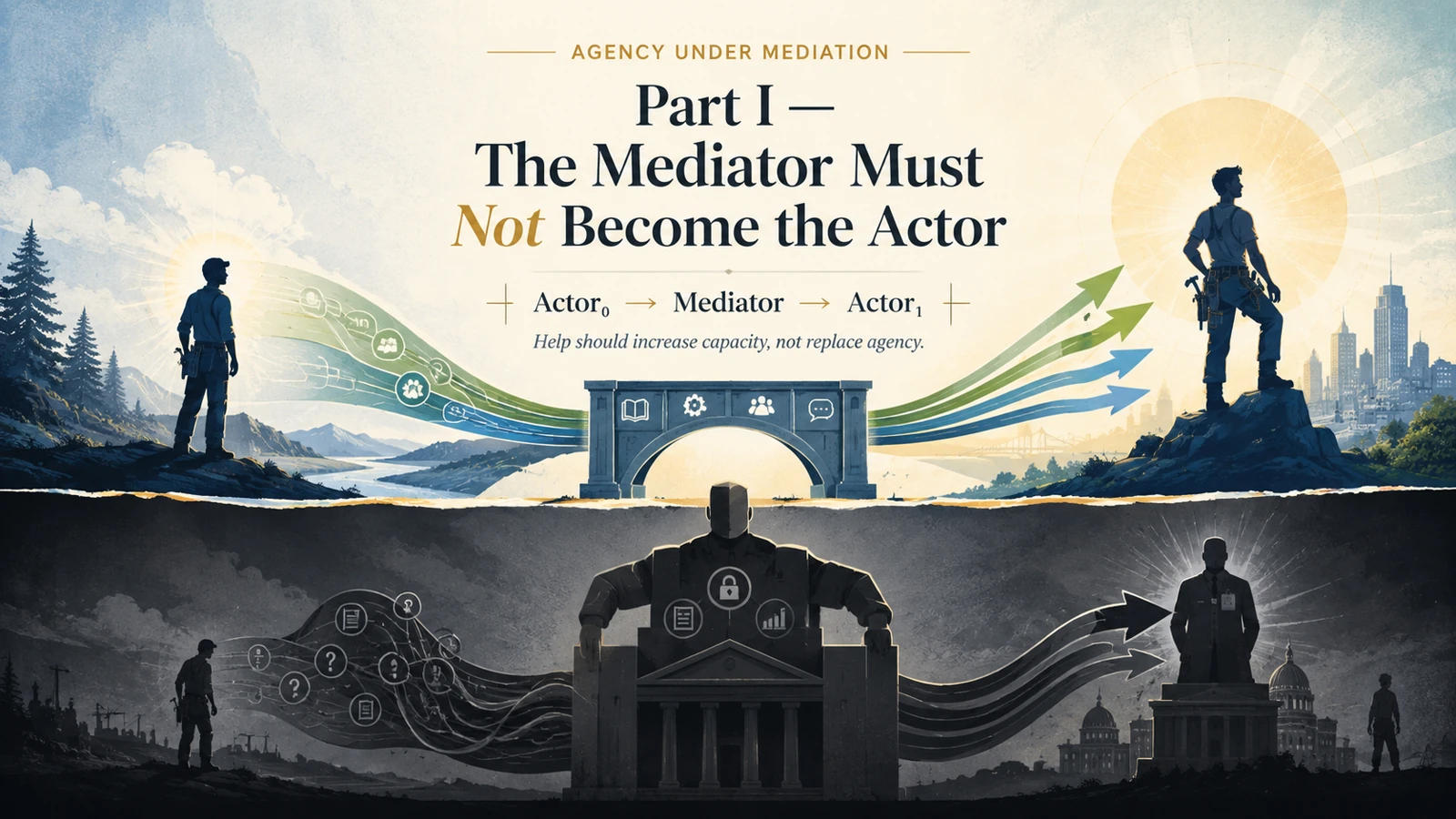
Afterword

After Mediation

Ten domains later, the same transformation keeps appearing.

A worker encounters a safety system.

A movement encounters an organizer.

A citizen encounters a representative.

A dependent person encounters an institution.

A subject encounters authority.

A local reality encounters a centralized model.

A vulnerable person encounters care.

A believer encounters ecclesial authority.

A human encounters an intelligent machine.

Each case initially looks different because the mediator is different.

But underneath them is a common structure:

State₀ → Mediator → Transformation → State₁

The mediator enters because something cannot, should not, or need not be accomplished by the original actor alone.

That is not a defect.

It is one of the basic facts of human life.

We become capable through mediation.

Language mediates thought.

Teachers mediate inherited knowledge.

Institutions mediate collective action.

Law mediates conflict.

Infrastructure mediates physical possibility.

Communities mediate belonging.

Tradition mediates memory.

Technology mediates capability.

Even freedom itself often depends upon structures no individual could construct alone.

The lesson of this series is therefore not that mediation contaminates agency.

The lesson is almost the opposite.

Agency is frequently produced through mediation.

The harder insight is that the same architecture capable of producing agency can also absorb it.

The difference is not always visible in the stated purpose.

Both systems may claim to help.

Both may produce measurable benefits.

Both may be staffed by competent people.

Both may sincerely believe they are serving the person, community, worker, believer, or user.

The difference appears in the transformation.

Who becomes more capable?

Who gains authority?

Who controls the information?

Who defines the goal?

Who can disagree?

Who can contest the mediator's interpretation?

Who can change the terms?

Who bears responsibility?

And which direction does authority move when circumstances change?

That is why intentions were never enough.

The mediator problem is architectural.

A good person can inhabit a bad mediation structure.

A benevolent institution can create dependency.

A competent expert can acquire authority beyond their expertise.

A popular leader can weaken the leadership capacity of everyone around them.

A representative can sincerely love the people represented while gradually becoming their authoritative interpreter.

A caregiver can protect someone so thoroughly that protection begins replacing life.

A church can defend truth while making its own institutional mediation increasingly difficult to distinguish from the Truth it claims to serve.

An AI system does not need ambition, consciousness, or a desire for control for humans to reorganize a workflow until the machine becomes the effective decision-maker.

The transformation can happen without villainy.

That is precisely why it deserves attention.

The series also forced several corrections to the original intuition.

The goal is not maximum independence.

Some dependencies are permanent and good.

The goal is not maximum decentralization.

Central institutions can see patterns invisible locally.

The goal is not the abolition of hierarchy.

Unstructured systems can hide power rather than remove it.

The goal is not unanimous participation in every decision.

Representation and delegation are necessary for scale.

The goal is not the disappearance of expertise.

Experts often know things the rest of us genuinely need.

The goal is not the elimination of authority.

Some situations require binding direction.

The goal is not the refusal of substitution under every condition.

An unconscious patient still needs treatment.

A child still needs protection.

An emergency may require someone to act before ordinary consent can be obtained.

And the goal is not to keep humans manually performing every function machines can perform better.

Delegation is itself an expression of agency.

The stronger principle is more precise.

The subject must remain the subject.

That does not mean the subject performs every action.

It means the purpose of the system remains downstream of the subject rather than quietly replacing them as its source of meaning.

Representation may exercise judgment, but the represented remain the principal.

Care may provide extensive support, but the person's life remains their life.

Authority may bind, but its scope remains attached to a legitimate source and purpose.

A model may simplify reality, but reality remains capable of correcting the model.

A teacher may interpret, but does not become the truth being interpreted.

A machine may execute, but capability does not manufacture its own jurisdiction.

The mediator may remain necessary.

But necessity cannot become ownership.

This gives us a more complete grammar of legitimate mediation.

State₀ establishes the original actor, context, capacity, limitation, and purpose.

The mediator enters with some additional capability.

A transformation becomes possible.

But the transformation is legitimate only insofar as several invariants survive.

The identity of the subject survives.

The purpose remains traceable.

Authority remains scoped.

Information can return from reality.

The mediator remains contestable where contestability is meaningful.

Competence is preserved or increased where competence can reasonably be developed.

Necessary dependency does not become unnecessary discretionary leverage.

And when temporary substitution was justified by a temporary condition, there is a path of restoration when that condition changes.

The outcome should therefore not be evaluated merely by asking:

Did State₁ improve?

We also have to ask:

What changed in the distribution of agency between State₀ and State₁?

That produces a deeper diagnostic.

A system may achieve its stated outcome while failing its subject.

It may be safe but incapacitating.

Efficient but unaccountable.

Caring but controlling.

Representative but unresponsive.

Expert but jurisdictionally unbounded.

Accurate but illegitimate.

Spiritually serious but epistemically closed.

Automated but no longer meaningfully governed.

The visible output can succeed while the underlying transformation fails.

That may be the central lesson of mediation.

The output is not the whole event.

The relationship created by producing the output matters too.

So the question with which the series began becomes sharper at the end.

Not simply:

Did the mediator help?

But:

What kind of actor emerged on the other side?

More capable?

More informed?

More able to participate?

Better protected while still able to exercise judgment?

Dependent, perhaps, but not captive?

Represented, but not replaced?

Governed, but not possessed?

Taught, but not epistemically imprisoned?

Technologically amplified without becoming technologically irrelevant?

That is the positive form of mediation.

Not self-sufficiency.

Not isolation.

Not freedom from every authority or dependency.

Something more relational:

capacity without capture.

authority without ownership.

support without substitution.

representation without replacement.

coordination without erasure.

The same distinction can be stated formally.

Let the actor begin in State₀.

Let M be the mediator.

Let T be the transformation.

Then:

State₀ → M → T → State₁

A mediation is agency-preserving when the transformation increases the actor's real capacity to pursue legitimate ends while the mediator's authority remains proportionate, traceable, bounded, and corrigible.

The strongest warning sign is the reversal:

Actor → Mediator

quietly becomes:

Mediator → Actor

The person who was supposed to remain the principal becomes the object being administered.

The system may still function.

It may function extremely well.

That is what makes the reversal easy to miss.

And so the final diagnostic is deliberately simple enough to carry elsewhere.

Whenever something claims to help, represent, protect, teach, coordinate, care for, govern, or act on behalf of another person, ask:

What did the mediator add?

Then ask:

What did the mediator take over?

Then ask:

Was that transfer actually necessary?

Then ask:

Can it be challenged, bounded, or returned?

And finally:

After mediation, who is still the subject?

If that question remains visible, mediation can become one of the strongest ways human beings extend one another's agency.

If it disappears, the same systems we build to help people act can slowly become systems that act in their place.

The difference is not whether the mediator is present.

The difference is whether the mediator still remembers what it is for.