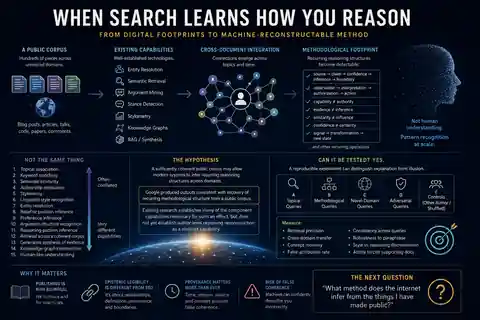
A strange observation
I recently noticed something strange while doing what began as a fairly ordinary exercise: checking my own public search footprint.
I was not asking only what a search system knew about me. I began asking questions about particular areas of my work: AI governance, provenance, authority, deterministic systems, human agency, and the relationship between them.
What caught my attention was that some generated search responses appeared to do more than identify subjects I had written about. They seemed to reconstruct recurring distinctions across separate pieces of work:
capability != authority

evidence != inference

similarity != influence

observation != authorization

source -> claim -> confidence -> inference -> boundary
That raised a question I had not originally intended to investigate:
Can a sufficiently coherent public corpus become machine-readable not only at the level of subject matter, but at the level of recurring reasoning method?
The observation itself does not answer the question. A search summary can look coherent because of repeated vocabulary, semantic similarity, query framing, entity linking, retrieval behavior, personalization, or generative synthesis. It can also hallucinate coherence that the author never intended.
So I went looking for the research lineage underneath the observation rather than treating the output as proof.
The technology already exists—in pieces
Several adjacent capabilities are already established enough that the hypothesis is not technologically absurd. But they are different capabilities, and collapsing them together would overstate what current systems can do.
Entity resolution
Entity-resolution and entity-linking systems try to determine which real-world entity a name or mention refers to. This is foundational for any person-level reconstruction: before a system can synthesize a corpus, it must avoid merging the wrong people. Research on personalized entity resolution and personal knowledge graphs shows that modern systems can connect distributed information to structured person- or user-centered representations.
Stylometry
Stylometry can identify measurable characteristics of how someone writes—sentence length, vocabulary distribution, word frequencies, punctuation, and other linguistic habits. This supports authorship attribution and the idea of a stylistic signature or fingerprint.
But recognizing how someone writes is not the same as recognizing how they reason.
Stance detection
Stance-detection systems can classify whether a text supports, opposes, or otherwise positions itself toward a proposition. That can help reconstruct what an author appears to believe about a defined issue.
But knowing a conclusion is not the same as knowing the procedure by which the conclusion was reached.
Argument mining
Argument mining gets closer to the question. Contemporary systems can identify claims, premises, supporting relations, counterarguments, and other components of argumentative structure. In other words, machines can increasingly recover pieces of the inferential architecture inside a document.
That still leaves a larger question open: can those structures be compared across many documents and recognized as a recurring author-level method?
Semantic retrieval, embeddings, and knowledge graphs
Semantic retrieval can connect documents by meaning rather than exact keyword overlap. Knowledge graphs can represent entities and their relationships. Retrieval-augmented generation can then pull evidence from multiple documents and synthesize a response.
These systems make cross-document connection increasingly practical. But embedding-based retrieval also has theoretical limits, and semantic proximity is not equivalent to logical equivalence. A system can retrieve two passages because they occupy nearby representational space without having recovered the rule that generated both of them.
The important distinction: style, belief, argument, and method
The central research boundary is easy to state and easy to violate:
how you write
      !=
what you believe
      !=
how one argument is structured
      !=
your recurring method of reasoning
A stylometric model might recognize that an author favors certain phrases. A stance model might classify the author's position. An argument-mining system might detect that one paragraph contains a claim supported by two premises.
What I am asking about is one level higher: whether recurring epistemic operations can become detectable across otherwise unrelated subject domains.
For example, imagine an author who repeatedly performs the same sequence across AI governance, history, theology, public policy, and institutional analysis:
identify source
      ->
separate observation from interpretation
      ->
assign confidence
      ->
separate evidence from inference
      ->
identify authority to act
      ->
state the boundary of the conclusion
If those operations recur often enough, the common feature of the corpus may no longer be its subject matter. The common feature may be the transformation itself.
A provisional term: methodological footprint
I am provisionally calling that possibility a methodological footprint.
The terminology needs a strong boundary. “Methodological footprint,” “epistemic fingerprint,” and “reasoning architecture” do not appear to be established technical categories in information retrieval or AI for this specific phenomenon. Existing literature uses better-established terms for adjacent concepts: stylometric signatures, argument structure, inference patterns, stance, entity linking, and argumentation schemas.
So the term should not be presented as though the literature has already named and validated the phenomenon. It is a label for a testable hypothesis.
The more precise claim
The claim I think the present evidence can support is narrower than “Google learned how I think.”
A sufficiently coherent public corpus may contain enough recurring semantic, argumentative, and relational structure that retrieval-and-generation systems can produce something resembling a recoverable author-level methodology.
That could emerge without a machine possessing a model of the author's mind. It could be produced by the interaction of simpler capabilities:
entity resolution
       +
semantic retrieval
       +
argument extraction
       +
cross-document aggregation
       +
generative synthesis
       =
apparent methodological reconstruction?
The question mark matters. The current literature establishes many of the ingredients. It does not establish the final author-level capability as a distinct, demonstrated phenomenon.
Corpus size may be less important than corpus coherence
A large corpus is not automatically a coherent corpus. Ten thousand disconnected posts may be harder to reconstruct than a smaller body of work whose claims, definitions, sources, revisions, and conceptual relationships are explicit.
Repeated terminology can help retrieval, but coherence involves more than repetition. It can include consistent authorship, canonical URLs, cross-links, stable definitions, explicit evidence boundaries, timestamps, citations, version histories, and recurring analytical procedures.
These do not “train” a public search system on the author in the ordinary machine-learning sense. Training, indexing, embedding, retrieval, context injection, summarization, and inference are different operations. But a coherent corpus can provide retrieval systems with many observable examples of the same conceptual relationships.
At sufficient scale, the corpus may begin to function as a distributed external representation of a method.
SEO versus epistemic legibility
This suggests a useful distinction in how we think about publishing.
Traditional SEO asks:
Can the system find this page?
A different question is:
Can the system reconstruct the relationships among my pages correctly?
I use epistemic legibility here as a descriptive phrase rather than a formal IR term. The question is not merely whether a document is discoverable. It is whether claims, evidence, definitions, provenance, uncertainty, and boundaries are made explicit enough that automated systems have a better chance of reconstructing them accurately.
A canonical URL tells a system which page is authoritative. A DOI gives an artifact a durable identifier. A Git commit gives a change a timestamped version-history position. Structured metadata can identify authorship and publication dates. Citations encode relationships. Cross-links make conceptual relationships visible. These mechanisms do not guarantee correct synthesis, but they reduce ambiguity.
Modern publishing increasingly addresses two audiences at once: the human reader and the retrieval layer.
The corpus as a distributed specification of method
This is the more consequential possibility.
Suppose no single document contains a formal statement of an author's complete reasoning procedure. Instead, hundreds of artifacts instantiate portions of it. One article separates source from inference. Another distinguishes capability from authority. A research note explicitly marks confidence. A technical repository encodes a human authorization boundary. A historical investigation distinguishes evidence from later tradition.
No single artifact is the method. The relationships among them are.
If retrieval systems can recover enough of those recurring relationships, the corpus begins to behave like a distributed specification: not a copy of a mind, but an external, observable record of recurring transformations.
That is a much smaller claim than machine understanding, but it is still important. It shifts digital identity from a list of facts about a person toward something closer to a machine-reconstructable pattern of intellectual practice.
The danger: false coherence
The same mechanisms that make reconstruction possible make misreconstruction possible.
False coherence
A system may force unrelated statements into a clean narrative because generative models are good at producing coherent explanations. Repetition is not proof that an author follows a formal rule.
Hallucinated beliefs
A system may transform an observed association into “the author believes X,” even when the author never made that claim.
Identity collisions
Two people with similar names can contaminate the corpus before higher-level synthesis even begins. Entity resolution helps, but it is not infallible.
Temporal collapse
People change their minds. Definitions mature. Hypotheses are rejected. A machine-generated profile that treats every indexed statement as simultaneously current can erase intellectual development.
Causal-influence hallucination
Similarity and chronology can tempt a system—or a reader—to infer influence. But independent convergence is not citation, and temporal priority is not proof of transmission.
Recursive reinforcement
Once machine-generated characterizations become public, they can themselves become searchable artifacts. An early mischaracterization can potentially be repeated, linked, and later retrieved as though it were independent evidence.
Machine legibility therefore does not reduce the importance of provenance. It increases it.
The hypothesis is testable
The question becomes useful only when it can fail.
A reproducible experiment could begin with a single-author corpus spanning several unrelated domains. Human annotators would identify recurring reasoning operations—source identification, evidence/inference separation, boundary checks, authority distinctions, falsification moves, and other recurring structures.
Then the corpus could be tested through several query classes:
- Topical queries: questions about subjects explicitly covered in the corpus.
- Methodological queries: questions about how the author evaluates evidence or reaches conclusions.
- Novel-domain queries: questions outside the corpus where the recovered method would have to transfer rather than merely retrieve a matching topic.
- Adversarial queries: prompts designed to induce false attribution or confuse repeated language with repeated logic.
- Controls: shuffled documents, another author's corpus, stylistic imitation with different reasoning, and reasoning-preserving rewrites in a different style.
The important measurements would include retrieval precision, cross-domain transfer, explicit pattern recovery, false-attribution rate, stability under paraphrase, robustness across systems, citation quality, and—most importantly—whether the system follows the reasoning structure when superficial style and vocabulary are changed.
What would count against the hypothesis?
The simplest competing explanation is that the apparent effect is sophisticated semantic matching of repeated language.
That explanation should be allowed to win.
If the apparent methodological footprint disappears when repeated terminology is removed, if another author using similar language produces the same reconstruction, if shuffling the corpus has no effect, or if the system cannot distinguish stylistic imitation from reasoning-preserving transformation, then the stronger hypothesis is weakened.
On the other hand, if recurring inferential structures remain recoverable across changes in vocabulary, domain, prose style, and retrieval system—and if the system can cite the distributed evidence supporting that reconstruction—then something more interesting may be occurring.
Even then, the result would demonstrate a computational pattern-recovery capability, not human-like understanding.
An open question in an existing lineage
We already know machines can recognize features of how people write. We know they can classify positions. We know they can extract parts of argument structure. We know they can connect semantically related documents and synthesize across them.
What has not been clearly established in the literature I reviewed is whether those capabilities can converge into reliable reconstruction of a person's recurring reasoning operations across a coherent multi-domain corpus.
That makes this less a declaration of discovery than a proposed next question in the lineage:
observation
    ->
literature review
    ->
boundary
    ->
hypothesis
    ->
experiment
    ->
evidence
    ->
refinement or rejection
The useful contribution is not to claim the answer in advance. It is to make the question precise enough that someone else can test it, reject it, narrow it, rename it, or build a better benchmark around it.
The next question
For years, the natural question about a digital footprint has been:
What does the internet know about me?
A different question may now be becoming possible:
What method does the internet infer from the things I have made public?
I do not yet know whether “methodological footprint” will survive as the right term, whether controlled experiments will validate the stronger version of the hypothesis, or whether simpler semantic explanations will account for most of the observed effect.
But the component technologies exist. The observation is concrete enough to investigate. The competing explanations are identifiable. And the question can be falsified.
That makes it worth asking.
Research Basis
Sources and boundaries
This article draws on research in argument mining, computational stylometry, entity resolution, stance detection, personal knowledge graphs, and embedding-based information retrieval. The literature supports the individual component capabilities described above, but not the stronger claim that author-level reasoning reconstruction across domains is already an established system capability.
- Kaiser, D. et al. (2025), Large Language Models in Argument Mining: A Survey. Surveys systems for extracting argumentative structures including claims, premises, and relations. arXiv:2506.16383.
- Skjæveland, M. G. et al. (2024), An Ecosystem for Personal Knowledge Graphs: A Survey and Research Roadmap. Surveys structured representations of information related to individuals. arXiv:2304.09572.
- Lin, Y. et al. (2021), Personalized Entity Resolution with Dynamic Heterogeneous Knowledge Graph Representations. Addresses linking mentions to the correct entities in personalized settings. arXiv:2104.02667.
- Burnham, M. (2024), Stance Detection: A Practical Guide to Classifying Political Beliefs in Text. Useful for distinguishing stance inference from broader reasoning-method reconstruction. arXiv:2305.01723.
- Weller, O. et al. (2026), On the Theoretical Limitations of Embedding-Based Retrieval. Establishes important limits on what single-vector embedding retrieval can represent. arXiv:2508.21038.
- Castro, F. & Epps, N. (2018), Stylometry-based Approach for Detecting Writing Style Changes in Literary Texts. Used here for the established distinction between quantifiable stylistic features and deeper reasoning structure.